

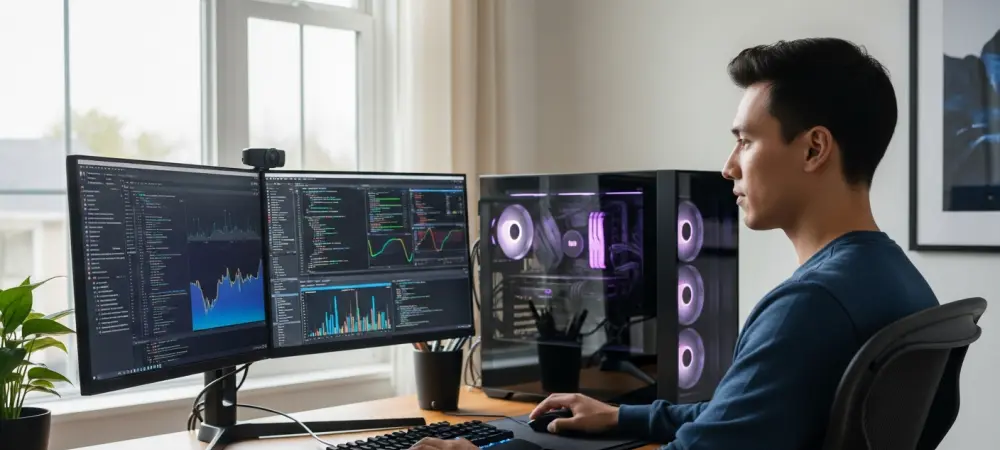
The transformation of high-end graphics hardware from niche enthusiast playthings into the cornerstone of modern localized computing represents one of the most significant shifts in the digital landscape of 2026. Where users once struggled to justify the expense of 24GB VRAM units like the RTX 3090 or its successors, these specifications have now become the baseline for anyone seeking to deploy meaningful artificial intelligence locally. The era of running large-scale models poorly on insufficient hardware has ended, replaced by a sophisticated environment where optimization and strategic resource allocation take center stage. For professionals and serious hobbyists, the focus has moved away from mere novelty toward the extraction of actual utility from consumer-grade flagships. This movement reflects a broader maturation of the industry, where the ability to maintain privacy and speed without relying on cloud-based API providers has become a primary driver for hardware investment across the globe.
Strategic Shifts in Model Optimization
The Equilibrium of Intelligence and Speed
The prevailing strategy for local enthusiasts has undergone a significant paradigm shift from a size-at-all-costs mentality to a focus on efficiency for the win. While users previously tried to force massive 70-billion parameter models onto 24GB cards using heavy quantization, the consensus in 2026 has shifted decisively to the 20-billion to 35-billion parameter class. These mid-sized models provide a superior balance for the average workstation, offering high tokens-per-second throughput and expansive context windows that bulky, slow-moving variants simply cannot match in a single-GPU environment. By choosing these optimized architectures, practitioners ensure that their local agents remain responsive enough for real-time interaction while still possessing the cognitive depth required for complex problem-solving. This shift illustrates a growing understanding that raw parameter count is a secondary metric to the actual user experience and the speed at which a model can complete a requested task.
Technical Precision in Memory Allocation
Achieving high performance in this environment requires a surgical understanding of how VRAM is partitioned among several competing demands. Within the 24GB ceiling, memory is split between the static model weights, the dynamic Key-Value cache, and the necessary runtime overhead. In 2026, the Q4_K_M quantization method emerged as the professional benchmark, striking an ideal compromise between precision loss and memory savings. A 32-billion parameter model compressed via this method typically occupies approximately 20GB of space, leaving a thin but essential margin for the context window. This conversational history, stored in the KV cache, determines the model’s ability to recall long strings of information during a single session. Neglecting to leave a 1–2GB buffer for the serving stack often results in catastrophic system crashes when the model hits its maximum token limit. Consequently, the most stable configurations are those that respect these mathematical boundaries.
Prominent Architectures for Single-GPU Environments
Versatile Powerhouses for General Tasks
Leading the pack of recommended models is the Qwen3.6-27B, a versatile dense model that has become a staple for agentic workflows and repository-level coding projects. This architecture excels at following complex instructions and maintaining logical consistency over long-form document generation. For those prioritizing raw inference speed without sacrificing quality, the Qwen3.6-35B-A3B Mixture-of-Experts variant offers lightning-fast tool use, allowing local systems to interface with external databases and APIs seamlessly. Furthermore, Google’s Gemma 4 26B provides robust multimodal capabilities, enabling users to process visual data and text simultaneously across over 140 languages. These models are specifically engineered to thrive within the 24GB limit, offering a level of sophistication that was previously reserved for massive server clusters. Their adoption marks a new chapter where professional-grade performance is accessible to anyone with a high-end desktop.
Specialized Reasoning and Performance Tools
Specialized needs in the local landscape are met by models like Mistral Small 3.2 24B, which remains a favorite among developers due to its light footprint and professional-grade instruction following. When the task demands rigorous logical deduction or scientific analysis, reasoning specialists turn to OpenAI’s gpt-oss-20b for structured tool use or the DeepSeek-R1-Distill-Qwen-32B for advanced transparency. This latter model utilizes distilled “Chain of Thought” reasoning, providing users with a glimpse into the model’s internal logic before it arrives at a final answer. Each of these options allows for the creation of a tailored local AI setup that fits the specific requirements of the user, from document analysis to complex mathematical proofs. By selecting a model that matches the intended use case, practitioners avoid wasting computational resources on unnecessary parameters, further highlighting the importance of the mid-sized category in the current technological ecosystem.
Infrastructure and the Limits of Local Hardware
The Reality of the Frontier Wall and Memory Limits
Despite these advancements, a single 24GB card still faces an immovable technological barrier often referred to as the Frontier Wall. Modern server-class models, including the latest trillion-parameter releases from major labs, remain far out of reach for consumer-grade hardware. Because Mixture-of-Experts models require the entire parameter set to reside in VRAM regardless of how many experts are active during a specific query, these massive entities are strictly reserved for multi-GPU clusters or enterprise systems with unified memory architectures. Attempting to run these models on a single card leads to extreme latency that renders them useless for practical applications. This reality has reinforced the importance of the 20B–35B “Goldilocks” zone, as it represents the highest tier of intelligence that can be sustained without the massive power draw and expense of a data-center-style installation. Local users must therefore operate within these physical constraints.
Establishing Robust Pipelines for Local Inference
The implementation of these technologies required a disciplined approach to software selection and hardware management throughout the current cycle. Professionals discovered that the 24GB threshold provided a unique opportunity to bypass the latency of the cloud while maintaining high levels of accuracy. By prioritizing mid-sized models, users avoided the pitfalls of excessive quantization that once plagued larger architectures. Organizations that established local pipelines successfully prioritized the integration of modular inference servers like vLLM and llama.cpp to manage their memory buffers with maximum efficiency. Moving forward, the most effective strategy involved a continuous evaluation of quantization levels against the backdrop of evolving hardware capabilities. By maintaining this balance, practitioners ensured that their local infrastructure remained both resilient and cutting-edge. Ultimately, the transition to local autonomy proved that the right balance of software and hardware could overcome the most daunting computational challenges.