

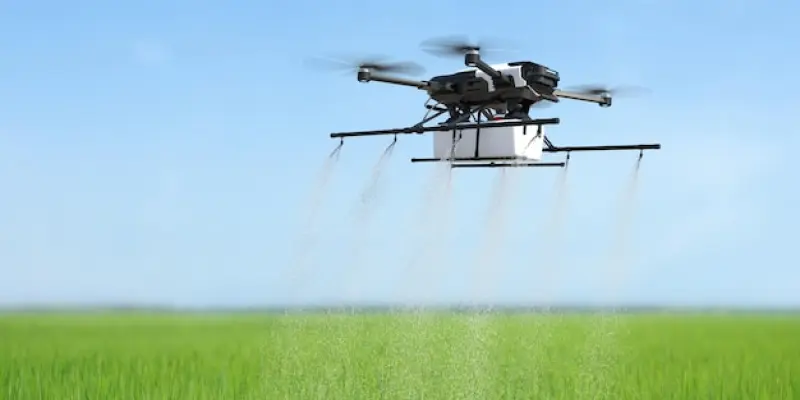
In recent years, the agriculture sector has witnessed transformative technological advancements, chiefly in the domain of microrobotics and autonomous systems. These innovations are reshaping traditional farming practices by enhancing efficiency, precision, and sustainability. Central to this evolution are microrobots like the RoboBee, designed to mimic biological mechanisms, along with novel autonomous machines that can navigate complex agricultural landscapes. Through sophisticated engineering and computer science, researchers aim to tackle long-standing challenges while boosting productivity and operational safety across the farming spectrum. This article delves into these groundbreaking developments, exploring their implications and future prospects for agriculture.
RoboBee: A Marvel of Microrobotics
Biomimicry and Design Innovations
Biomimicry serves as a fundamental design principle in the development of RoboBee, a micro aerial robot that mirrors the physical attributes and functionalities of insects. Inspired by the crane fly, RoboBee features ultra-thin segmented legs and wings crafted to provide precise control over its movements. Among its key components are piezoelectric actuators that simulate the striated muscles found in nature. These actuators play a crucial role in translating mechanical stress into movement, ensuring precision and agility. Researchers invested meticulous effort into refining the robot’s leg design, incorporating insights from natural specimens to achieve optimal stiffness and dampening. The result was a two-joint compliant leg crafted using materials such as Kapton film, carbon fiber, adhesive, and TPE, a rubber-like elastomer that added flexibility and strength.
Technical Advancements in Landing Mechanisms
The landing mechanism of RoboBee was notably improved to address challenges related to safe descents onto natural surfaces like leaves or tree trunks. Previous iterations posed landing difficulties due to ground effect air vortices that interfered with smooth descents. The introduction of an upgraded controller marks a significant leap forward, allowing RoboBee to land gracefully without the necessity of shutting off the robot mid-air. By resolving these landing issues, the team enabled RoboBee to retain functionality upon impact, setting a new benchmark for microrobots. Furthermore, this advancement opens avenues for broader applications, extending its utility beyond artificial pollination to encompass disaster surveillance and environmental monitoring. As researchers work towards integrating onboard electronics for autonomous functioning, the RoboBee embodies a fusion of robotics and biological mechanics with promising future dimensions.
Autonomous Machines: Transforming Agricultural Practices
Navigating Complex Farm Environments
Recent developments in autonomous agricultural machinery reflect a profound understanding of the intricate challenges posed by modern farming environments. Professor Takuya Fujinaga’s pioneering work in automating small robot navigation within these landscapes underscores the complexity faced in high-bed crop rows with spatial limitations and uneven terrain. Conventional sensors have struggled within such challenging settings, prompting the adoption of LiDAR-based navigation solutions that generate 3D environmental maps through laser reflections. This technology adapts dynamically in real-time, accommodating environmental changes such as wind, ensuring precise navigation. Faculty efforts focus on refining algorithms to enhance productivity without necessitating prior path planning. These systems have demonstrated efficacy in virtual simulations, marking a pivotal step in optimizing sensor selection and navigation strategies before implementing them in real-world scenarios.
Innovative Tractor Designs
A standout innovation in autonomous agricultural machinery comes from the University of Córdoba, where researchers have unveiled a tractor design characterized by steerable wheels and self-leveling axles. This novel tractor’s adaptive capabilities allow it to navigate harsh and restricted agricultural terrains, including olive groves and vineyards, without losing stability. It significantly mitigates the risk of tipping over, enhancing precision for sensors like GPS and LiDAR, thereby improving farming operations such as spraying and harvesting. The tractor employs hybrid steering mechanisms and sophisticated self-leveling systems that ensure optimal contact with the soil, augmenting efficiency. While autonomous giants like the John Deere 8R tractor boast capabilities on level terrains using GPS, cameras, and AI, the Córdoba design caters to much more daunting environments, illustrating the importance of adaptation in autonomous agricultural machinery.
Implications and Future Prospects
Fostering Sustainable Farming Solutions
The integration of microrobotics and autonomous technologies within agriculture signifies a broader shift towards sustainable practices. Improved maneuverability and enhanced productivity become evident as these technologies promise precision farming experiences that minimize environmental disturbances. This transition highlights the interdisciplinary collaboration of engineering, computer science, and biology, fostering environmentally responsible agriculture and signaling a departure from traditional farming workflows. By elevating accuracy and efficiency, these technological advancements champion sustainability while addressing distinct agricultural challenges. As the landscape of microrobotics and autonomous machinery continues evolving, the focus remains on promoting biomechanical insights and boosting contemporary farms’ productive capacities.
Expanding Capabilities and Future Goals
In recent years, groundbreaking technological advances in agriculture have notably emerged, specifically in the realm of microrobotics and autonomous systems. This transformation is reshaping traditional farming by amplifying efficiency, precision, and sustainability. At the heart of this change are microrobots, such as the RoboBee, created to imitate biological processes, alongside innovative autonomous machinery capable of maneuvering through intricate agricultural environments. !=Fueled by advancements in engineering and computer science, researchers are addressing long-standing agricultural issues while enhancing productivity and safety. == By delving into these significant developments, we gain insight into their profound implications and the bright future prospects they hold for agriculture. These technologies are not only tackling the challenges of modern agriculture but also promise to revolutionize the industry, fostering a more efficient, sustainable, and safe farming landscape for future generations.