

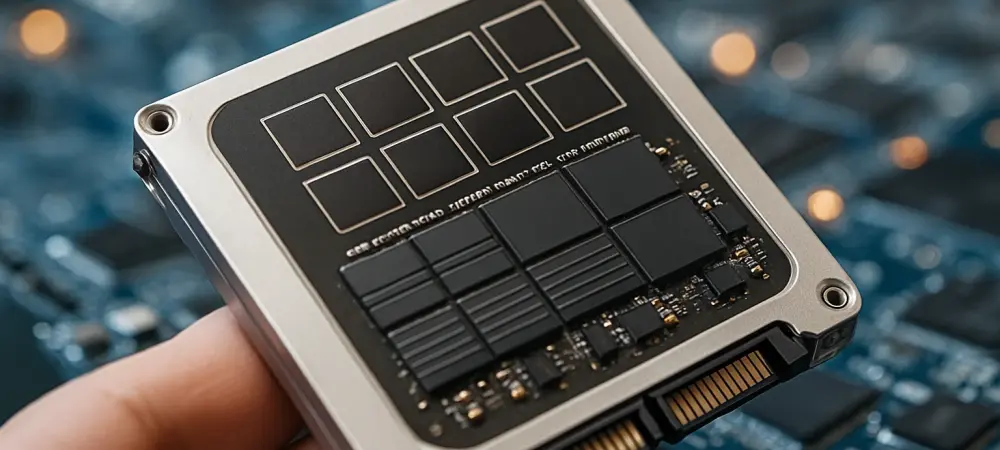
Welcome to an exciting conversation with Dominic Jainy, a seasoned IT professional renowned for his expertise in cutting-edge technologies like artificial intelligence, machine learning, and blockchain. Today, we dive into the world of data storage innovation, focusing on the recently unveiled 6600 ION SSD by Micron. With Dominic’s deep understanding of tech applications across industries, we’ll explore how this high-capacity SSD is poised to transform data centers, its standout features, and the future of storage solutions. Our discussion touches on performance advancements, energy efficiency, and the potential shift away from traditional hard disk drives, offering insights into what this means for hyperscale and enterprise environments.
How does the 6600 ION SSD stand out in the crowded storage market, and what unique features does it bring to the table?
The 6600 ION SSD really pushes boundaries with its massive 122TB capacity, which is a game-changer for high-density storage needs. What sets it apart is its use of PCIe Gen5 technology, delivering blazing-fast data transfer speeds that outpace many competitors still on Gen4 or older standards. It’s built on advanced NAND architecture, allowing for not just capacity but also impressive performance gains. This SSD isn’t just about raw numbers; it’s tailored for data-heavy environments like hyperscale data centers, where efficiency and scalability are critical.
Can you elaborate on how the PCIe Gen5 technology in the 6600 ION enhances its performance compared to previous generations?
Absolutely. PCIe Gen5 doubles the bandwidth of Gen4, offering up to 32 gigatransfers per second per lane. For the 6600 ION, this translates to significantly reduced latency and faster access to massive datasets, which is crucial for applications like AI training or real-time analytics. Compared to Gen3 or Gen4 SSDs, you’re looking at a leap in throughput that can handle more simultaneous workloads without bottlenecks. It’s like upgrading from a two-lane road to a superhighway—data just flows much more efficiently.
Micron is marketing the 6600 ION as a viable replacement for hard disk drives in data centers. What makes this a realistic goal in your view?
The push to replace HDDs comes down to efficiency and performance. The 6600 ION offers substantial advantages in power consumption, using just 1 watt per 4.9TB, which is a fraction of what traditional HDD arrays require. It also provides a 67% density improvement, meaning you can store way more data in less physical space. For data centers, this is huge—less rack space and lower energy bills. Plus, SSDs have no moving parts, so they’re more reliable over time compared to HDDs, which can fail mechanically. I think these factors build a strong case for the transition.
What are some of the challenges that might still stand in the way of fully replacing HDDs with SSDs like the 6600 ION?
Cost remains a big hurdle. While SSD prices are dropping, the cost-per-terabyte for high-capacity drives like the 6600 ION is still higher than HDDs, which can be a sticking point for budget-conscious operations. Endurance under constant heavy workloads is another concern—HDDs have a long track record in that area, and SSDs need to prove they can match up over the long haul. Lastly, compatibility with existing infrastructure can be an issue. Not all data center setups are ready to pivot to SSD-only systems without significant upgrades, so that transition period could be tricky.
Micron has plans to scale the 6600 ION’s capacity to 245TB by early 2026. Can you walk us through what kind of advancements might be needed to hit that target?
Scaling to 245TB will likely involve further refinements in NAND technology, possibly stacking more layers in their 3D NAND architecture to pack in higher density without increasing the physical footprint. Improvements in controller technology will also be key to manage that capacity without sacrificing speed or reliability. We might see innovations in error correction and wear-leveling algorithms to ensure longevity at such massive scales. It’s a complex puzzle, but Micron’s track record suggests they’re investing heavily in R&D to make this leap feasible by 2026.
With a reported capability of delivering up to 88PB per rack, how does this position the 6600 ION against other solutions currently available?
The 88PB per rack is a standout metric—many competitors are still hovering below 40PB per rack, so Micron is really setting a new benchmark for storage density. This kind of capacity means data centers can consolidate their infrastructure, reducing the number of racks needed for the same amount of data. For hyperscale environments, this translates to lower operational costs and less physical space, which is a massive win. It positions the 6600 ION as a leader in the race for efficiency, especially for businesses scaling up to handle exabytes of data.
The 6600 ION supports up to 36 SSDs in a 2U server, achieving 4.42PB per server. How does this kind of compact design impact efficiency for large-scale workloads like AI?
This compact setup is a big deal for AI workloads, which often require rapid access to enormous datasets. With 4.42PB in just a 2U server, you’re maximizing storage density while minimizing latency because everything is tightly integrated. It reduces the need for sprawling server farms, cutting down on power and cooling costs. For AI training models that need to crunch petabytes of data in real time, this design ensures faster data retrieval and processing, ultimately speeding up innovation cycles in those fields.
Micron highlights a 67% density improvement over previous alternatives. Can you explain what this means for data center operators in practical terms?
A 67% density improvement means data center operators can store nearly twice as much data in the same physical space compared to older solutions. Practically, this slashes the footprint of their storage infrastructure—fewer racks, less floor space, and lower real estate costs. It also ties into energy savings since you’re powering fewer units for the same capacity. For operators managing exabyte-scale data, this efficiency can lead to significant cost reductions while still meeting the growing demand for storage, especially in cloud and enterprise settings.
What is your forecast for the future of high-capacity SSDs like the 6600 ION in reshaping data center landscapes over the next decade?
I’m optimistic that high-capacity SSDs will become the backbone of data centers within the next decade. As capacities continue to grow—potentially hitting petabyte-scale per drive—and costs per terabyte drop, we’ll see a near-complete shift away from HDDs in most hyperscale and enterprise environments. The focus on energy efficiency will drive adoption, especially as sustainability becomes a bigger priority. I also expect tighter integration with AI and machine learning workloads, where speed and density are non-negotiable. The 6600 ION is just the beginning; we’re likely to see even more disruptive innovations as NAND technology evolves and new standards like PCIe Gen6 become mainstream.