

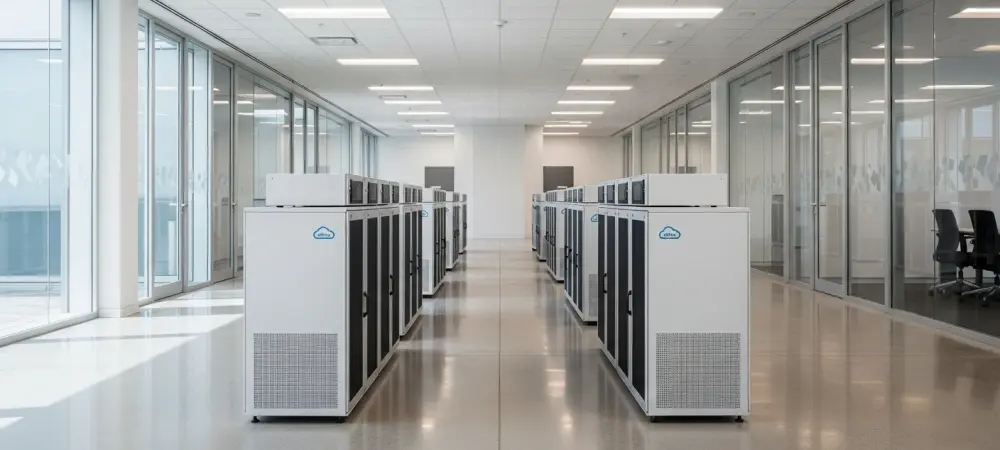
The once-unquestioned dominance of massive, centralized data centers is rapidly giving way to a more agile and distributed reality where processing power resides exactly where the action happens. While the technological landscape spent the last decade rushing toward massive, centralized cloud regions, a quiet but powerful reversal is taking place right under the feet of modern enterprises. Decision-makers are discovering that the speed of light is a non-negotiable bottleneck, and waiting for a data center three states away to process a local transaction is no longer a viable strategy for high-stakes operations. As localized demand for real-time processing explodes, the traditional data center is essentially being shrink-wrapped and delivered directly to the loading dock of factories, warehouses, and retail hubs. This shift marks the rise of the micro-cloud, a decentralized powerhouse that brings high-performance computing to the very edge of the network.
The Silent Migration from Centralized Hubs to the Local Edge
The transition from a centralized core to a localized periphery represents a fundamental reimagining of the corporate digital footprint. For years, the prevailing wisdom suggested that consolidation was the only path to efficiency, leading to the construction of sprawling server farms in remote climates. However, the rise of latency-sensitive applications has exposed the flaws in this “hub-and-spoke” model. When a robotic arm on a factory floor requires sub-millisecond feedback or a retail sensor must process a thousand concurrent customer movements, the trip to a central cloud and back is simply too long. Consequently, the industry is witnessing a “re-localization” of IT resources, where micro-clouds serve as the primary engine for immediate decision-making.
This migration is often invisible to the end-user but remains transformative for the back-end infrastructure. By deploying localized micro-clouds, companies can process data at the source, significantly reducing the burden on long-haul network transit. This not only lowers bandwidth costs but also provides a level of operational resilience that centralized systems cannot match. Even if the primary connection to the global internet is severed, the micro-cloud continues to operate, ensuring that the lights stay on and the data keeps flowing. This shift is turning the “edge” from a simple collection of endpoints into a sophisticated, autonomous extension of the enterprise.
Why the Decentralization of IT Infrastructure Is Accelerating
The move toward micro-cloud data centers is driven by the urgent need to bridge the widening gap between data generation and data processing. In industries ranging from high-tech manufacturing to global retail, the volume of data produced at the work front has finally surpassed the capacity of traditional backhaul networks to handle it efficiently. Relying on a remote central hub introduces latency that can cripple autonomous systems or disrupt sensitive customer experiences in an instant. Consequently, organizations are adopting Edge IT to ensure localized data sovereignty and operational reliability that remains immune to regional fiber cuts.
This evolution is not merely about moving hardware; it is a direct response to the reality that in a world of instant demands, the wait time of the cloud has become an unacceptable business liability. From 2026 to 2030, the emphasis will remain on reducing the distance between the user and the compute resource to near-zero. By processing information locally, companies eliminate the jitter and lag that traditionally plagued distributed systems, allowing for a level of responsiveness that was previously impossible. This decentralization effectively turns every branch office or remote site into a self-sufficient digital island that contributes to the broader corporate goals without being tethered by a digital umbilical cord.
The Architectural Pillars of the Micro-Cloud Revolution
Containerization acts as the fundamental building block of the micro-cloud, allowing a specialized, miniature version of a central data center to exist within a single, cloud-hosted rack. These self-contained ecosystems package applications with all necessary dependencies, ensuring that edge sites remain fully functional even when disconnected from the broader corporate network. By utilizing these portable units, IT departments can deploy complex software stacks to remote locations with the same ease they once enjoyed in a centralized cloud environment. This modularity ensures that the edge is not a stripped-down version of IT, but a highly focused one. Industry leaders have identified four critical areas that define the success of a micro-cloud deployment: precise resource sizing to avoid waste, identity-centric security that moves with the user, absolute revision consistency to prevent system drift, and evolved support models that balance internal control with provider expertise. Unlike traditional branch offices that rely on constant communication with headquarters, micro-clouds are designed for independence. By hosting localized storage and processing power, these units can manage real-time compute tasks locally, shielding the enterprise from the risks of network outages or bandwidth congestion. A significant trend in decentralized IT is the push for perfect synchronicity across every node. Maintaining the exact same operating system kernels and application versions across hundreds of geographic locations is essential for mass updates and efficient troubleshooting. This turns a potentially chaotic network of disparate sites into a disciplined extension of the digital core. When every micro-cloud site mirrors the central standard, the management burden shifts from manual intervention to automated orchestration, which is the only way to scale effectively.
Navigating the Operational Realities of Distributed Computing
Industry consensus suggests that while the benefits of micro-clouds are transformative, they introduce management hurdles that do not exist in a central hub. Experts highlight the resource sizing paradox, where IT teams often struggle to balance physical site constraints with the need for performance overhead. “The edge is not a smaller version of the cloud; it is a more disciplined version,” notes the prevailing sentiment among IT architects who deal with these systems daily. The physical footprint of an edge site is often limited, meaning every CPU cycle and gigabyte of storage must be justified.
Furthermore, security professionals are sounding the alarm on the fluid perimeter, noting that when users move between various containerized environments, traditional firewall-based security fails. The emerging expert view is that security must now be applied at the container entry point, creating a granular, multi-layered defense strategy that accounts for the mobile nature of the modern workforce. This approach ensures that a breach at one remote location does not provide a gateway to the entire corporate network, effectively air-gapping the security logic while maintaining connectivity for data.
Best Practices for Orchestrating a High-Performance Edge
Moving away from the fluid allocation models used in the public cloud is the first step toward stability. Before deployment, organizations should calculate exact processing and networking requirements through rigorous stress testing to ensure containers are lean, efficient, and free of unnecessary development files. This precision provisioning prevents the resource bloat that often plagues virtualized environments. It also ensures that the hardware on-site is perfectly matched to the workload, reducing both heat generation and energy consumption at the edge. IT departments must also remain the primary pilots of the micro-cloud, even when using managed services. Establishing strict protocols for data flows and application updates ensures that while third-party providers may own the hardware, the enterprise retains absolute control over the health of the containerized ecosystem. This involves shifting focus from protecting the edge of the network to protecting the entrance of each container. Implementing granular access management that checks authorizations at every entry point ensures security remains consistent regardless of the user’s physical location.
The management of hundreds of micro-sites was eventually treated as a formalized strategy rather than a series of ad-hoc fixes. Mirroring these requirements in Service Level Agreements with providers ensured accountability for infrastructure uptime and version synchronization. The ultimate goal was to ensure that the distributed nature of the infrastructure did not lead to a distributed mess of configurations. By standardizing the stack and the support model, enterprises transformed the edge into a reliable, high-speed extension of their core business capabilities. This proactive stance allowed organizations to move beyond simple connectivity and toward true computational autonomy.