

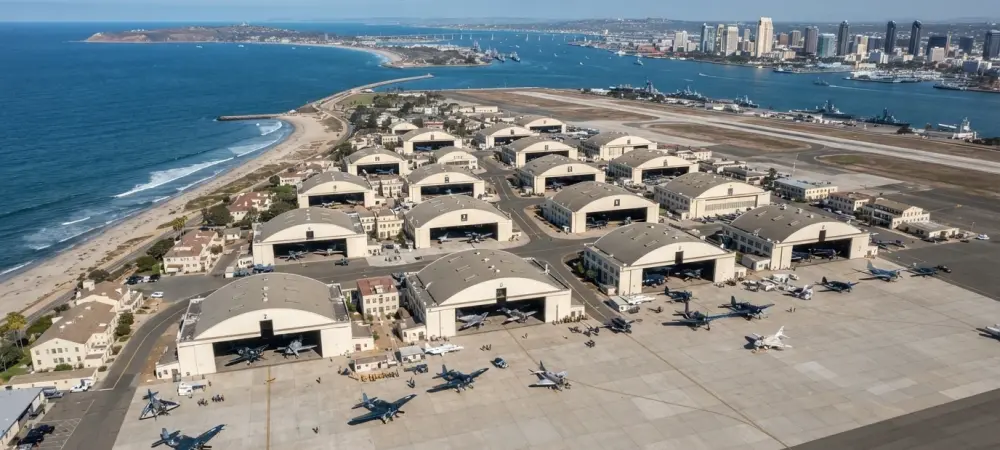
The salty air of the Pacific coast currently drifts over a 70-acre expanse where historic World War II-era hangars stand as relics of a bygone industrial era. This site, long used by the Navy, now serves as the stage for a transformative proposal that would replace these weathered structures with a 400-megawatt data center. Manchester Financial Group is leading this charge, signaling a departure from its heritage of luxury hotels to embrace the rigorous infrastructure demands of the artificial intelligence era.
A 400-Megawatt Pivot in San Diego’s Urban Skyline
Manchester Financial Group is betting on a high-stakes transition that trades guest suites for server racks. By proposing an industrial engine at the Navy Old Town Campus, the developer aims to establish one of the most significant digital facilities in Southern California. This pivot marks a bold expansion for a firm historically focused on hospitality, reflecting a strategic move toward the lucrative data center market.
The project represents a dramatic alteration of the San Diego skyline, replacing traditional commercial aspirations with a facility designed for maximum power density. Such a development would position the region as a critical node in the global data network. However, the scale of this 400-megawatt plan necessitates a complete reimagining of local land-use, prioritizing digital throughput over standard urban aesthetics.
From Obsolete Hangars to National Security Hubs: The NAVWAR Necessity
The impetus for this redevelopment is the modernization of the Naval Information Warfare Systems Command (NAVWAR). Currently, NAVWAR operates from aging facilities that no longer meet the technical requirements of modern cybersecurity and space system operations. To address this, the Navy has engaged in a 99-year lease agreement with Manchester Financial and Edgemoor Infrastructure to secure a contemporary headquarters.
This partnership allows the federal government to utilize private investment to upgrade critical military infrastructure. In exchange for providing the Navy with a state-of-the-art command center, the developers receive long-term commercial rights to the surrounding land. This arrangement reflects a broader trend of leveraging Department of Defense assets to build private-sector digital infrastructure while maintaining military readiness.
Analyzing the Shift from Mixed-Use Community to Industrial Infrastructure
The recent proposal represents a radical shift from the “mini-town” concept originally presented to the public. Those initial plans promised a vibrant district filled with housing, retail, and hotels designed to revitalize the Midway area. In contrast, the current focus on a data center prioritizes industrial utility, which would occupy a large footprint previously slated for residential density.
This transition underscores the tension between the immediate demand for cloud services and the desire for human-centric urban design. While a data center provides the computing power essential for modern life, it lacks the walkability and social vibrancy of a mixed-use neighborhood. Consequently, the project highlights the difficult choices cities face when balancing economic infrastructure against the goal of creating livable community spaces.
Political Friction and the Fight for Local Transit-Oriented Development
Local officials have expressed sharp concerns regarding the project’s evolution, particularly its impact on regional housing goals. Representative Scott Peters and Councilmember Marni von Wilpert have criticized the shift toward industrial use, arguing that the site’s proximity to transit makes it ideal for residential growth. They maintain that a closed-off data center fails to serve the community’s need for accessible housing.
The pushback also centers on a perceived lack of transparency during the negotiation process. Critics argue that the move away from transit-oriented development contradicts the spirit of the project’s early stages. For many local stakeholders, the priority remains the construction of a neighborhood that supports residents rather than a facility that primarily houses server cooling systems.
Navigating the Intersection of Federal Requirements and Municipal Growth
The challenge of reconciling military needs with urban development required a delicate negotiation between federal agencies and local stakeholders. Planners sought a framework that could deliver a secure Navy headquarters while still addressing the city’s housing shortage. Moving forward, this project served as a primary example of the complexities inherent in public-private partnerships involving high-value federal land and essential municipal goals. Ultimately, the proposal necessitated a balanced approach to infrastructure that accounted for both national security and local quality of life. Lessons learned from the San Diego site helped shape future strategies for integrating large-scale data centers into dense urban environments. By addressing the “missing middle” housing crisis alongside military modernization, the final strategy aimed to ensure long-term regional stability.