

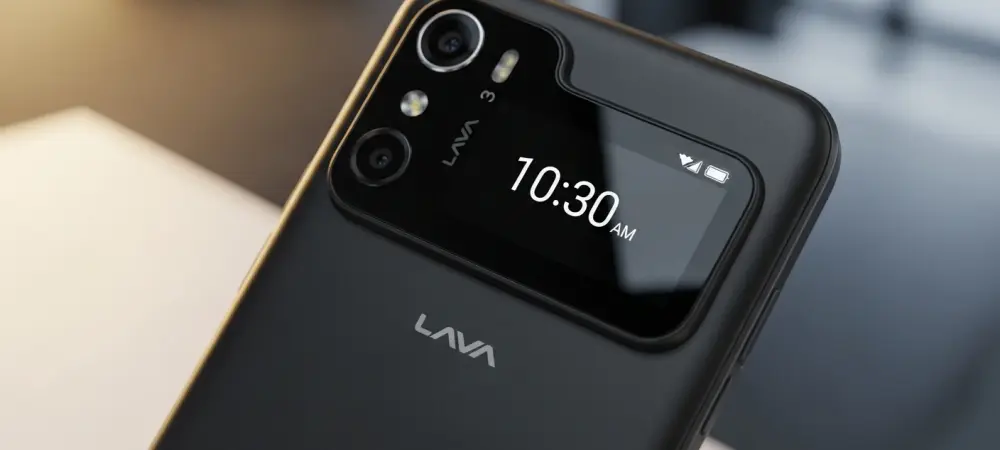
Today we’re speaking with Dominic Jainy, an IT professional with deep expertise in the convergence of artificial intelligence and mobile technology. We’ll be diving into the upcoming Lava Blaze Duo 3, a device that’s generating significant buzz with its unique features. Our conversation will explore the practical design philosophy behind its secondary rear display, the performance enhancements brought by its next-generation software and hardware, and the sophisticated AI processing that powers its main camera. We will also touch on the delicate balance of integrating premium features like a powerful battery and an AMOLED screen while targeting the competitive mid-range market in India.
The Lava Blaze Duo 3 introduces a 1.6-inch secondary rear display. Beyond notifications, what specific use cases did your team prioritize for this feature, and what was the biggest challenge in integrating it without compromising the phone’s slim 7.55mm profile?
That’s an excellent starting point. Our primary goal was to make that small screen immensely practical, transforming it from a novelty into a tool for daily convenience. We focused heavily on two key scenarios: seamless music control without waking the main display, and perhaps more importantly, enabling high-quality selfies with the main rear camera. The idea that you can frame a perfect shot using the powerful 50-megapixel sensor is a game-changer. The engineering challenge was immense; fitting an entire secondary screen assembly into a device that’s only 7.55mm thick required meticulous internal component arrangement. We had to ensure it was structurally sound and didn’t create any heat dissipation issues, all while maintaining that sleek, premium feel in the hand.
Shipping with Android 15 is a significant move. How has the MediaTek Dimensity 7060 chipset been optimized for this new OS, and what tangible performance benefits can users expect from the combination of LPDDR5 RAM and UFS 3.1 storage in daily use?
Launching with Android 15 out of the box is a statement of our commitment to providing the latest and most secure experience. The MediaTek Dimensity 7060 is a fantastic chipset that we’ve worked to tune specifically for the new OS, ensuring that all the new animations, privacy features, and background processes run with absolute fluidity. For the user, this translates into a visibly smoother experience. But the real magic happens when you pair this with 6GB of LPDDR5 RAM and UFS 3.1 storage. It’s not just about benchmark numbers; it’s about how the phone feels. Apps launch almost instantly, saving large files feels effortless, and multitasking between heavy applications is completely seamless. It’s a combination that elevates the device from just “fast” to truly responsive and delightful to use day-to-day.
The primary camera is an AI-backed 50-megapixel Sony sensor. Could you detail how the AI processing enhances image quality, and what steps a user would take to capture a high-quality selfie using this main camera with the help of the rear display?
The “AI-backed” label is more than just marketing; it’s about intelligent processing that happens in the blink of an eye. The AI algorithms analyze the scene in real-time, optimizing for things like dynamic range in tricky lighting, sharpening details without introducing noise, and ensuring color accuracy for vibrant, true-to-life photos. For taking that perfect selfie, the process is incredibly intuitive. You simply flip the phone over, and the 1.6-inch secondary display activates as a live viewfinder. You can see yourself clearly, frame the shot perfectly, and capture an image with the full power of the 50-megapixel Sony sensor. This means your selfies have the same incredible detail, color, and low-light performance as your main photos, something an 8-megapixel front camera simply can’t match.
With a 5,000mAh battery and 33W fast charging, power management is key. What optimizations ensure all-day battery life, especially with two active displays, and what metrics can users expect for charging times from zero to a full hundred percent?
Managing a 5,000mAh battery, especially with a bright AMOLED panel and a second screen, was a top priority. Our software optimizations are aggressive in managing background processes and adapting power consumption based on usage patterns. The secondary display is also extremely low-power, designed to sip energy for quick glances at notifications, not drain it. This intelligent management ensures that even heavy users can comfortably get through a full day without reaching for a charger. When you do need to power up, the 33W fast charging is incredibly efficient. While exact times can vary, users can expect to see a significant charge in a very short amount of time, getting them back up and running without being tethered to a wall outlet for hours. It’s about providing both endurance and a quick recovery.
Balancing features like an AMOLED screen, an IP64 rating, and stereo speakers is crucial for the mid-range market. What trade-offs were considered during development to include these premium features, and how do they cater specifically to the demands of consumers in India?
Crafting a device for the Indian market requires a deep understanding of what consumers truly value. We knew that a vibrant, 1,000-nit peak brightness AMOLED display for media consumption and powerful stereo speakers were non-negotiable. Similarly, an IP64 rating provides essential peace of mind against dust and splashes, which is a practical reality in many environments. The trade-offs are always about meticulous resource allocation. Instead of chasing a spec that looks good on paper but has little real-world impact, we prioritized these tangible user experiences. We chose a robust and efficient MediaTek chipset and paired it with high-speed memory and storage, ensuring the core experience feels premium. It’s about delivering a balanced, durable, and feature-rich device that feels like it punches well above its price point, directly addressing the core demands for quality and value.
What is your forecast for the adoption of secondary displays on mid-range smartphones?
I believe we’re at the very beginning of a fascinating trend. For years, secondary displays were a novelty reserved for expensive foldables or niche gaming phones. What we’re doing now is democratizing that technology, proving it can be implemented in an affordable, practical, and elegant way. As consumers experience the genuine convenience of checking notifications discreetly or taking superior selfies, the demand will grow. I forecast that within the next two to three years, we will see this feature become a key differentiator in the crowded mid-range segment, pushing other brands to innovate beyond just camera bumps and processor speeds. It’s not about being a gimmick; it’s about fundamentally improving the way we interact with our most personal device.