

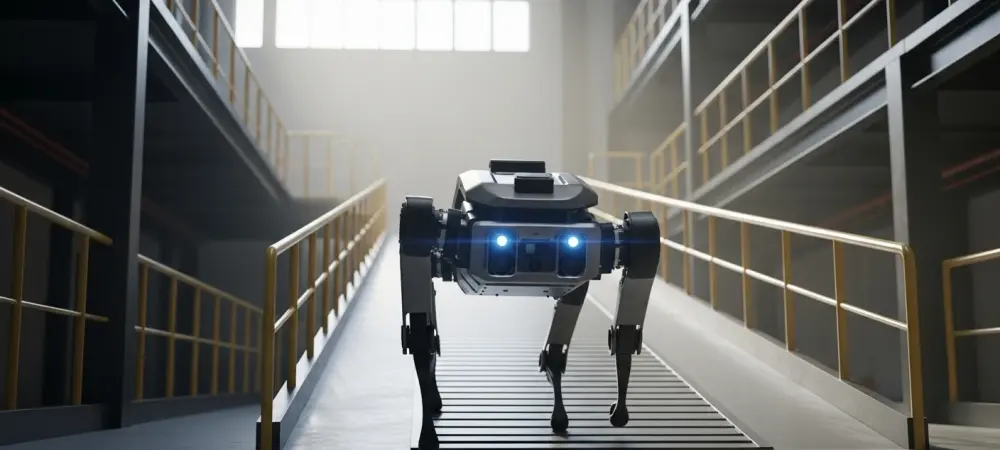
Dominic Jainy is a distinguished IT professional whose expertise lies at the intersection of artificial intelligence, machine learning, and blockchain technology. With a deep focus on how these advanced systems can be integrated into physical hardware, he has become a leading voice in the evolution of autonomous robotics. His insights into the DreamWaQ++ system highlight a transformative shift in robotics, where machines no longer just react to their surroundings but actively perceive and interpret them to navigate complex, real-world environments with unprecedented agility.
The discussion explores the transition from blind locomotion to anticipatory movement, detailing how the fusion of internal and visual sensors creates a robust fail-safe for robots. It also covers the computational efficiency required for rapid stair climbing, the logic behind postural adjustments on steep slopes, and the remarkable ability of reinforcement learning models to generalize skills far beyond their initial training parameters.
Internal sensing provides stability in low-visibility, but adding LiDAR and cameras allows a robot to anticipate terrain. How does fusing these data streams change the decision-making process, and what specific fail-safes ensure the system remains stable if visual sensors fail in dusty or dark environments?
The fusion of LiDAR, cameras, and internal joint sensors completely transforms the robot from a reactive machine into a proactive navigator. In older systems, the robot had to physically strike an object before adjusting its gait, but now it interprets the geometry of the path ahead to adjust its stride before contact is even made. This multimodal reinforcement learning approach is designed with a critical fallback mechanism where the internal sensing acts as a foundational safety net. If the cameras are blinded by dust or the LiDAR fails in total darkness, the system seamlessly reverts to its “blind” walking capabilities, relying on high-frequency joint position and motion data to feel its way through the environment. By processing these inputs simultaneously, the robot maintains a high level of stability, ensuring that a loss of sight does not lead to a catastrophic fall.
Moving from reactive stepping to anticipatory movement mimics animal behavior. When a robot encounters a steep 35-degree slope or a sudden drop, what logic determines its postural shift, and how does it decide when to pause and assess the area versus pushing forward?
When the robot faces a steep 35-degree incline, which is significantly more aggressive than the 10-degree terrain it typically encounters in training, the control logic triggers a shift in the center of mass to optimize traction. It dynamically adjusts its posture to offload pressure from the rear legs, preventing the motors from stalling while maintaining grip on the vertical ascent. In scenarios involving sudden drops or highly uncertain footing, the system exhibits what we call exploratory behavior, much like a living creature would. Instead of blindly marching forward, the logic mandates a temporary pause to assess the depth and stability of the area, allowing the neural network to calculate the safest foothold before committing to the next movement.
Navigating a 50-step course in 35 seconds requires both speed and precision. Can you walk through the real-time computational steps required to maintain this pace, and how does the system reduce the physical load on the rear legs when transitioning from horizontal to vertical movement?
To maintain such an impressive pace of 50 steps in just 35 seconds, the system utilizes a lightweight computational architecture that avoids the heavy overhead of traditional path-planning algorithms. The real-time processing involves a continuous loop where visual data is converted into a height map and immediately fused with the robot’s proprioceptive state to command joint torques. As the robot transitions from a flat surface to a vertical climb, the DreamWaQ++ controller adjusts the leg extension angles and timing to ensure the rear legs aren’t overextended or overstressed. By shifting the load distribution across all four limbs, the system preserves the mechanical integrity of the actuators, allowing the robot to sustain high speeds even during grueling vertical climbs.
Systems trained on small obstacles can sometimes clear much larger hurdles, such as 42cm steps or high barriers while carrying a payload. What enables this level of generalization beyond specific training parameters, and how do you prevent the reinforcement learning model from becoming over-reliant on simulation?
The ability to clear 42cm steps after being trained on 27cm obstacles demonstrates the incredible generalization power of the reinforcement learning model. This happens because the system learns the underlying physics of balance and propulsion rather than just memorizing specific heights, allowing it to maintain an 80% success rate even with a heavy payload. To prevent the “reality gap” where a robot performs well in simulation but fails in the real world, we use diverse environmental randomization during the training phase. In simulation, we’ve seen these controllers handle obstacles as high as 1 meter or even 1.5 meters on different quadruped frames, which proves the control method is hardware-agnostic and robust enough to handle the chaotic variables of the physical world.
In unpredictable settings like disaster zones or dense forests, paths are rarely clear. How does the robot prioritize its own path-planning over following a fixed trajectory, and what are the practical trade-offs when using a lightweight system that must process multiple inputs simultaneously?
In a disaster zone, a fixed trajectory is a liability, so our system prioritizes local environmental awareness to “pick” its own path through debris and clutter. The robot doesn’t follow a pre-rendered map; instead, it uses its perception-based controller to identify the path of least resistance in real time, treating obstacles as dynamic challenges to be stepped over or navigated around. The primary trade-off in using such a lightweight system is the balance between sensor resolution and processing speed. While we sacrifice some of the granular detail found in heavy, high-latency mapping systems, we gain the ability to react instantly to shifting terrain, which is far more valuable for a robot that needs to stay upright in a collapsing building or a dense, uneven forest.
What is your forecast for quadrupedal robot control technology?
I believe we are rapidly approaching a “zero-shot” era where quadrupedal robots will be deployed into completely unknown environments, such as deep caves or off-world colonies, without any prior site-specific training. In the next few years, the integration of vision and touch will become so seamless that these robots will possess a level of physical intuition that rivals biological organisms. We will see these systems move beyond the lab and into permanent roles in industrial inspection and search-and-rescue, where their ability to interpret and adapt to the world in real time will save lives and revolutionize how we interact with the most hazardous places on Earth.