

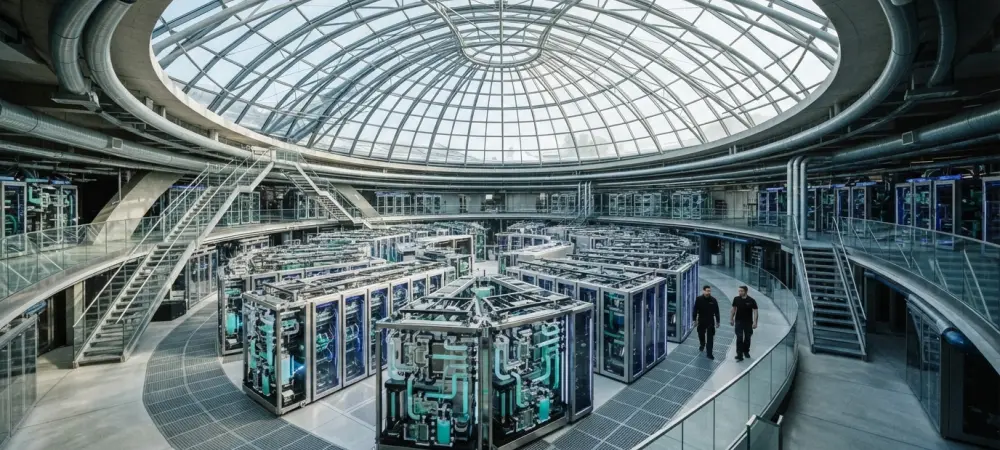
Redefining the Industrial Skyline in the Texas High Desert
Standing atop the rugged terrain of Hudspeth County, the shimmering silhouette of a geodesic dome signals a radical departure from the windowless concrete monoliths that have long defined the architecture of the global digital infrastructure industry. In the arid expanse of West Texas, the $10 billion Desert Haven project transformed the historic Hueco Ranch into a testing ground for 350 megawatts of high-density computing capacity. These massive structures do not merely house servers; they represent an attempt to integrate digital needs into a self-sustaining ecosystem that respects the limitations of the surrounding environment. By trading the traditional aesthetic of a big-box warehouse for high-tech domes, developers addressed the visual and functional inefficiencies of legacy sites. The facility signaled a move away from the energy-hungry reputation of the sector, focusing instead on how geometry could dictate performance. This site demonstrated that the next generation of the internet might not live in a building, but rather inside a structure specifically designed to harmonize with the harsh Texas climate.
The Convergence of AI Demand and Resource Scarcity
The global appetite for artificial intelligence generated an unprecedented hunger for processing power, which frequently outpaced the capacity of aging municipal electrical grids. As data centers faced intense scrutiny over their water footprints and their tendency to become visual blights in rural communities, the industry reached a critical breaking point. To sustain modern computing needs, infrastructure developers realized that independence from public utilities was no longer a luxury but a fundamental requirement for operational stability.
This shift toward off-grid solutions became a necessity in regions where resources are increasingly fragile. By decoupling from the local grid, these facilities mitigated the risk of regional outages while simultaneously reducing the strain on community power supplies. The transition underscored a broader trend where infrastructure must adapt to environmental constraints to avoid becoming a burden on the very populations it serves.
Engineering a Self-Sustaining Digital Fortress
The Hudspeth County development pioneered a multi-layered approach to independence, utilizing a combination of local gas solutions and geothermal energy to operate behind-the-meter. This configuration allowed the facility to maintain a constant baseload of power without relying on external providers, creating a digital fortress insulated from the volatile energy market. By generating electricity on-site, the project achieved a level of resilience that traditional centers cannot match.
The architecture itself functioned as the primary cooling mechanism through the ServerDome design, which utilized a 600ft x 300ft shell to leverage natural convection. Air intakes at the base and exhaust vents at the apex eliminated the need for mechanical chillers, which typically consume massive amounts of electricity. Even with this passive foundation, the interior supported liquid cooling for high-performance AI workloads reaching 250kW per rack, while a closed-loop hydronic system recycled water to prevent the depletion of local aquifers.
Insights from the Vanguard of Biophilic Infrastructure
Architects involved in the project emphasized that the building’s geometry served as its greatest asset, drawing from technology that proved effective in earlier deployments at Oregon Health & Science University. This approach showed that mimicking natural airflows could drastically reduce operational costs and maintenance compared to standard big-box designs. By prioritizing the physics of airflow, the project moved beyond traditional engineering toward a more biological understanding of temperature control.
Despite technical successes, leadership recognized the human element by engaging in transparent dialogue with Hudspeth County officials to manage the scale of the development. CEO David J. Keegan acknowledged that managing community impact was vital for the long-term viability of even the most environmentally conscious projects. Through the use of green roofs and low-profile silhouettes, the campus adopted a biophilic design philosophy, helping these 700-acre sites blend into the natural landscape.
Strategies for Deploying Next-Generation Data Infrastructure
Strategic site selection moved beyond Texas as the industry prioritized land availability and specialized thermal management in places like Utah and Saudi Arabia. The deployment of standardized dome shells allowed teams to complete construction within a 12-month window, significantly outpacing the timelines associated with traditional masonry. This speed established prefabrication as the preferred method for companies racing to meet the explosive demand for AI processing power. The diversification of energy portfolios integrated geothermal power to ensure consistent 24/7 uptime, moving away from the intermittency of solar and wind. Joint ventures between private equity and specialized AI investment vehicles provided the necessary capital to scale this proprietary technology globally. These actions solidified the geodesic dome as a viable solution for digital infrastructure, proving that resource efficiency and rapid growth successfully coexisted in a changing climate.