

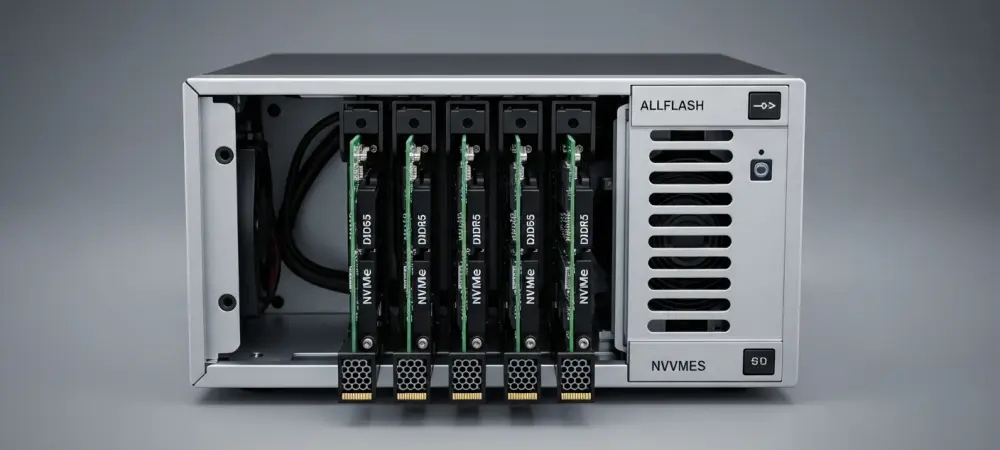
The persistent hum of mechanical hard drives and the bulky footprint of traditional server towers have long been the compromise users accepted for high-capacity local data management. As digital environments transition toward sleek, unobtrusive hardware, the emergence of flash-based network storage represents a fundamental shift in how professionals and home users perceive data accessibility. The TerraMaster F4 SSD enters this space as a compact solution that challenges the status quo by replacing spinning platters with four M.2 2280 NVMe slots. This design choice effectively eliminates the mechanical vibration and noise typically associated with network-attached storage, resulting in an operating volume measured below 19 decibels. Such a low acoustic profile allows the device to sit comfortably on a workspace or within a media center without distracting from the surroundings. By prioritizing a form factor roughly the size of a standard paperback book, the hardware demonstrates that significant storage density no longer requires a massive chassis. It caters specifically to the modern remote worker who requires immediate data availability without the physical or auditory clutter of older server architectures.
Engineering a Silent Powerhouse: Technical Specifications
Building on the foundation of silence, the internal architecture of the device utilizes modern processing power to handle demanding workflows that were previously the domain of much larger systems. At its core, the Intel N95 quad-core processor provides a turbo frequency of 3.4GHz, ensuring that file transfers and media transcoding remain fluid under pressure. This is supported by 8GB of DDR5-4800 memory, a standard that offers significant bandwidth improvements over the DDR4 configurations commonly found in entry-level servers. The inclusion of four NVMe slots allows for a total capacity reaching 32TB, which provides ample space for 4K video libraries or extensive architectural projects. Beyond raw speed, the move to flash storage simplifies the physical interaction with the hardware. A tool-free installation process makes expanding memory or storage an intuitive task rather than a technical chore. This accessibility ensures the device remains adaptable as storage needs evolve from 2026 to 2028, reflecting a broader industry trend where user-serviceable components and flash memory become the standard.
Security and Thermal Management: Implementation Strategies
Functionality extends beyond hardware speed into the realm of data integrity and professional-grade software utility. The integration of the Business Backup Suite provided a robust framework for managing snapshots and cloud synchronization, which served as a critical defense against the increasing threat of ransomware. Users found that the ability to perform off-site recovery and maintain historical data versions was no longer exclusive to enterprise-level data centers. To address the heat generation inherent in high-speed NVMe drives, the system utilized an active airflow cooling system paired with convection channels. This thermal management strategy proved essential for maintaining hardware longevity during sustained workloads without compromising the silent nature of the device. Looking forward, individuals seeking to optimize their storage infrastructure should prioritize all-flash configurations to reduce power consumption and physical wear. Implementing a multi-layered backup strategy that combines local flash speed with encrypted cloud mirrors became the recommended approach for ensuring total data resilience. Investing in such dense, quiet technology offered a scalable path for managing the ever-growing digital footprints of the modern era.