

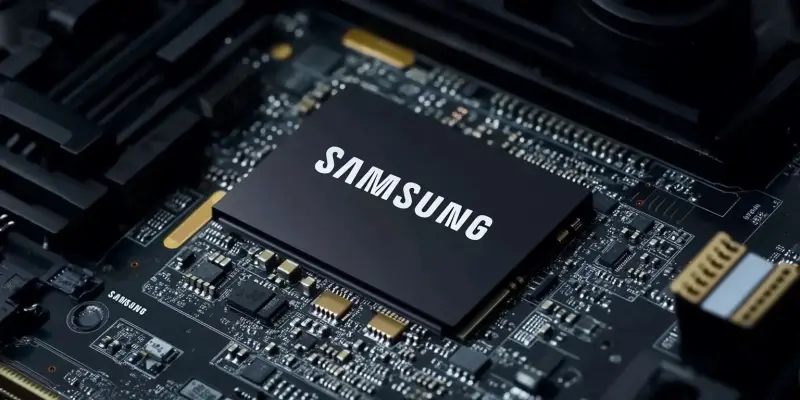
Samsung has introduced its next-generation consumer SSD, the 9100 PRO Gen5, which boasts industry-leading speeds and capacities. The flagship SSD was unveiled in a recent press release and features the PCIe 5.0 interface, doubling the speed of the previous PCIe 4.0 standard. Its impressive performance metrics and power-efficient design have piqued the interest of tech enthusiasts and professionals alike.
A standout feature of the 9100 PRO Gen5 is its astonishing sequential read and write speeds, which reach up to 14,800 MB/s and 13,400 MB/s, respectively. These figures represent a remarkable 99% performance improvement over its predecessor, the 990 PRO. In addition to superior sequential speeds, the drive offers exceptional random read/write speeds of up to 2,200K and 2,600K IOPS. This ensures rapid data processing and flawless multitasking performance, making it indispensable for professional content creators and gamers who demand peak performance from their hardware. The SSD’s impressive stats are underpinned by Samsung’s proprietary technologies, which continue to push the boundaries of what’s possible in consumer-grade storage.
A Leap in Speed and Performance
With speeds reaching 14,800 MB/s for sequential reads and 13,400 MB/s for sequential writes, this SSD dwarfs its predecessor, the 990 PRO, which already had garnered praise for its capabilities. Such high speeds are not just numbers on a spec sheet; they translate into real-world benefits such as faster game load times, swifter file transfers, and an overall more responsive computing experience.
Furthermore, the drive’s random read/write speeds further cement its position as a leader in the consumer SSD market. Achieving up to 2,200K IOPS for random reads and 2,600K IOPS for random writes, the 9100 PRO Gen5 excels in scenarios requiring quick access to data scattered across the drive. This is particularly beneficial for applications involving large databases, virtual machines, or complex simulation software. The ability to handle numerous small tasks simultaneously without bottlenecks ensures that the SSD can keep up with the demands of modern computing environments.
Power Efficiency and Advanced Heat Management
Beyond speed, the 9100 PRO Gen5 also emphasizes power efficiency, making it a well-rounded choice for various applications. The SSD demonstrates up to 49% better efficiency compared to the 990 PRO, a feat achieved through advanced heat management solutions. These solutions include an integrated 8.8mmT heatsink for the 1TB to 4TB models and an 11.25mmT heatsink for the forthcoming 8TB model. Such thermal management features are crucial in preventing overheating and ensuring consistent performance over prolonged periods.
The introduction of an 8TB capacity in Samsung’s consumer NVMe SSD lineup marks another milestone. This model is designed to meet the extensive storage needs associated with high-performance gaming, next-generation content creation, and professional workloads. Samsung’s inclusion of the Magician software with the SSD further enhances user experience by offering optimization tools, streamlined data migration, and advanced security features. Such features ensure that users can maximize the potential of their SSD while keeping their data safe.
Availability and Technical Specifications
Samsung plans to roll out the 9100 PRO Gen5 SSD series in multiple capacities—1TB, 2TB, 4TB, and 8TB—to cater to various user needs. The 1TB, 2TB, and 4TB models will be available starting March 18, 2025, with suggested retail prices set at $199, $299, and $549, respectively. The 8TB model, catering to those with even greater storage demands, is expected to be launched in the second half of 2025. These pricing and availability details underscore Samsung’s commitment to making top-tier storage solutions accessible to a broad spectrum of consumers.
The technical specifications revealed by Samsung highlight the use of in-house controllers and Samsung V NAND TLC for the 9100 PRO. These components ensure that the SSD delivers sustained, high-level performance while maintaining durability and reliability. Power consumption varies slightly among the models, with active read/write power ranging from 7.6W/7.2W to 9.0W/8.2W. Moreover, data encryption is robustly supported through AES 256, TCG/Opal v2.0, and MS eDrive (IEEE1667), providing a secure and reliable data storage solution for consumers.
Future Implications
Samsung has revealed its latest consumer SSD, the 9100 PRO Gen5, which sets new standards with its impressive speed and capacity. Announced in a recent press release, this flagship SSD features the PCIe 5.0 interface, effectively doubling the speed of the previous PCIe 4.0 standard. The 9100 PRO Gen5 is perfect for various applications, from gaming and AI content creation to multitasking across laptops, desktops, and gaming consoles. Its performance and power efficiency have garnered significant attention from tech enthusiasts and professionals.
One of the key highlights of the 9100 PRO Gen5 is its remarkable sequential read and write speeds, reaching 14,800 MB/s and 13,400 MB/s, respectively, a significant 99% improvement over its predecessor, the 990 PRO. Additionally, the drive offers excellent random read/write speeds of up to 2,200K and 2,600K IOPS, ensuring swift data processing and seamless multitasking. This makes it indispensable for content creators and gamers who demand the best from their hardware. Samsung’s proprietary technologies drive the SSD’s outstanding capabilities, continuing to push the boundaries in consumer-grade storage solutions.