

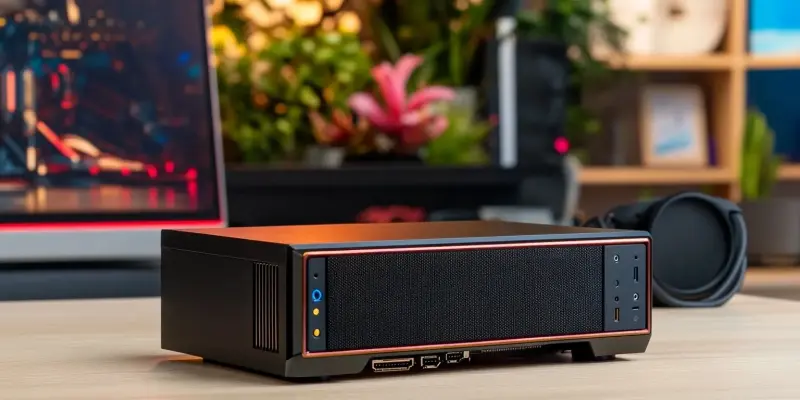
The tech landscape is constantly evolving, and the release of cutting-edge devices continually reshapes our expectations. A strong contender for the latest breakthrough is the GMKtec EVO-X2 mini-PC, which offers a unique blend of power and compactness. This highly anticipated device, slated for pre-order starting April 7, is set to redefine high-performance computing. Leveraging AMD’s Strix Halo platform and featuring the formidable AMD Ryzen 9 APU, the EVO-X2 is designed to push the boundaries of what mini-PCs can achieve.
Unpacking the Specs
The GMKtec EVO-X2 is priced at around $2,000, making it AMD’s most expensive mini-PC to date. However, the steep price can be justified by its impressive specifications. Central to its performance is the AMD Ryzen 9 APU, which boasts 16 cores and 32 threads, with a boost clock of up to 5.1 GHz. Coupled with an 80 MB cache and the Radeon 8060S integrated GPU featuring 40 compute units, this mini-PC is built for outstanding computational power and graphics performance. In terms of memory, the EVO-X2 supports up to a staggering 128 GB of LPDDR5X memory, allowing for seamless multitasking and enhanced efficiency.
Additionally, the EVO-X2 offers up to 2 TB of storage, ensuring ample space for applications, files, and multimedia content. Connectivity options are top-notch, featuring Wi-Fi 7 and Bluetooth 5.3, which provide high-speed wireless connections and superior data transfer rates. The device’s maximum power consumption is 140W, which highlights its high-performance capabilities while ensuring energy efficiency.
Industry Impact and Future Prospects
The GMKtec EVO-X2 aims to set new performance benchmarks in the mini-PC market, targeting professionals and demanding users who require a balance of power and portability. Its integration of AMD’s latest technology showcases the leap in mini-PC capabilities, making it an attractive proposition for users in fields such as content creation, data analysis, gaming, and beyond. Despite its hefty price tag, the combination of high-spec configurations and advanced features positions the EVO-X2 to compete with traditional desktop systems, offering a compact alternative without compromising on performance.
The market’s reception of the EVO-X2 will be crucial in determining its success and potential influence on future mini-PC designs. If widely adopted, this could signal a shift towards more powerful and sophisticated mini-PCs, driving innovation and competition in the segment. Companies will likely take note of GMKtec’s use of AMD’s Strix Halo platform, possibly adopting similar technologies in their future offerings to meet the growing demand for high-performance yet space-saving devices.
Closing Thoughts
The tech landscape is in a constant state of flux, with new devices regularly altering our digital expectations. One significant contender for the latest technological breakthrough is the GMKtec EVO-X2 mini-PC. This innovative device marries power with a compact form, offering an intriguing combination that could set new precedents in high-performance computing. Scheduled for pre-order beginning April 7, the EVO-X2 aims to push the limits of what’s possible in the realm of mini-PCs. It utilizes AMD’s powerful Strix Halo platform and boasts the impressive AMD Ryzen 9 APU. The EVO-X2 is designed to challenge and surpass the capabilities traditionally associated with mini-PCs, promising users an unprecedented computing experience. As we continue to witness rapid advancements in the tech world, the introduction of the GMKtec EVO-X2 mini-PC symbolizes a significant step forward, poised to reshape our understanding of compact yet powerful devices.