

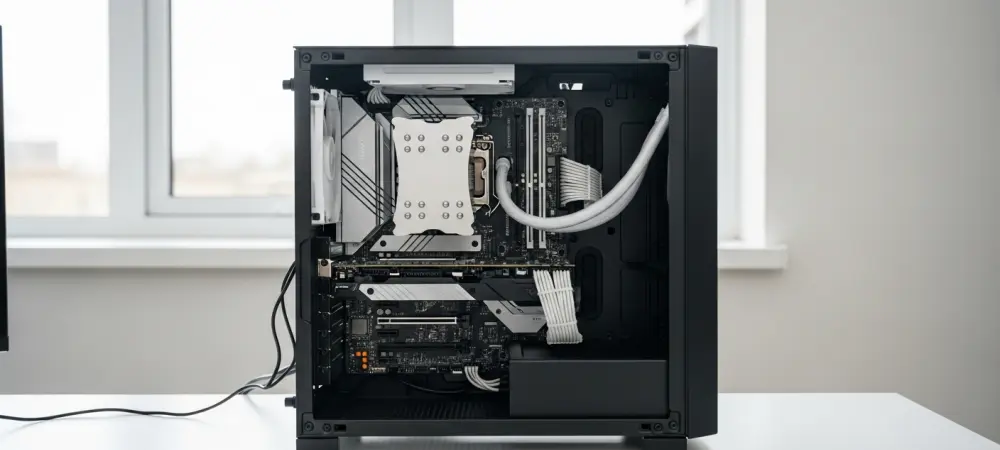
The persistent clutter of messy cables has long been the primary aesthetic hurdle for PC enthusiasts striving to achieve a minimalist and professional look within their tempered glass enclosures. While the industry has seen incremental improvements through modular power supplies and cable combs, the true revolution lies in relocating connectors entirely to the rear of the motherboard. This shift represents a fundamental change in how desktop architecture is conceived, moving away from the traditional layout that hasn’t changed significantly in decades. The B850M AORUS Stealth emerges as a pivotal component in this movement, targeting the mid-range market where such innovations were previously reserved for ultra-premium models. By leveraging the latest AM5 chipset capabilities, this motherboard simplifies the building process while providing a visual clarity that was once impossible without custom modifications. It bridges the gap between high-end custom loops and standard consumer builds, proving that clean aesthetics and performance can coexist.
Structural Evolution: Aesthetic Precision and Thermal Efficiency
Relocating the primary power delivery and data connections to the underside of the PCB requires a radical departure from conventional manufacturing processes and trace routing strategies. The B850M AORUS Stealth utilizes a dense multilayer design to ensure that signal integrity remains uncompromised despite the unconventional placement of the 24-pin ATX and 8-pin EPS connectors. Engineering these pathways on the back of the board prevents electromagnetic interference from affecting sensitive components located on the front, such as the memory controllers and PCIe lanes. Furthermore, the absence of bulky cables on the front surface significantly improves internal airflow patterns, allowing the heatsinks for the VRM and M.2 drives to operate with much greater efficiency. This thermal advantage is particularly noticeable during sustained workloads where standard builds often suffer from heat pockets. The result is a more stable environment for high-frequency operations, ensuring that the hardware performs at peak levels throughout its lifespan.
Constructing a system around the B850M AORUS Stealth fundamentally alters the traditional assembly sequence, requiring builders to focus on the rear of the chassis rather than the interior chamber. Because all critical headers are inverted, the initial stage of the build involves securing the motherboard and immediately managing the primary power cables through the back panel. This workflow prevents the common frustration of trying to plug in small fan headers after a large graphics card has been installed. The industry-wide push for standardized cutout dimensions from 2026 to 2028 has ensured that modern enclosures provide sufficient clearance for these rear-mounted plugs, eliminating the risk of cable strain or port damage. By centralizing all connectivity in a single hidden plane, the motherboard allows for a level of cable organization that is visually satisfying. This methodology encourages builders to prioritize efficient spatial management, turning the back of the case into a clean hub. The widespread adoption of the B850M AORUS Stealth successfully transformed the expectations of the mid-range PC market by proving that immaculate aesthetics were achievable without custom modifications. This transition demonstrated that the design of internal components had finally evolved to meet the demands of modern industrial fashion, where transparency and minimalism remained paramount. As enthusiasts moved away from cluttered traditional layouts, the hardware ecosystem matured to provide a seamless integration between motherboards, power supplies, and specialized enclosures. The industry’s shift toward hidden connectivity prompted a significant improvement in thermal efficiency and assembly convenience, which benefited novice and expert builders alike. Ultimately, these advancements established a new benchmark for desktop architecture that prioritized a clean internal environment. By embracing these innovative routing strategies, the community moved toward a future where the beauty of a PC build was defined by what was absent just as much as what was present.