

The legendary $999 price tag that once defined the MacBook Air has become a relic of a pre-AI landscape where basic productivity tasks demanded far less from consumer hardware. In the current technological environment, Apple has pivoted its entire silicon strategy to prioritize Neural Engine performance and massive unified memory pools, a shift that directly contradicts the economics of budget-friendly computing. As the industry moves toward 2027 and 2028, the requirement for every laptop to serve as a local AI powerhouse means that the entry-level machine must now possess specifications that were considered high-end workstations just a few years ago. This transition has forced a fundamental recalculation of manufacturing costs, as the sophisticated components necessary for running multi-billion parameter models locally do not scale down to consumer-friendly prices easily. Consequently, the dream of a cheap Apple laptop is fading as the cost of innovation continues to climb.
Silicon Complexity: The Hardware Tax on Intelligence
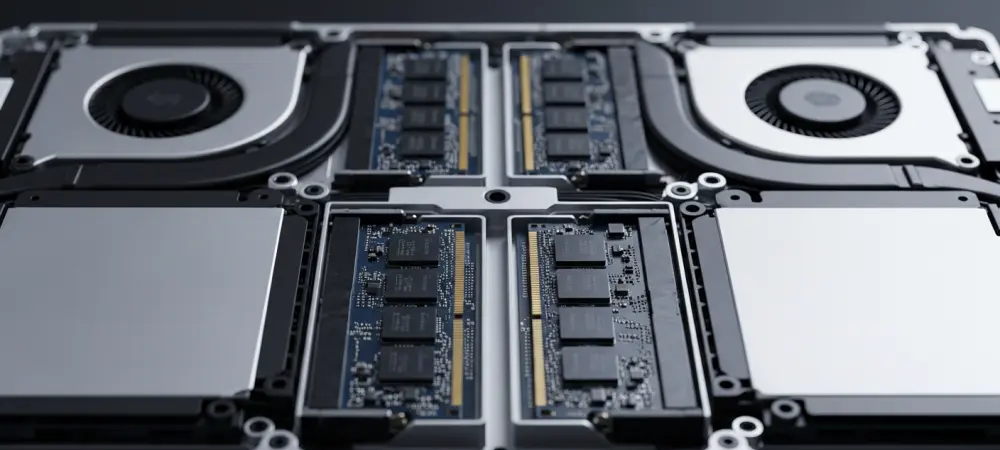
Integrating specialized Neural Processing Units into every M-series chip has fundamentally altered the physical architecture of the MacBook, necessitating larger die sizes and more complex cooling solutions. To handle modern generative tasks effectively, the baseline memory configuration has finally migrated away from 8GB to a much more expensive 24GB or 32GB standard, as low-memory systems simply cannot support the throughput required for real-time video generation or sophisticated coding assistants. This hardware elevation is not merely a choice by Apple but a functional necessity to keep the ecosystem competitive in a market obsessed with local privacy and low-latency response times. The unified memory architecture, while incredibly efficient, is physically integrated into the SoC, meaning buyers can no longer opt for cheaper third-party storage or memory solutions. Every gigabyte of high-bandwidth RAM added to the base model adds a significant premium to the final retail price of the device.
Beyond the internal components, the shift to advanced lithography processes like TSMC’s refined 2nm node has introduced astronomical manufacturing expenses that must be passed down to the consumer. These cutting-edge nodes are essential for maintaining the power efficiency MacBooks are known for while simultaneously pushing the trillions of operations per second required for modern workloads. However, yield rates for such dense silicon are historically lower in the early stages of production, creating a supply-side bottleneck that keeps prices elevated across the entire lineup. When combined with the rising costs of rare earth minerals and specialized substrates used in high-density packaging, the floor for what constitutes a profitable laptop has risen significantly. Apple’s insistence on using premium materials like recycled aluminum and mini-LED displays further compounds these silicon-level costs, making it nearly impossible to return to the sub-thousand-dollar market without compromising the core brand identity.
Strategic Repositioning: Why the Budget Market Is Vanishing
Apple has intentionally steered its marketing and product development toward a professional-centric model, effectively rebranding the MacBook Air as a pro-lite machine rather than a student-focused budget option. This strategic pivot ensures that the company maintains high profit margins even as global shipping volumes for traditional PCs fluctuate in a saturated market. By positioning on-device AI as a premium feature that justifies a higher entry price, the company avoids the race to the bottom that characterizes the Windows-based laptop sector. This approach also encourages users to lean into the subscription-based services of the iCloud and Apple One ecosystem to offload some processing tasks, yet the core selling point remains the local hardware capability. The result is a curated lineup where the distinction between consumer and professional hardware is blurred, leading to a unified, high-price tier that leaves little room for those seeking a simple, low-cost gateway into the macOS software environment.
Consumers who navigated this shifting landscape found that the most viable path toward affordability involved looking toward the robust secondary market or extending the lifecycle of existing hardware through 2027. This shift necessitated a change in purchasing behavior, where buyers prioritized high-spec initial investments over frequent, low-cost upgrades to ensure long-term compatibility with evolving software. Business leaders and educational institutions adapted by reallocating budgets to accommodate higher per-unit costs, recognizing that the productivity gains from integrated AI tools outweighed the initial capital expenditure. The focus eventually shifted toward optimizing software efficiency to lower the hardware barrier, yet the era of the disposable, cheap laptop effectively ended. Strategic planning for deployments focused on modular software environments that leveraged both local and cloud resources. These steps ensured that while the hardware remained expensive, the actual value continued to grow.