

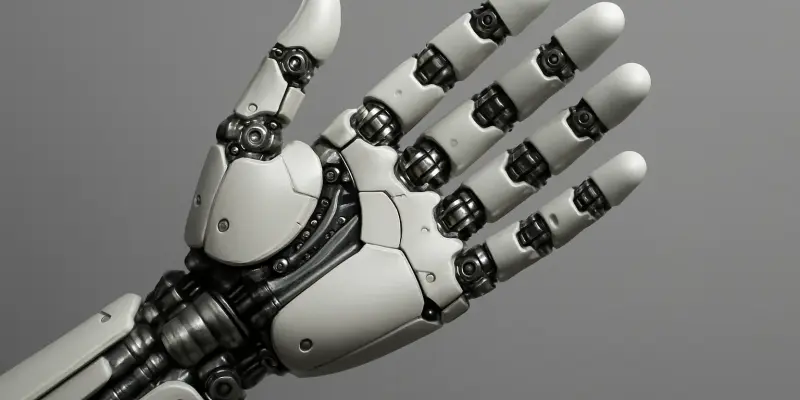
The ADAPT robotic hand, developed by researchers at École Polytechnique Fédérale de Lausanne (EPFL), is poised to transform the future of robot-human interaction. This remarkable innovation promises to bridge the gap between humans and machines by emulating the form and functionality of the human hand with impressive precision. A key characteristic of this device is its ability to grasp without complex programming, offering a glimpse into the potential of robotics that mirrors human-like dexterity. Featuring compliant materials and bio-inspired mechanics, the hand leverages adaptive dexterity to enhance its usefulness. Within its design, 20 joints powered by 12 motors located in its wrist focus their operation on four principal motion points. This setup ensures natural motion and simplified control, eliminating the need for motor activation across every joint. It’s a compelling development that aspires to redefine the conventional understanding of robotic intelligence by fostering distributed mechanical intelligence.
Innovative Design Features of the ADAPT Hand
Central to the ADAPT hand’s innovation is its revolutionary approach to configurable stiffness and open-loop control mechanisms. This strategy facilitates autonomous grasping without reliance on environmental sensory feedback, setting it apart in the field of robotics. The system relies on pre-programmed actuation signals to achieve human-like movement, offering unprecedented control over actuator positioning through a custom signal mixer box equipped with linear potentiometers. Such precision enabled the hand to demonstrate a 93% success rate in grasp trials involving 24 different objects. By adjusting its grip based on the orientation and size of objects, the hand showcases adaptable intelligence akin to its human counterparts, initiating a pivotal change in robotic design. These actions signal a departure from traditional robotic models that emphasize centralized intelligence, advocating for a shift toward distributed intelligence embedded within mechanical elements like joints, muscles, and skin—areas naturally predisposed to intelligent behavior. The success of the ADAPT hand in handling various objects with remarkable precision underscores its potential impact on assistive devices and service robots intended for seamless interaction with humans. It exemplifies how simplicity in robotic systems can enhance functionality, offering insight into how the right mechanical innovations can facilitate complex tasks effortlessly. This development paves the way for a future where machines might exhibit flexibility equal to human hands, fostering new applications that could revolutionize industries reliant on precision and adaptability. Such advancements create new paradigms where mechanical and biological principles are interwoven, demonstrating the hand’s ability to react naturally to changing environments without intricate computation. As researchers continue to explore biomimetic design and mechanical intelligence, the ADAPT hand signals a promising future where human-like dexterity in robotic systems may become a standard expectation.
Implications for Future Development
Significant progress in the ADAPT hand’s design represents a decisive step forward in bio-inspired robotics, with implications extending across multiple domains. Not only does this advancement highlight the potential for mechanical intelligence in robotics, but it also lays the groundwork for creating flexible, human-like machines. With the research team planning enhancements such as sensory feedback and possibly integrating artificial intelligence, the hand’s adaptability is bound to improve further. These planned upgrades aim to retain the inherent mechanical advantages of the ADAPT design while bridging the gap to more dynamic functionalities. The ability to maintain foundational mechanical benefits while incorporating advanced technologies exemplifies a balanced approach to innovation, which could transform the landscape of robotics as service robots and assistive devices increasingly interact with humans in natural settings.
By combining biological principles with robotic innovations, the ADAPT hand encourages the creation of systems that preclude the need for intricate programming. Such inventions are reflective of a broader trend in robotic research dedicated to generating machines that are not only capable of performing complex tasks but do so with limited external control. It opens up new avenues for advancing the design and functionality of devices aimed at enhancing human life, offering solutions to long-standing challenges within the field. As the boundary between biological design and artificial innovation becomes less distinct, developments like the ADAPT hand promote an era of unprecedented robotic capabilities that hold promise for improved interaction, adaptability, and efficiency in various applications across industries.
The Path Ahead and Emerging Prospects
The ADAPT robotic hand, conceived by researchers at École Polytechnique Fédérale de Lausanne (EPFL), is set to revolutionize robot-human interactions. This cutting-edge innovation aims to bridge human-machine gaps through precise emulation of the human hand’s form and function. A standout feature of the device is its ability to grasp objects without necessitating intricate programming, showcasing potential robotic advancements akin to human-level dexterity. Constructed with compliant materials and inspired by biological mechanics, the hand capitalizes on adaptive agility to improve its practical applications. It boasts 20 joints driven by 12 motors situated in the wrist, concentrating on four main motion points. This configuration facilitates natural movement and simplifies control, negating the need for motor activation in every joint. The development is set to challenge existing notions of robotic capabilities by promoting distributed mechanical intelligence, possibly reshaping our understanding of robot utility and their role in everyday life.