

Dominic Jainy stands at the forefront of the modern digital infrastructure revolution, bringing over a decade of insight into how artificial intelligence and high-frequency trading are reshaping the physical world of data centers. As financial institutions face unprecedented pressure to increase compute density without compromising the stability of their global networks, Dominic’s expertise in liquid cooling has become essential for navigating this transition. In this discussion, we explore the strategic move toward high-density architecture, focusing on the deployment of advanced two-phase systems that allow for massive scaling across dozens of international facilities. We cover the mechanics of waterless thermal management, the nuances of supporting Tier 1 banking environments, and the long-term economic shifts driven by a new generation of sustainable, high-performance design.
Financial institutions are shifting toward high-density compute to handle AI and advanced analytics. How does implementing waterless, two-phase direct-to-chip cooling specifically improve rack density, and what are the primary operational risks you mitigate by removing water from the IT environment?
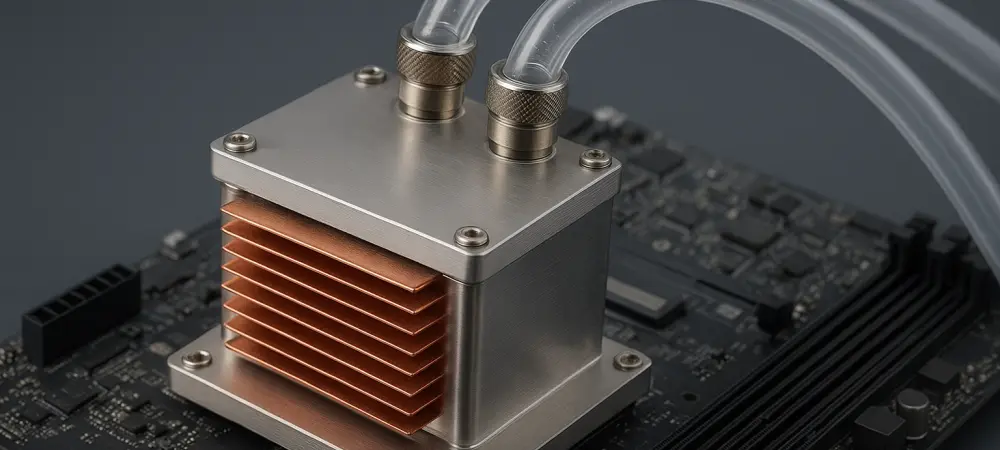
The move to two-phase cooling is a complete game-changer because it allows us to pack more power into every square foot of the data center than ever before. By using a specialized dielectric coolant that boils and condenses directly at the chip level, we can manage heat profiles that would completely overwhelm traditional air-cooled systems. This technology lets firms deploy much denser, more powerful compute setups, which is vital as AI and analytics workloads become the standard in 2026. Most importantly, by keeping water entirely out of the IT environment, we eliminate the catastrophic risk of leaks that could short-circuit expensive hardware or cause massive downtime. It provides a profound sense of security for infrastructure managers who no longer have to worry about the literal and figurative dampness threatening their mission-critical operations.
Scaling infrastructure across forty global data centers requires significant coordination. When deploying liquid-cooled environments in facilities like Equinix NY5 for Tier 1 banks, what are the step-by-step technical hurdles to integration, and how do you ensure the cooling architecture remains reliable for high-frequency trading?
Managing a global footprint of over 40 data centers means every deployment must be surgical, especially when we are working in high-stakes environments like Equinix NY5 or taking capacity in NY3. The first hurdle is integrating the liquid-cooled infrastructure into a facility that was often originally designed for traditional air cooling, requiring a seamless bridge between the new HyperCool systems and existing facility water loops. For a Tier 1 bank, reliability is non-negotiable because even a microsecond of lag in high-frequency trading can result in millions of dollars in lost opportunities. We ensure this reliability by using closed-loop systems that operate independently, providing a stable thermal environment that doesn’t fluctuate with external building temperatures. It is about creating a controlled, whisper-quiet atmosphere where the hardware can run at peak performance 24/7 without the fear of thermal throttling slowing down a trade.
Traditional cooling methods often force a trade-off between power and sustainability. How does a closed-loop system that allows coolant to boil and condense compare to standard heat conduction in terms of thermal efficiency metrics, and what impact does this have on long-term infrastructure costs?
Standard heat conduction is like trying to cool a hot engine with a damp cloth, whereas two-phase cooling is more like the efficient, repeating cycle of a high-end refrigeration system. By allowing the coolant to change phase from liquid to gas as it absorbs heat, we can carry away significantly more thermal energy than liquid-only conduction or air ever could. This leap in efficiency means we use far less energy to maintain optimal temperatures, directly lowering the Power Usage Effectiveness (PUE) across our massive 200-rack facilities like the one we have operated in London for the last 19 years. In the long run, this translates to massive savings on electricity and maintenance, as there are fewer moving parts and massive fans to fail. We are seeing firms realize that the initial investment in this tech pays for itself through the sheer reduction in operational overhead and the significant extension of hardware life.
Managed infrastructure platforms serve a diverse range of clients, from hedge funds to private equity firms. How do the cooling requirements for a standard financial workload differ from those of a generative AI stack, and what specific performance gains have you observed in high-performance environments?
A standard financial workload might involve the steady, predictable processing of transactions, but a generative AI stack is a different beast entirely, generating intense and localized heat spikes that can fry standard components. Hedge funds using these advanced AI models require infrastructure that can handle those “bursty” compute requirements without breaking a sweat or forcing the server to shut down. With the backing of investment powerhouses like Abry Partners and Vitruvian Partners, we have seen the resources necessary to scale these platforms to meet those rigorous demands. In high-performance environments, transitioning to specialized liquid cooling can unlock double-digit percentage gains in processing speed because the chips never have to slow down to protect themselves from overheating. This performance gain is a massive competitive advantage for asset managers who rely on rapid data analysis to make split-second investment decisions.
Investment from major global technology and HVAC firms suggests a shifting standard in data center design. How do you see the role of specialized cooling providers evolving as financial services move more workloads to liquid-cooled environments?
The fact that giants like Samsung, Mitsubishi, and Carrier are taking major stakes in this technology confirms that we have reached a definitive tipping point in the industry. Specialized cooling providers are no longer just component suppliers; they have become critical strategic partners in the design of the next generation of financial infrastructure. As more workloads shift toward liquid-cooled setups, these providers will move toward deeper integration with hardware manufacturers like Wiwynn to create servers that are literally born for liquid immersion. This evolution will allow us to build even more compact and efficient data centers, potentially moving back into urban centers where space is at a premium but proximity to trading hubs is essential. We are entering an era where the cooling system and the server are designed as a single, unified unit, maximizing every milliwatt of power for the client.
What is your forecast for liquid cooling in the financial sector?
My forecast is that within the next few years, air cooling will be viewed as a legacy solution only suitable for the most basic office tasks, while liquid cooling will be the mandatory standard for any serious financial operation. We are already seeing Tier 1 banks lead the way in New York and London, and the rest of the market will have to follow or risk being left behind by faster, more efficient competitors. The integration of high-density AI and advanced analytics is not a temporary trend—it is the new foundation of global finance that requires this thermal precision. Within a short time, the quiet, waterless hum of two-phase cooling will be the heartbeat of every major trading floor and investment house in the world.