

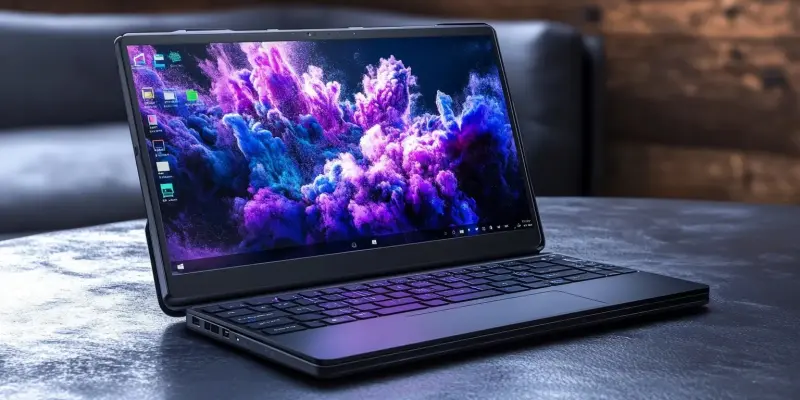
The technology landscape is witnessing rapid advancements, and Lenovo’s upcoming ThinkBook Flip AI is poised to make a significant impact with its unique folding OLED screen. Unveiling at the MWC next month, the ThinkBook Flip AI promises to offer a display that is approximately twice the height of a standard laptop, providing unprecedented flexibility. Unlike traditional laptops, this innovative device can fold in half, allowing the bottom portion to face the user while the top half faces away, making it an ideal tool for collaborative work. Whether you’re sharing the display with colleagues or utilizing it as a regular-sized screen, the ThinkBook Flip AI’s versatile functionality is certainly a game-changer. Even more intriguing is its ability to transform into a tablet, similar to 2-in-1 convertible laptops, adding another layer of utility for users on the go.
Revolutionary Design and Usability
The ThinkBook Flip AI stands out not just for its folding mechanism but also for how it enables a seamless experience that dual-screen devices have struggled to achieve. Traditional dual-screen laptops often rely on two separate screens connected by a hinge, which can be bulky and cumbersome. Moreover, these devices usually face issues like a visible crease in the middle, affecting the overall user experience. Lenovo’s new offering sidesteps these challenges by incorporating a single continuous screen that bends in the middle, minimizing any noticeable crease and delivering a more immersive viewing experience. This extensive screen space is particularly beneficial for professionals, whether they are coding, managing long chat threads, or displaying social media feeds. The flexible design caters to a broad range of tasks, establishing the ThinkBook Flip AI as a highly adaptable tool in both personal and professional settings.
While detailed specifications and pricing are yet to be announced, the ThinkBook Flip AI is expected to sit in the high-end segment of the market, likely featuring advanced hardware to match its innovative design. Lenovo’s track record in futuristic laptop concepts is well-documented, as seen with the ThinkBook Plus Gen 6, which featured a vertically expandable OLED display. This earlier model showcased Lenovo’s expertise in creating adaptable screen technology, setting the stage for the ThinkBook Flip AI. Given the lack of specifics, one can only speculate, but it is clear that Lenovo is targeting a premium audience with a penchant for cutting-edge technology.
Ultimately, Lenovo’s ThinkBook Flip AI represents a forward-thinking approach to laptop design, blending versatility and enhanced functionality. The trend toward foldable screens in laptops indicates a broader evolution in portable computing, aimed at meeting the diverse needs of modern users with innovative solutions. Although concrete details about the new laptop remain scarce, its upcoming debut is eagerly anticipated as another milestone in Lenovo’s pursuit of state-of-the-art technology. Whether it becomes a mainstream success or serves niche markets, the ThinkBook Flip AI underscores Lenovo’s commitment to pushing the boundaries of what a laptop can do.