

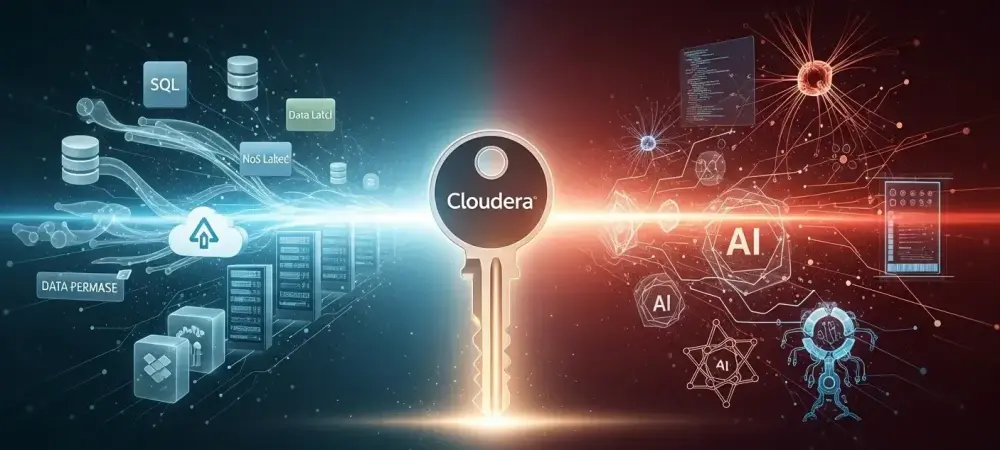
The modern enterprise currently faces a striking contradiction where the urgency to deploy sophisticated artificial intelligence frequently crashes against the immovable wall of fragmented legacy infrastructure. While the potential for AI-driven transformation is immense, the reality for most organizations involves a tangled web of data stored across disparate on-premises servers and various public cloud environments. This fragmentation creates a massive “readiness gap,” making the promise of seamless automation feel more like a theoretical exercise than an achievable strategy. This analysis explores how the latest architectural updates from Cloudera aim to bridge this divide by offering a unified management layer that prioritizes stability, security, and the high-performance analytics required for the next generation of industrial intelligence.
Bridging the Gap Between Legacy Infrastructure and AI Innovation
The pursuit of AI readiness has forced a reckoning with the technical debt accumulated over years of rapid digital expansion. Many organizations find themselves trapped between the need for modern agility and the necessity of maintaining older systems that house mission-critical data. This tension is particularly acute as the demand for real-time insights grows, yet the pipelines required to feed these models remain clogged by silos and inconsistent data formats. Consequently, the focus is shifting toward solutions that can harmonize these environments without requiring a complete and costly overhaul of existing assets.
A unified data management approach is increasingly seen as the essential bridge for this transition. By streamlining data operations through a singular platform, enterprises can theoretically maintain the integrity of their legacy foundations while simultaneously plugging into the high-velocity world of cloud-based AI. The primary challenge lies in ensuring that this integration does not introduce new layers of complexity or security vulnerabilities. As organizations look to move past the experimental phase of AI, the ability to manage data as a fluid, singular resource across a hybrid landscape becomes the ultimate competitive advantage.
The Evolution from Big Data Silos to Sovereign Hybrid Architectures
The historical trajectory of data management has moved from the initial excitement of the “Big Data” era toward a more nuanced understanding of “data sovereignty.” In previous years, the industry witnessed a massive push toward “cloud-first” strategies, often driven by the belief that physical data centers were becoming obsolete. However, the high costs of data egress and the stringent regulatory requirements of sectors like finance and healthcare have led to a significant repatriation of workloads. Today, the prevailing philosophy is no longer about choosing one environment over another but about creating a “sovereign” hybrid model where data resides exactly where it is most efficient and compliant.
Cloudera has responded to this shift by pivoting away from the forced migration patterns of the past. By extending support for legacy on-premises systems while integrating modern cloud capabilities, the platform acknowledges the reality that the modern data center is a permanent fixture of the enterprise. This evolution is vital because it allows businesses to protect their intellectual property and meet regional compliance standards without sacrificing the scalability inherent in cloud computing. Understanding this shift is key to recognizing why stability and long-term support have become as important as raw processing power in the current market.
Technical Foundations for a Data-Driven Future
Maximizing Performance Through Automated Lakehouse Optimization
One of the most significant technical hurdles in the current landscape is the sheer administrative burden of keeping data “clean” and accessible for machine learning models. Recent market data suggests that a staggering 92% of Chief Data and Analytics Officers still feel their organizations are not fully optimized for AI workloads. To combat this, the integration of Apache Iceberg as a foundational open table format has become a game-changer. This allows for high-performance analytics to be conducted across diverse environments without the need for constant data movement. The introduction of specialized optimization tools, such as the Lakehouse Optimizer, has reportedly improved query performance by as much as 38% while cutting storage overhead by over a third. These enhancements are not merely incremental; they represent a fundamental shift toward automated data governance. By reducing the manual labor involved in managing massive datasets, enterprises can free up their data science teams to focus on model training and refinement. This automation ensures that the underlying data remains reliable, which is the non-negotiable prerequisite for any successful AI deployment.
Eliminating the Trade-off Between Security and Scalability
For many years, scaling a data operation meant choosing between the security of a private data center and the elasticity of the public cloud. The emergence of “cloud bursting” capabilities has finally begun to dissolve this binary choice. This technology allows organizations to maintain their primary workloads on secure, private infrastructure while seamlessly tapping into cloud resources during periods of peak demand. Crucially, this is achieved without the need to rewrite applications or physically move sensitive information, which has traditionally been a major source of security risk and operational friction. This “in situ” processing model is a major breakthrough for industries operating under heavy regulatory oversight. It allows for the rapid expansion of compute power without the “data gravity” problem that usually makes cloud migrations so expensive and time-consuming. By keeping the data stationary and moving the compute resources to it, businesses can maintain a much tighter grip on their security posture. This balance of power and protection is essential for maintaining operational resilience in an increasingly volatile global digital economy.
Navigating Global Compliance and the Myth of Wholesale Migration
As regional data regulations become more complex, the myth that AI readiness requires a total move to the cloud is being debunked. In markets like Australia, where data sovereignty laws are particularly stringent, the ability to maintain local control is a matter of legal necessity. Innovations in data sharing now allow for live access to standardized tables across different platforms without the need for duplication. This ensures a “single source of truth” that remains governed by the organization’s own security protocols, regardless of where the analytical tools are hosted.
This trend toward decentralized but governed data highlights the importance of a unified management layer. It allows different business units or even external partners to collaborate on the same datasets while respecting the boundaries of data residency. By removing the need for “rip-and-replace” cycles, organizations can modernize at their own pace. This approach proves that the most effective path to innovation is not through the destruction of existing systems, but through the intelligent layering of new capabilities on top of a stable, secure foundation.
The Future of Enterprise AI and In Situ Analytics
The trajectory of the industry suggests a future where high-performance analytics are executed directly where the data resides, rather than moving the data to the tools. We are entering an era of “sovereign AI,” where companies will prioritize building and training models on their own infrastructure to safeguard proprietary algorithms and sensitive customer information. As the AI market continues to expand into a multi-trillion-dollar sector, the focus will move toward long-term architectural stability rather than chasing every new cloud-native trend.
Predictions for the coming years indicate that the most successful enterprises will be those that adopt a “platform-as-a-service” mindset across their entire hybrid estate. The promise of decade-long support windows for core infrastructure suggests that the industry is maturing, favoring reliability over the disruptive upgrade cycles that have historically slowed down progress. In this environment, the ability to execute complex AI workloads in situ will be the defining characteristic of a modern, data-driven organization.
Actionable Strategies for Building a Resilient Data Strategy
To navigate this shifting landscape, leadership teams must adopt a hybrid-first mindset that treats on-premises and cloud environments as a single, fluid ecosystem. A primary best practice is the adoption of open table formats like Apache Iceberg, which effectively prevents vendor lock-in and ensures data remains accessible across various tools. Furthermore, organizations should leverage automated optimization tools to rein in storage costs and administrative overhead, allowing more capital to be diverted toward actual AI innovation rather than mere maintenance. Professionals should also focus on implementing “governance at the source,” ensuring that security and compliance are integrated into the data layer itself. This prevents the bottlenecking that occurs when security is treated as a final, external checkpoint. By prioritizing architectural stability and resisting the urge to engage in unnecessary “rip-and-replace” migrations, businesses can build a foundation that is resilient enough to support the evolving demands of artificial intelligence. The goal is to create a system that is robust yet flexible enough to pivot as new analytical methodologies emerge.
Conclusion: Stability as the Catalyst for Innovation
The journey toward full AI readiness required a strategic pivot toward the intelligent integration of hybrid systems rather than the abandonment of established infrastructure. It became clear that the most effective way to close the data readiness gap was through a unified management layer that reconciled the security of the data center with the agility of the cloud. Organizations that succeeded in this transition were those that utilized open formats and automated optimization to keep their data clean, accessible, and secure. By focusing on long-term stability and in situ analytics, businesses finally managed to scale their AI ambitions without compromising their operational integrity. Ultimately, the future of enterprise intelligence was defined by a hybrid reality where data was managed as a singular, sovereign asset across every environment.