

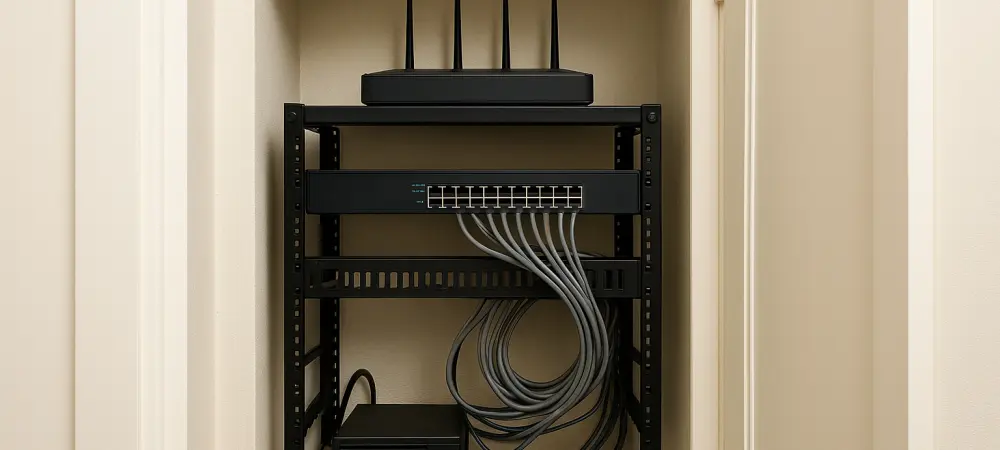
Choosing business-oriented networking gear prevents the bottleneck effect where every device on a secondary node suffers when the wireless backhaul degrades. This reality has become increasingly apparent as residential properties transform into complex digital hubs requiring the same level of reliability once reserved for corporate offices. While consumer-grade mesh systems have dominated the market for years by promising an effortless setup, the limitations of these “set it and forget it” solutions are becoming a significant hurdle for households with high-bandwidth demands. In the current landscape, the average home handles a staggering array of simultaneous connections, from ultra-high-definition streaming services and low-latency virtual reality environments to critical remote-work infrastructure. The traditional approach of using a single router or a basic mesh kit often results in inconsistent performance, leading many to reconsider the hardware residing in their utility closets. Moving toward a professional-grade architecture represents a shift from reactive troubleshooting to proactive network design, ensuring that every corner of a property receives a stable signal without the inherent compromises of retail-tier equipment.
The Financial Realities of Networking
The economic landscape of home networking is often obscured by flashy marketing and the promise of simplicity, yet a rigorous analysis of long-term costs reveals a different story. For many consumers, the initial appeal of a retail mesh system lies in its perceived value and ease of acquisition from big-box stores. However, the financial commitment rarely ends at the initial purchase, as these systems are built on business models that prioritize recurring hardware sales and proprietary ecosystem lock-in. To truly understand the investment required for a high-performance network, one must look past the entry-level price tags and evaluate the total cost of ownership, including expansion, maintenance, and the eventual need for hardware replacement when consumer-grade components fail to keep pace with modern standards.
The Hidden Costs: The Price of Proprietary Lock-In
The “Mesh Tax” is a very real phenomenon where the initial convenience of a retail kit leads to expensive proprietary lock-in that restricts future flexibility. While a starter pack might seem affordable at first glance, high-end consumer systems like eero Pro or NETGEAR Orbi can quickly climb toward the eight hundred dollar mark for a comprehensive three-node configuration. Because these systems are proprietary, homeowners are unable to mix and match different brands or utilize specialized hardware for specific needs. If a user discovers a new dead zone in a detached garage or an outdoor patio, they are forced to purchase an additional, expensive node from the original manufacturer, regardless of whether the internal hardware specifications actually justify the premium price tag being charged. This lack of interoperability creates a captive market where the consumer has little leverage to seek more cost-effective alternatives.
The Hidden Costs: The Modular Economic Advantage
By contrast, business-grade components like the TP-Link Omada series or Ubiquiti UniFi follow a much more economical and modular model that respects the user’s budget over the long term. By separating the network into a dedicated wired router, a Power over Ethernet switch, and individual access points, users only pay for the specific hardware they actually need for their unique floor plan. A comprehensive business-grade setup—featuring a professional router and three high-performance Wi-Fi 6 access points—often costs hundreds of dollars less than a flagship consumer mesh kit while providing hardware engineered for continuous operation. This modularity also means that if a single component fails or requires an upgrade, the homeowner only needs to replace that specific piece of equipment rather than discarding the entire interlocking mesh system, leading to significantly lower waste and higher financial efficiency.
Architectural Advantages of Professional Gear
The shift from consumer mesh to business-grade equipment is not merely a matter of cost, but a fundamental change in how data is moved throughout a building. Consumer mesh systems are generally designed as all-in-one boxes that attempt to handle routing, switching, and wireless transmission simultaneously within a single compact chassis. While this design is space-efficient, it introduces significant technical trade-offs, particularly regarding thermal management and signal processing. Professional-grade architecture, however, treats the network as a distributed system where each component is optimized for a specific task. This specialized approach allows for greater throughput, lower latency, and a much more resilient connection that can withstand the heavy traffic loads typical of a modern smart home without the frequent reboots often required by retail hardware.
Overcoming Wireless Weakness: The Bandwidth Penalty
The primary technical flaw in most consumer mesh systems is their reliance on wireless backhaul, a method where nodes communicate over the air to pass data back to the main router. This process inherently consumes a significant portion of the available wireless bandwidth, creating a “hidden” overhead that reduces the speeds available to the user’s actual devices. Instead of utilizing the full capacity of the radio to talk to a phone or laptop, the mesh node must reserve a large slice of its airtime just to maintain the link with its neighboring node. This overhead becomes even more problematic in multi-hop configurations where data must pass through several nodes, as each hop further degrades the signal and introduces additional latency. Consequently, the high speeds promised on the box are often unattainable in real-world scenarios where the wireless backhaul is struggling to maintain a stable connection.
Overcoming Wireless Weakness: Environmental Volatility
Beyond the loss of raw speed, wireless backhaul is highly susceptible to the physical and electronic environment of the home, leading to unpredictable performance fluctuations. Factors such as the thickness of walls, the presence of metal appliances, and even the movement of people through a room can cause the link between mesh nodes to fluctuate or drop entirely. This environmental volatility is often invisible to the user but manifests as frustrating lag during video conferences or sudden buffering during a high-definition movie. Because the backhaul is wireless, it must also compete with neighboring Wi-Fi networks and other sources of 2.4 GHz and 5 GHz interference. In a business-grade environment, these issues are systematically eliminated by moving the critical infrastructure links to physical copper wires, ensuring that the backbone of the network is unaffected by the chaos of the wireless spectrum.
The Superiority of Physical Connections: Wired Backhaul Benefits
Networking professionals almost universally agree that a wired connection will always outperform a wireless one, and business-grade access points are designed to capitalize on this truth. By utilizing “wired backhaul,” where every access point is connected directly to the central switch via an Ethernet cable, the full capacity of the Wi-Fi radio is dedicated entirely to client devices. This setup eliminates the risk of a node losing its “sync” with the rest of the network, as the data travels instantly and securely through physical cables. This transition from wireless repeating to wired distribution ensures that a homeowner receives the full benefit of their internet service provider’s speed at every access point location, providing a level of consistency that wireless mesh systems simply cannot match.
The Superiority of Physical Connections: Power over Ethernet Flexibility
The use of Power over Ethernet (PoE) in business-grade setups provides a strategic advantage in terms of hardware placement that retail mesh kits cannot replicate. Since a single Ethernet cable carries both data and electricity, business-grade access points do not need to be located near a standard power outlet. This allows them to be mounted in the most effective locations for signal propagation, such as on a ceiling or high on a central wall, far away from furniture and other obstructions that block radio waves. Consumer mesh nodes, conversely, are usually relegated to bookshelves or side tables because they must be plugged into a wall outlet, which often places them at the worst possible height for coverage. By optimizing the physical location of the radios through PoE, homeowners can often achieve better coverage with fewer units, further increasing the efficiency of the overall system.
Long-Term Value and Advanced Control
The final layer of the argument for business-grade equipment involves the sophisticated control and extended lifecycle that professional hardware offers. In the consumer world, software features are often stripped back to provide a simplified experience, which can leave the network vulnerable or poorly optimized for specific needs. Business gear provides a suite of tools that allow for granular management of how data flows through the home, protecting sensitive information while ensuring that high-priority devices always have the bandwidth they require. Furthermore, the commitment to long-term firmware support means that the network is not just faster today, but more secure and functional for years to come, long after a retail mesh system would have been discontinued and left without critical security updates.
Professional Features: Security and Optimization
One of the most significant benefits of professional gear is the inclusion of advanced “prosumer” features like Virtual Local Area Network (VLAN) support and fine-tuned roaming standards. VLANs allow homeowners to isolate “chatty” or potentially insecure smart home gadgets from the primary network where sensitive personal data and financial information are stored. This logical separation ensures that even if a cheap smart bulb or a third-party camera is compromised, the intruder cannot gain access to the family’s computers or storage devices. Additionally, professional gear supports advanced roaming standards such as 802.11k, 802.11v, and 802.11r, which work together to ensure that a smartphone seamlessly hands off from one access point to the next as a person walks through the house. This level of optimization prevents the “sticky” connection problem where a device stays tethered to a weak, distant signal.
Professional Features: The Longevity Advantage
The lifecycle of business-grade hardware is significantly longer than that of consumer alternatives, providing better value over the years from 2026 to 2031 and beyond. Consumer manufacturers often move on to new models quickly, frequently cutting off firmware and security updates for older units after just a few years to encourage new sales. Business hardware manufacturers, however, typically support their products for five to seven years or longer, recognizing that their customers require stable, long-term infrastructure. This commitment ensures that the initial investment remains functional and protected against emerging security threats for a much longer duration. Because the system is modular, the transition to newer wireless standards is also less painful; a homeowner can simply replace the access points while keeping the existing router, switch, and cabling, avoiding the full-system replacement cycles common in the retail world.
Strategic Management: The User Experience Evolution
Admittedly, the biggest hurdle to adopting business-grade equipment is the initial setup complexity, which requires more planning than a retail kit. While mesh systems use simple smartphone apps and Bluetooth to guide novices through a basic installation, professional gear often requires the use of a centralized management “controller” to unlock its full potential. However, modern business platforms have made massive strides in user experience, now offering web-based dashboards that provide incredible insight into device health, signal strength, and network traffic. These tools allow the user to see exactly which devices are consuming the most bandwidth and to identify potential interference sources in real-time. While the learning curve was steeper than a retail app, the resulting network provided a professional level of insight and control that transformed the home network into a truly managed utility.
Strategic Management: A Resilient Conclusion
The decision to move away from consumer mesh toward business-oriented hardware represented a fundamental shift in how the home network was maintained and perceived. For those who sought the best possible performance, the investment in professional gear proved to be the more resilient and cost-effective path over the long term. By prioritizing wired backhaul and modular components, users successfully eliminated the common frustrations of signal drops and speed degradation that plagued traditional retail systems. The transition provided a stable foundation that handled the increasing demands of the connected household with ease, ensuring that the digital environment remained robust and secure. Ultimately, the extra effort spent in the planning and configuration stages yielded a network that functioned reliably for years, demonstrating that the business-oriented approach was the superior choice for a high-performance home.