

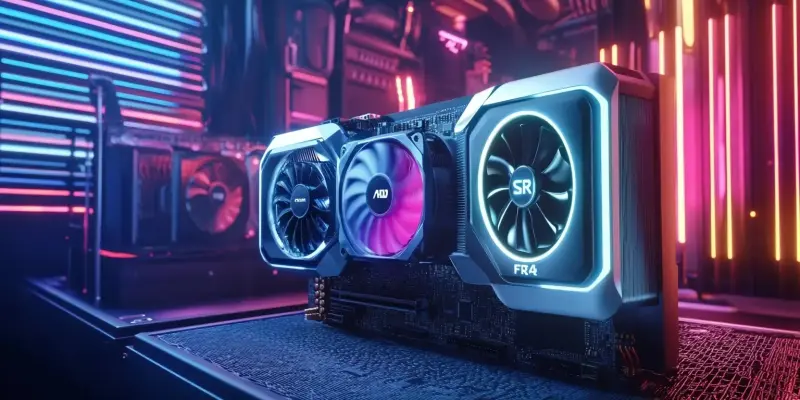
With rising anticipation, the gaming community eagerly awaits the launch of AMD’s FidelityFX Super Resolution 4 (FSR 4), a technological advancement promising to boost frame rates significantly. FSR 4 is poised to be a versatile and seamless upgrade over its predecessor, FSR 3.1, by providing a more efficient and straightforward integration process for game developers. What makes this launch even more exciting is the implication that FSR 4 will not require additional developer effort to implement into games that already support FSR 3.1. This promises a more user-friendly and developer-friendly experience, enhancing the gaming landscape.
Effortless Integration and Broad Support
Streamlined Transition from FSR 3.1 to FSR 4
A significant aspect of AMD’s FSR 4 revolves around its effortless integration. This new version aims to be a “drop-in” replacement for FSR 3.1, utilizing the same DLL file, which simplifies the process of upgrading. This advancement ensures broad compatibility with existing FSR 3.1 supported games, making the transition virtually seamless. During the CES 2025 reveal, AMD hinted that the smooth upgrade path from FSR 3.1 to FSR 4 aligns with their vision of minimal disruption for developers and maximum benefit for gamers. With over 50 games currently supporting FSR 3.1, the potential for broad game support right at the onset of FSR 4’s release is a promising prospect.
The strategic advantage of maintaining the same DLL file is significant. Game developers accustomed to FSR 3.1 will face minimal hurdles adapting to FSR 4, allowing them to quickly optimize and enhance their games with the latest technology. For gamers, this means an immediate improvement in frame rates and overall visual experience without waiting for extensive game updates. This streamlined approach is a testament to AMD’s commitment to user convenience and performance enhancement.
Competitive Landscape: AMD vs. Nvidia
The competitive dynamics between AMD and Nvidia are another critical theme in the discussion of FSR 4. As AMD gears up with FSR 4, Nvidia continues to push its DLSS 4 technology. Analysts have noted that AMD’s new release could be a game-changer for Team Red, offering long-awaited advancements in frame rate boosting capabilities. This competition between AMD’s FSR 4 and Nvidia’s DLSS 4 underscores the intense rivalry in the graphics card market, with manufacturers vying to deliver the best performance and value to consumers.
FSR 4’s promised improvements spark early optimism among AMD users eager for better quality upscaling and frame generation. In the past, AMD’s technology faced criticisms for lagging behind Nvidia’s DLSS in these specific areas. Now, with FSR 4 on the horizon, AMD appears ready to close the gap, delivering a more compelling option for gamers seeking enhanced performance. This development could shift market dynamics and user preferences in AMD’s favor, demonstrating the evolutionary strides AMD is making in the gaming sector.
Exclusivity and Strategic Timing
AMD’s Shift to Exclusivity for RDNA 4
Breaking from tradition, AMD’s FSR 4 will be exclusive to its upcoming RDNA 4 graphics cards, such as the anticipated RX 9070. This shift marks a departure from AMD’s historically open approach, where previous FSR iterations were available for use with Nvidia GPUs. While some may view this exclusivity as a limitation, it is a strategic compromise intended to deliver higher-quality upscaling and frame generation. By focusing on their hardware, AMD aims to ensure that FSR 4 leverages the full potential of their RDNA 4 architecture, addressing past criticisms and aiming to outshine Nvidia’s DLSS.
The move towards exclusivity suggests that AMD is concentrating on optimizing its ecosystem, ensuring that both its hardware and software are finely tuned to work in harmony. This focus on optimization could lead to more substantial performance gains and a better overall user experience for those investing in AMD’s latest hardware. While this may disappoint some gamers who previously enjoyed the broader compatibility, those planning to upgrade to AMD’s new RDNA 4 graphics cards can look forward to significant advancements.
Impact of Delayed RDNA 4 Graphics Cards
AMD’s decision to delay the launch of its RDNA 4 graphics cards reflects a strategy centered around ensuring a seamless release with optimized graphics drivers and comprehensive FSR 4 support. This patience contrasts with Nvidia’s rumored relaxed timeline for its next-gen RTX 5000 series, suggesting that AMD is prioritizing quality over speed. By taking the time to perfect its new hardware and software integration, AMD aims to deliver a more polished and reliable product upon release.
This conservative approach could potentially yield substantial benefits for AMD in the long run. Ensuring that FSR 4 and RDNA 4 are fully optimized and compatible from the start will likely result in fewer issues and a smoother user experience. Additionally, this could strengthen AMD’s position in the market, as gamers and developers might prefer a well-polished product over one that is rushed to market. The strategic delay indicates AMD’s commitment to quality and performance, reinforcing its reputation as a serious contender in the competitive graphics card industry.
Conclusion
The gaming community is buzzing with excitement as it anticipates the release of AMD’s FidelityFX Super Resolution 4 (FSR 4). This cutting-edge technology is set to significantly enhance frame rates, providing a smoother and more immersive gaming experience. FSR 4 is designed to be a major improvement over its predecessor, FSR 3.1, with a more efficient and straightforward integration process for game developers. One of the most exciting aspects of this launch is that FSR 4 can be implemented in games that already support FSR 3.1 without requiring additional work from developers. This means that both gamers and developers can enjoy the benefits of FSR 4 without any extra hassle. Furthermore, this upgrade promises a user-friendly and developer-friendly experience that could revolutionize the gaming landscape. With more efficient rendering and ease of use, FSR 4 has the potential to become a game-changer in the industry, making it a highly anticipated release among gaming enthusiasts and professionals alike.