

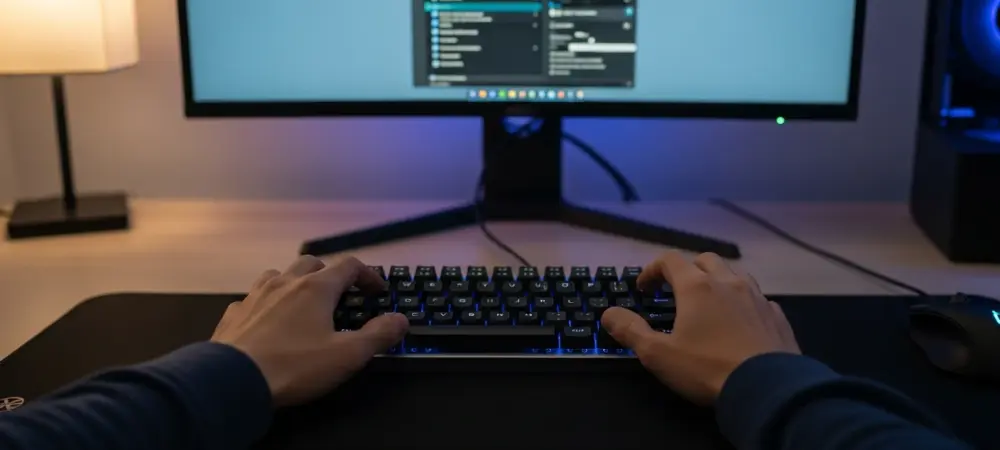
The boundary between human intent and digital execution is rapidly shrinking, driven by a new generation of peripherals that abandon mechanical friction in favor of magnetic field manipulation. While standard mechanical keyboards rely on physical metal leaves making contact to register a keystroke, the IQUNIX EV63 utilizes the Hall Effect to measure the proximity of a magnet with surgical precision. This shift is not merely a change in components; it represents a fundamental modernization of how gamers interact with software. By tracking the exact position of a key throughout its entire travel, the EV63 allows for a level of responsiveness that was technically impossible just a few years ago.
The Hall Effect keyboard market has transitioned from a niche enthusiast curiosity into the primary standard for competitive eSports. In this landscape, the EV63 emerges as a specialized tool designed for those who view a millisecond not as a negligible unit of time, but as a win-condition. By eliminating physical wear and debouncing delays inherent in traditional switches, this device addresses the modern demand for lower latency and extreme durability. As we examine the evolution of this technology, it becomes clear that the EV63 is positioned to challenge the status of established gaming giants by prioritizing raw performance over mass-market versatility.
The Emergence of Magnetic Switch Technology
At the heart of the EV63 lies a sophisticated application of electromagnetic physics. Within each switch, a permanent magnet moves toward a Hall Effect sensor located on the printed circuit board. As the magnet nears the sensor, the voltage increases, allowing the keyboard’s controller to interpret exactly how far the key has been depressed. This data-driven approach eliminates the “dead zone” found in mechanical switches, where a key must travel to a fixed point to trigger an electrical circuit. By removing physical contact, IQUNIX significantly reduces the risk of double-clicking and physical degradation, extending the lifespan of the hardware well beyond traditional limits.
The relevance of this technology in the current technological landscape cannot be overstated. In high-stakes competitive environments, players require a level of customization that mechanical keyboards cannot provide. The ability to software-adjust the actuation point means a player can set their movement keys to trigger at the slightest touch while keeping their ability keys at a deeper setting to prevent accidental activation. This precision is the primary driver behind the mass migration of professional tactical shooter players toward magnetic sensing devices, as it allows the hardware to adapt to the player’s specific ergonomics rather than forcing the player to adapt to the switch.
Core Features and Technical Implementation
Magnetic X Ultra Switches and Hall Effect Precision
The Magnetic X Ultra switches serve as the primary engine for the EV63’s performance, offering a linear travel that is frequently described as exceptionally fluid. Unlike traditional switches that may have slight scratchiness due to plastic-on-plastic friction or metal leaf resistance, these magnetic switches feel virtually frictionless. This smoothness is essential for “jiggle” movements and rapid-fire strafing in titles like Valorant, where the speed at which a key resets can determine whether a player successfully dodges an incoming projectile.
Furthermore, the resolution of these sensors is a critical differentiator. IQUNIX has implemented a sensor array with a wider voltage range, which effectively increases the “granularity” of the key tracking. This means the keyboard is not just seeing “up” or “down,” but is instead mapping the key’s position across hundreds of tiny increments. This high-resolution tracking is what enables the 0.01mm sensitivity adjustments, providing a tactile experience that feels like an extension of the user’s own reflexes rather than a clunky mechanical interface.
8000 Hz Polling Rate and Latency Reduction
While the standard for gaming peripherals has long been a 1000 Hz polling rate, the EV63 pushes the envelope to 8000 Hz. This technical leap means the keyboard reports its status to the computer 8,000 times per second, reducing the input delay from 1ms down to a staggering 0.125ms. In isolation, this might seem like a marginal gain, but when combined with the near-instant actuation of magnetic switches, the cumulative reduction in system latency becomes significant. It ensures that the computer receives the signal as close to the moment of physical intent as current USB technology allows.
However, this ultra-high polling rate is a double-edged sword that requires a powerful host system to manage. Processing 8,000 reports every second puts a non-trivial load on the CPU, which is why IQUNIX has opted for a dedicated wired connection. By avoiding the inherent instability and packet loss of wireless protocols, the EV63 maintains a consistent data stream. This focus on reliability over convenience reinforces the board’s identity as a professional instrument rather than a casual accessory, catering to users who prioritize a stable frame rate and zero-lag environment.
Industrial Design and Material Science
The construction of the EV63 reflects a serious investment in material science, moving away from the hollow plastic shells common in the industry. The chassis is sculpted from a solid block of CNC-machined aluminum, providing a structural rigidity that eliminates any flex during intense gaming sessions. This density is vital not just for durability, but for the acoustic profile of the board. A heavy, solid base absorbs vibrations, resulting in a deeper, more refined sound that lacks the “pinging” associated with cheaper metallic housings.
Integrated into the aluminum frame are forged carbon-fiber inserts, a material choice borrowed from aerospace and high-performance automotive engineering. These inserts provide a striking visual contrast while reinforcing the side channels of the keyboard. Every unit features a unique texture on the front housing due to the high-pressure manufacturing process, giving the device a bespoke, artisanal quality. This blend of industrial strength and aesthetic uniqueness positions the EV63 as a premium object that feels as substantial as the technology it houses.
Innovations in Customization and Software Ecosystem
A significant shift in the IQUNIX ecosystem is the move toward “driverless” customization. Rather than forcing users to install resource-heavy software that runs in the background and consumes system memory, the EV63 utilizes a sophisticated web-based interface. This allows users to adjust lighting, actuation points, and key bindings directly through a browser. The settings are then saved directly to the keyboard’s onboard memory. This approach is a response to the growing frustration among gamers regarding “bloatware” that can interfere with system performance or trigger anti-cheat software in competitive games.
The software also democratizes high-level play through its “Pro-level” accessibility features. Users can import specific performance profiles used by professional eSports athletes, instantly mimicking the actuation distances and sensitivity settings favored by the world’s best players. By providing a platform where these settings can be shared and iterated upon, IQUNIX has created a living ecosystem. This bridge between the casual enthusiast and the professional professionalizes the hardware, turning the keyboard into a programmable platform for skill development.
Real-World Applications and Gaming Performance
In the context of tactical shooters, the EV63’s Rapid Trigger (RT) functionality is the standout feature. Traditional switches require a key to travel back up past a reset point before it can be pressed again. In contrast, the RT feature on the EV63 resets the key the millisecond it begins to move upward. This allows for incredibly fast “counter-strafing,” a technique where a player must stop their movement instantly to regain shooting accuracy. The precision of the 0.01mm reset point gives users a tangible advantage in timing, making movement feel snappier and more intentional.
The 63-key layout represents a calculated balance between the minimalism of a 60% board and the utility of a larger layout. By including dedicated arrow keys, IQUNIX addresses one of the most common complaints regarding ultra-compact keyboards. This design choice provides enough space for expansive mouse movements—critical for low-sensitivity aimers—while maintaining the functionality needed for quick navigation in spreadsheets or coding environments. It is a layout optimized for the “desk-space economy,” where every square inch saved provides more room for competitive aim adjustments.
Technical Hurdles and Market Obstacles
Despite the impressive performance, the transition to magnetic technology introduces several challenges. The most notable is the steep learning curve for typing productivity. Because the switches are linear and lack the tactile “bump” of traditional mechanical switches, they can feel overly sensitive to those accustomed to resting their fingers heavily on the keys. This often leads to accidental keystrokes, particularly on the EV63’s smaller right-side Shift key. For users who split their time equally between gaming and heavy data entry, the ultra-responsive nature of the board can initially feel like a liability.
Furthermore, the physical difficulty of maintaining these specialized switches remains a barrier. While the board is advertised as hot-swappable, the magnetic switches are held in place with tight tolerances to ensure sensor accuracy. This makes them significantly harder to remove than standard mechanical switches, risking damage to the plastic housings if the user does not possess specialized tools. Additionally, the premium price point and the lack of wireless connectivity may alienate mainstream consumers who have grown accustomed to the convenience of “tri-mode” keyboards that offer Bluetooth and 2.4GHz options at a lower cost.
Future Outlook for Hall Effect Peripherals
Looking toward the coming years, magnetic sensing technology is poised to move beyond the gaming niche and into the enthusiast DIY market. We can expect breakthroughs in sensor resolution that will allow for even more complex features, such as “analog” movement in racing games or flight simulators, where the depth of the keypress controls the throttle. The EV63 is a harbinger of a future where standard mechanical contact is viewed as an obsolete relic, replaced by sensors that provide a continuous stream of data rather than a binary on/off signal.
The long-term impact of high-polling-rate devices like the EV63 will likely be the standardization of professional gaming hardware requirements. As 8KHz polling and adjustable actuation become the expected norm, manufacturers will be forced to innovate in build materials and software integration to stay relevant. The EV63 sets a high bar for this new era, proving that a keyboard can be both a high-fidelity instrument and a durable piece of industrial design. This shift toward “software-defined hardware” will define the next decade of peripheral development.
Assessment of the IQUNIX EV63
The IQUNIX EV63 successfully established a new benchmark for what a focused, performance-oriented keyboard should deliver. It moved the conversation away from flashy RGB gimmicks toward meaningful technical metrics like sensor resolution, polling frequency, and material integrity. The decision to prioritize a rock-solid wired connection and a heavy aluminum chassis demonstrated a clear understanding of the target demographic: gamers who value consistency and speed above all else. Its leadership in the Hall Effect sector was earned through a refusal to compromise on the core components that affect in-game performance.
In hindsight, the device functioned as a specialized tool that excelled within its specific domain while remaining transparent about its trade-offs. It offered a glimpse into a future where the physical limitations of mechanical hardware no longer dictated the boundaries of digital interaction. While the price and layout required a specific type of user, the EV63’s impact on the competitive gaming sector was profound, pushing the industry to reconsider the relationship between material science and software-driven customization. It remained a top-tier recommendation for those seeking a “zero-compromise” approach to competitive input.