

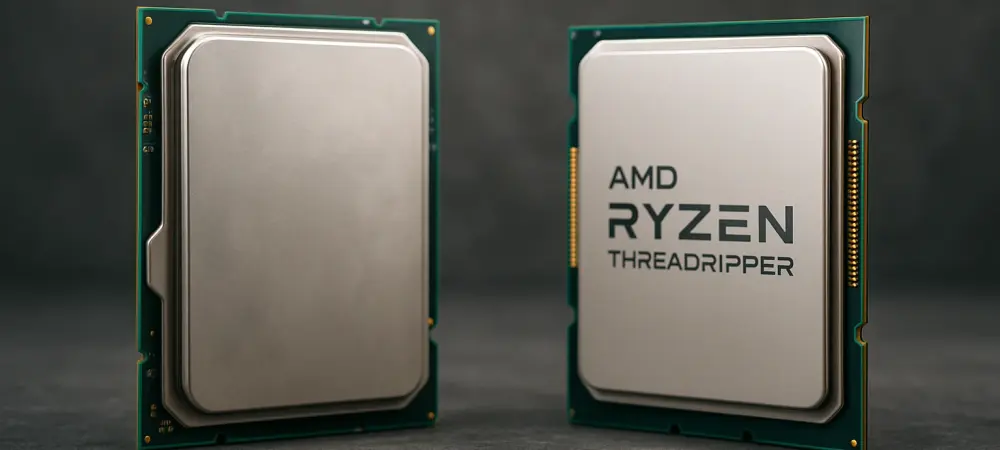
The relentless advancement of professional computing has pushed the boundaries of processing power, creating an insatiable demand for platforms that can handle increasingly complex and data-intensive tasks. In this high-stakes environment, the battle for the workstation throne has been reignited, with two silicon giants preparing to deploy their most formidable creations yet. Intel’s official launch of the Xeon 600 series marks a significant offensive, directly challenging AMD’s long-held dominance in the high-end desktop space and setting the stage for a monumental clash with the anticipated Ryzen Threadripper 9000 series. This renewed competition promises not just an escalation in performance but a fundamental rethinking of what a professional workstation can achieve.
The New Era of High-End Desktop Processors
Introducing the Contenders: Intel and AMD
The workstation market is now a two-player game at the highest level. Intel has entered the ring with its Xeon 600 series, specifically the Granite Rapids-WS processors, built on the advanced Intel 3 (3nm) process. This lineup is a clear statement of intent, designed to offer a compelling alternative to AMD’s Ryzen Threadripper family, which has largely defined the category for the past several years.
As professionals await the arrival of the Threadripper 9000 series, Intel’s Xeon 600 serves as a powerful preview of the technological arms race to come. It represents a focused effort to recapture market share by leveraging a new architecture, cutting-edge memory support, and a strategic emphasis on emerging workloads. The confrontation between these two processor families will ultimately shape the future of professional computing for years to come.
Target Audience and Primary Applications
Both the Intel Xeon 600 and AMD Threadripper 9000 series are engineered for a specific class of user: the power user whose livelihood depends on computational throughput. This includes AI developers training complex models, 3D artists rendering photorealistic scenes, data scientists crunching massive datasets, and engineers running intricate simulations. These are not processors for casual gaming or everyday office tasks; they are specialized tools for the most demanding professional applications.
The core design philosophies, however, may cater to slightly different priorities within this audience. Intel’s inclusion of specialized instructions like FP16 for AI acceleration targets the machine learning community directly. Meanwhile, the sheer core count that has historically defined Threadripper appeals strongly to the content creation and scientific computing segments, where parallel processing capabilities are paramount.
Market Positioning and Strategic Goals
Intel’s launch of the Xeon 600 series is more than just a product release; it’s a strategic maneuver to reassert its leadership in a market it once dominated. The company is positioning these processors not only as performance powerhouses but also as foundational components for the burgeoning AI industry. This move is a direct response to AMD’s success with Threadripper and a signal that Intel is committed to competing aggressively at the high end.
The broader goal for Intel is to prove its engineering prowess and regain the trust of professionals who may have shifted toward AMD’s offerings. By introducing a new platform with features like CXL 2.0 and next-generation memory support, Intel aims to create an ecosystem that is not just powerful but also future-proof. The success of this strategy will depend on whether the real-world performance and value proposition can sway a demanding and well-informed customer base.
Core Architecture and Technical Specifications
CPU Architecture and Core Count
At the heart of the Intel Xeon 600 series lies the new Granite Rapids-WS architecture, which exclusively utilizes Redwood Cove Performance cores. This all-P-core design strategy is a notable departure from hybrid architectures, focusing entirely on maximizing single-threaded and multi-threaded performance for intensive tasks. The lineup scales dramatically, offering configurations from a 12-core base model all the way up to a staggering 86-core flagship, the Xeon 698X. This top-tier processor also boasts a turbo frequency of 4.8GHz and a massive 336MB of L3 cache, specifications clearly aimed at dethroning existing performance champions.
In contrast, the upcoming AMD Threadripper 9000 series is expected to leverage the Zen 5 architecture, which will likely continue AMD’s legacy of pushing core counts to new heights. The primary battleground will be defined by how Intel’s all-P-core, high-frequency approach competes with AMD’s potentially higher raw core counts and mature chiplet-based design. The choice for consumers will hinge on whether their specific workloads benefit more from fewer, faster cores or a larger number of highly efficient ones.
Memory Support and Bandwidth
A standout feature of the Xeon 600 platform is its revolutionary approach to memory. Supporting eight channels of DDR5 memory, the platform can accommodate up to an immense 4TB of RAM, catering to users working with extraordinarily large datasets. This capability is critical for applications in scientific computing and high-resolution video editing, where memory capacity can be a significant bottleneck.
Moreover, Intel is introducing support for Multiplexer Combined Ranks DIMMs (MRDIMMs) on its higher-end models. This technology enables unprecedented memory speeds of up to 8000 MT/s, a substantial leap over the 6400 MT/s supported by standard RDIMMs. This enhancement provides a massive bandwidth advantage that will be particularly beneficial for memory-intensive simulations and data analysis, setting a new benchmark for workstation memory performance that the Threadripper 9000 series will have to meet or exceed.
Platform, Connectivity, and I/O
The supporting platform for a processor is just as crucial as the CPU itself, and Intel has built a robust foundation for the Xeon 600 series. These processors feature up to 128 PCIe 5.0 lanes, offering extensive bandwidth for multiple GPUs, high-speed storage, and other expansion cards. Only the three entry-level models are limited to a still-generous 80 lanes. This high level of connectivity ensures that the CPU is never starved for data from peripheral devices. Furthermore, the platform integrates CXL 2.0, enabling advanced functionalities like memory pooling for even greater flexibility in data center and high-performance computing environments. The introduction of the new Socket LGA 4710-2 and the accompanying W890 chipset, which includes support for WiFi 7, modernizes the entire ecosystem. This comprehensive I/O and connectivity suite makes the Xeon 600 platform a forward-looking choice for building next-generation workstations.
Performance Benchmarks in Key Workloads
AI and Machine Learning Acceleration
Intel is making a clear and aggressive play for the AI and machine learning market with the Xeon 600 series. The inclusion of FP16 instructions is a game-changer, as it directly accelerates the types of calculations common in AI model training and inference. This hardware-level optimization, combined with the high core counts and massive memory bandwidth, positions the Xeon 600 as a formidable tool for data scientists and AI researchers.
This focus on AI acceleration provides Intel with a distinct advantage in a rapidly growing field. While the Threadripper 9000 will undoubtedly offer immense raw compute power, the targeted AI enhancements in the Xeon 600 could deliver superior performance-per-watt and faster turnaround times for specific machine learning tasks, making it a highly compelling option for professionals specializing in this domain.
3D Rendering and Content Creation
For decades, 3D rendering and content creation have been benchmark workloads for high-end processors, and this new generation is no exception. The Intel Xeon 600, particularly the flagship 86-core model, is engineered to excel in these parallel-processing-heavy tasks. The combination of a high core count, a 4.8GHz turbo frequency, and a 336MB L3 cache creates a potent formula for reducing render times and improving workflow fluidity in applications like Blender, V-Ray, and Cinema 4D.
This is a direct challenge to the traditional dominance of AMD’s Threadripper in the creative professional space. The performance battle will be fierce, as artists and studios evaluate whether Intel’s high-frequency P-cores can outperform the raw core-count advantage that Threadripper is known for. The ultimate winner will be the processor that delivers the most tangible reduction in the time it takes to bring a creative vision to life.
Data Analysis and Scientific Computing
The demands of modern data analysis and scientific computing often revolve around manipulating and processing vast quantities of data. Here, the Intel Xeon 600 platform’s memory capabilities become its greatest asset. The support for up to 4TB of eight-channel DDR5 memory, especially with the 8000 MT/s speeds offered by MRDIMMs, provides the bandwidth and capacity needed to handle complex simulations and large-scale data modeling without being constrained by system memory.
Additionally, the platform’s 128 PCIe 5.0 lanes and CXL 2.0 support ensure that data can be moved rapidly between memory, storage, and accelerators. This comprehensive, high-throughput ecosystem is tailor-made for scientific researchers, financial analysts, and engineers whose work depends on processing enormous datasets efficiently. It establishes a new standard for data-centric workstation performance.
Ecosystem, Pricing, and Practical Considerations
Motherboard Platform and Chipset Features
Upgrading to an Intel Xeon 600 processor necessitates a move to a new platform built around the Socket LGA 4710-2 and the W890 chipset. This means that existing motherboards are not compatible, requiring a significant investment for system builders. However, this new platform brings with it a host of modern features, including integrated WiFi 7 and the robust I/O capabilities needed to support the processor’s full potential.
This platform refresh is a critical part of Intel’s strategy, ensuring that every component of the ecosystem is designed to handle the next generation of workloads. For potential buyers, this means factoring in the cost of a new motherboard when evaluating the total price of a Xeon 600-based workstation. The long-term benefits of the new chipset’s features will need to be weighed against this initial platform cost.
Pricing and Total Cost of Ownership
Intel has positioned the Xeon 600 series with a clear pricing structure for consumers building their own systems. With five models available in retail boxes, the entry point is the Xeon 654 at $1,199, while the lineup extends to the high-performance Xeon 696X at $5,599. This pricing places the series firmly in the premium workstation category, competing directly with the expected price points of the AMD Threadripper 9000 series.
When considering the total cost of ownership, buyers must look beyond the initial CPU price. The cost of a compatible W890 motherboard, high-speed DDR5 or MRDIMM memory, and a robust cooling solution will all contribute to the final build price. This strategic pricing reflects Intel’s confidence in the performance and features offered, aiming to provide a compelling value proposition for professionals who can leverage its capabilities to generate a return on their investment.
Power Consumption and Thermal Management
While specific TDP figures were not detailed at launch, a processor with up to 86 high-performance cores operating at high frequencies will undoubtedly be power-hungry. The Intel Xeon 600 series will demand substantial power delivery from the motherboard and a high-performance cooling solution, whether air or liquid, to maintain optimal performance under sustained load. This is a critical consideration for system integrators and individual builders designing a workstation.
This high power draw is not unique to Intel in the HEDT space, as AMD’s high-core-count Threadripper processors are also known for their significant thermal output. The key comparison will be in performance-per-watt. Professionals will need to balance their desire for maximum computational power with practical considerations such as electricity costs, chassis thermal capacity, and workplace acoustics, making power efficiency a crucial factor in the purchasing decision.
Final Verdict and Recommendations
Summarizing the Key Differences
The rivalry between the Intel Xeon 600 and the upcoming AMD Threadripper 9000 came down to competing philosophies. Intel’s strategy centered on an all-P-core architecture, pushing for high clock speeds and introducing specialized features like FP16 instructions for AI and groundbreaking MRDIMM support for unmatched memory bandwidth. This created a platform finely tuned for specific, high-value workloads.
In contrast, AMD was expected to continue its successful strategy of maximizing core and thread counts with its Zen 5 architecture, appealing to users whose applications scale near-linearly with more cores. The key differences lay in this trade-off: Intel’s focus on frequency, specialized instructions, and memory speed versus AMD’s anticipated leadership in raw parallel processing power.
Who Should Choose the Intel Xeon 600
The Intel Xeon 600 series is the ideal choice for a distinct set of professionals. Data scientists and AI researchers who can directly leverage the new FP16 instructions will find a significant performance uplift in their machine learning workflows. Similarly, financial analysts and engineers running memory-bound simulations will benefit immensely from the platform’s pioneering support for 8000 MT/s MRDIMMs and its massive 4TB memory capacity.
Furthermore, professionals working with software that is historically optimized for Intel’s architecture or those who prioritize the highest possible single-threaded performance alongside strong multi-threaded capabilities should give the Xeon 600 serious consideration. It is a platform for specialists who require its unique, forward-looking features to gain a competitive edge in their field.
Who Should Opt for the AMD Threadripper 9000
The AMD Threadripper 9000 series is poised to remain the go-to option for users whose workloads demand the absolute maximum number of cores and threads. 3D rendering artists, visual effects specialists, and video editors working with 8K footage will likely find that Threadripper’s raw parallel processing power continues to offer the fastest render times and the smoothest experience in heavily multi-threaded applications.
Moreover, users who have already invested in the AMD TR5 ecosystem may find the upgrade path to a Threadripper 9000 to be more cost-effective. For those whose primary metric is multi-core throughput for tasks like code compilation or complex scientific computing that scales across dozens of cores, AMD’s offering will likely present an unbeatable proposition in terms of pure computational density.