

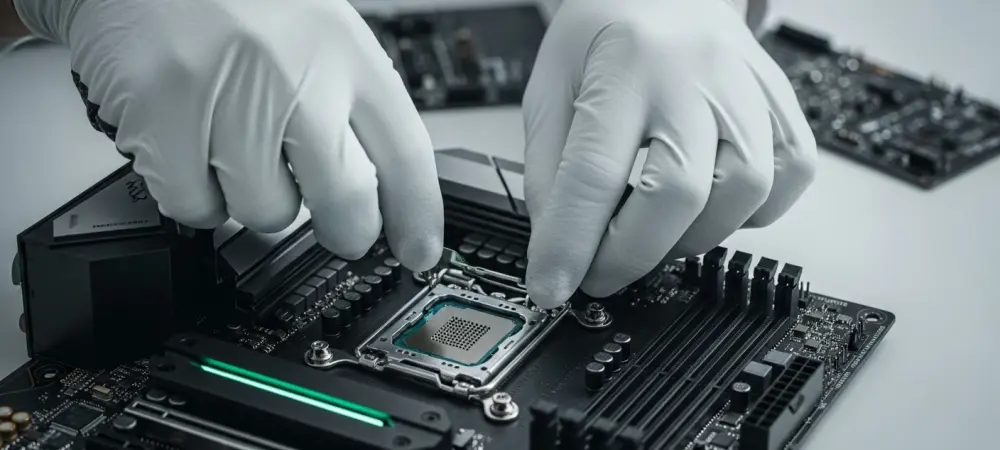
The faint but unmistakable echo of a do-over is rippling through the semiconductor industry as Intel prepares a second-act for its desktop processor lineup, a move driven by competitive necessity and a desire to rewrite a challenging market narrative. Following a lukewarm reception for its initial Core Ultra 200S series, the company is doubling down with the “Plus” refresh, a strategic mid-cycle update designed not as an evolutionary leap but as a pointed corrective measure. This lineup, more commonly known as the Arrow Lake Refresh, aims to address the shortcomings of its predecessor, bolster enthusiast confidence, and firmly re-establish Intel’s footing in the high-stakes battle against its primary rival, AMD, before the next major architectural shift arrives.
A Strategic Do Over Why Is Intel Releasing a Plus Series So Soon
The necessity for this refresh stems directly from the market’s initial reaction to the Core Ultra 200 series. Despite pre-launch hype, the processors reportedly fell short of performance expectations upon release, creating a perception gap that early microcode updates struggled to close. By the time software fixes began to unlock the hardware’s true potential, the crucial launch window had passed, leaving a lasting impression of a product that required post-purchase validation and ceded valuable ground to the competition.
This stumble provided a golden opportunity for competitors. AMD capitalized on the moment with its potent Ryzen 9000 series, particularly capturing the lucrative enthusiast and high-end gaming market with its Zen 5 architecture and the gaming-focused Ryzen 7 9800X3D. The momentum shifted decisively in AMD’s favor, leaving Intel in the reactive position of needing to regain the performance crown and the confidence of system builders and DIY enthusiasts who demand peak performance from day one.
Consequently, the Arrow Lake Refresh is being positioned as a direct answer to these challenges. It is less a technological marvel and more a tactical recalibration. By launching a “Plus” series, Intel is signaling a more refined, powerful, and problem-free product from the start. The strategy is clear: regain lost market share and re-engage a core audience that may have felt underserved by the original launch, solidifying its product stack for the immediate future.
The Core of the Strategy Resetting the Narrative Before Nova Lake
This approach is not without precedent in Intel’s recent history. The strategy draws clear parallels to the 14th Gen Raptor Lake Refresh, which successfully served as a mid-cycle update to the well-regarded 13th Gen lineup. That refresh provided incremental but meaningful performance gains through higher clock speeds and, in the case of the Core i7, more cores. This established a successful template for extending a generation’s lifespan and competitiveness, a formula Intel is now applying to Arrow Lake. The ultimate goal is to launch a product that is polished and performs as advertised right out of the box, thereby resetting the narrative that plagued its predecessor. Intel aims to erase the memory of launch-day performance discrepancies and deliver a lineup that instills immediate confidence. This move is crucial for stabilizing its desktop CPU segment and providing a strong, reliable option for consumers building new systems in the interim.
Functionally, the Core Ultra 200S Plus series serves as a critical placeholder. While not a groundbreaking new architecture, it is an essential stopgap designed to maintain a robust presence in the fiercely competitive desktop market. It effectively bridges the gap between the current generation and the next major architectural overhaul, Nova Lake. By shoring up its current offerings, Intel ensures it does not cede further ground to competitors while its next-generation technology matures.
More Cores Where It Counts a Breakdown of the New K Series CPUs
At the top of the stack sits the new flagship, the Core Ultra 9 290K Plus. This processor represents the most conservative update in the lineup, focusing on refining the existing formula rather than reinventing it. It retains the familiar 24-core configuration, comprised of 8 Performance-cores and 16 Efficient-cores. The primary enhancement is a modest 100 MHz frequency increase, pushing its Thermal Velocity Boost clock to a formidable 5.8 GHz. With 36 MB of L3 cache and a 125W TDP, it is a direct, slightly faster successor to the Core Ultra 9 285K.
The most compelling story of this refresh arguably belongs to the Core Ultra 7 270K Plus. This SKU receives a substantial hardware upgrade that elevates its multi-threaded potential significantly. Intel is adding four additional E-cores, transforming it from a 20-core (8P+12E) chip into a 24-core (8P+16E) powerhouse. This move brings the Core Ultra 7 to core-count parity with the flagship Core Ultra 9, a strategic decision that mirrors the successful upgrade path of the Core i7-14700K. This change, combined with a 5.5 GHz max boost clock and an increased 36 MB L3 cache, positions it as a high-value proposition for gamers and content creators alike.
The mainstream segment is not being overlooked, with the Core Ultra 5 250K Plus receiving a potent dual upgrade. Following the trend of its more powerful sibling, it also gains four E-cores, bringing its total from 14 (6P+8E) to 18 (6P+12E). Alongside this core boost, Intel has added a 100 MHz frequency uplift, allowing its P-cores to reach a maximum of 5.3 GHz. This combination of more threads and higher speeds is designed to make it a far more formidable contender in the mid-range market, offering tangible improvements for both productivity and gaming.
Beyond the CPU Platform Enhancements and Early Performance Leaks
The improvements extend beyond the processor die itself. The entire Arrow Lake Refresh platform introduces a key enhancement with official out-of-the-box support for faster DDR5 memory. The new CPUs will support speeds up to 7200 MT/s, a notable 800 MT/s increase over the DDR5-6400 specification of the original series. This higher memory bandwidth will allow enthusiasts and system builders to extract additional performance, especially in memory-sensitive applications and games, without relying solely on overclocking.
Early performance indicators have begun to surface, providing a glimpse of what the refresh may offer. A leaked Geekbench benchmark for the Core Ultra 7 270K Plus, tested on a Gigabyte Z890 motherboard, shows promising results. Despite being paired with relatively slow DDR5-4800 memory, which likely acted as a bottleneck, the chip managed to outperform the previous-generation flagship, the Core Ultra 9 285K, in single-core tests. This suggests a strong per-core performance profile for the new series.
When compared to its direct predecessor, the Core Ultra 7 265K, the leaked data points to a performance uplift of around 5%. However, this figure may not tell the whole story. Industry analysts speculate that the true potential of the 270K Plus, especially in multi-threaded workloads and gaming, was masked by the slow test memory. The real-world impact of its four additional E-cores is expected to be more significant, offering a tangible boost that early synthetic benchmarks might not fully capture.
Planning Your Next Build Launch Timeline and Pricing Outlook
For those planning their next PC build, all signs point toward a formal reveal of the Core Ultra 200S Plus lineup at CES 2026. This timing positions the refresh as Intel’s primary desktop offering for the year, setting the stage for a renewed confrontation in the consumer CPU space. The launch will likely be a major focus of Intel’s keynote, detailing the full specifications, performance claims, and availability for the new “K” series processors.
While official pricing remains under wraps, industry observers anticipate a strategy that mirrors previous refresh cycles. It is highly probable that the new flagship, the Core Ultra 9 290K Plus, will launch at a price point very similar to its predecessor, offering a slight performance bump for the same cost. This maintains a stable pricing structure at the high end, which is a common practice for such iterative updates.
The pricing for the mid-range and mainstream models presents a more interesting puzzle. Given the substantial hardware upgrades—namely the addition of four E-cores to both the Core Ultra 7 and Core Ultra 5 models—a slight price increase could be justified to reflect the enhanced value. Alternatively, Intel might choose a more aggressive route, maintaining the existing price points to maximize market penetration and pressure its competition. This decision will be a key indicator of Intel’s confidence and strategic priorities for the coming year.
The rollout of the Arrow Lake Refresh represented a calculated and necessary maneuver from Intel. It was a strategy born from a challenging market reception and the relentless pressure of a strong competitor. By focusing on tangible upgrades like additional E-cores for its mid-range CPUs and faster memory support across the board, the company addressed key performance deficits and demonstrated a commitment to its enthusiast user base. The “Plus” series was not merely a product launch; it was a deliberate effort to reset the narrative and stabilize its position in the desktop market. This refresh ultimately served its purpose as a crucial bridge, shoring up Intel’s offerings and setting a more solid foundation from which to launch its next major architectural leap with Nova Lake.