

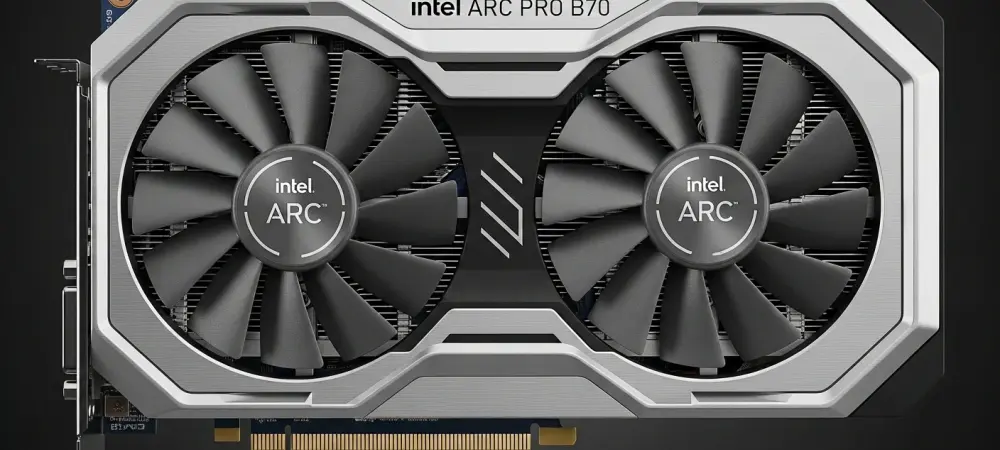
The long-standing duopoly in the professional visualization and computational market has finally met a disruptor that prioritizes raw utility over brand-name premiums. The Intel Arc Pro B70 represents a significant advancement in the professional GPU market, specifically targeting the burgeoning field of local AI inference. By pivoting toward the specific needs of modern engineers and data scientists, Intel has moved beyond just creating a graphics card; it has built a specialized tool for the local model era.
This review will explore the evolution of the technology, its key features, performance metrics, and the impact it has had on various applications. The purpose of this review is to provide a thorough understanding of the technology, its current capabilities, and its potential future development as a high-value alternative to established industry leaders.
Introduction to the Battlemage Professional Architecture
The Battlemage architecture marks a departure from Intel’s experimental phase, maturing into a robust platform designed for heavy-duty computational tasks. Unlike its predecessor, which struggled with driver stability and niche software compatibility, the B70 is built on a refined instruction set optimized for matrix math and deep learning. This shift is particularly relevant in the broader technological landscape, especially regarding its role in democratizing high-capacity VRAM for AI developers who were previously priced out of the market.
By focusing on high-bandwidth memory and streamlined data paths, Intel addresses the modern demand for local model execution. This evolution is not merely about incremental speed gains but about providing a stable foundation for the next generation of open-source artificial intelligence. The B70 serves as a bridge, allowing smaller firms to run complex models locally without relying on expensive, privacy-compromising cloud services.
Hardware Specifications and Technical Innovations
Superior Memory Capacity and VRAM Utilization
At the heart of the B70’s appeal is its 32 GB of dedicated memory, a figure that fundamentally shifts the expectations for mid-range professional hardware. This capacity is critical because it functions to eliminate bottlenecks in large language models (LLMs) that often fail on cards with smaller buffers. When a model exceeds available VRAM, the system is forced to offload data to much slower system RAM, resulting in a catastrophic drop in performance.
The significance of this memory overhead becomes even more apparent when handling expanded context windows. Modern AI tasks require the hardware to “remember” vast amounts of text or code simultaneously to maintain coherence. By offering 32 GB, Intel ensures that developers can load larger weights and maintain more extensive active datasets, effectively extending the lifespan and utility of the workstation.
The Battlemage Core and Chiplet Design
The underlying architecture offers an in-depth look at technical aspects such as increased transistor density and refined execution units. This generation differs from previous Alchemist iterations by utilizing a more efficient manufacturing process that reduces thermal output while increasing clock speeds. This refinement is not just a laboratory metric; it translates to improved real-world usage where consistent performance under sustained loads is a requirement.
Furthermore, the architectural improvements facilitate better communication between the GPU cores and the memory controller. This reduction in latency ensures that the massive 32 GB frame buffer is utilized effectively rather than becoming a dormant resource. The result is a balanced system where raw compute power and data delivery are synchronized to handle the most demanding algorithmic challenges.
Emerging Trends in Local AI Inference and Hardware Economics
The field is currently experiencing a rapid shift toward local model execution as organizations seek to protect proprietary data and reduce recurring cloud costs. In this environment, “tokens per dollar” has emerged as a primary success metric, replacing traditional frames-per-second benchmarks. Intel’s pricing strategy directly influences this professional hardware trajectory by lowering the barrier to entry for high-performance computing.
Moreover, the rise of specialized quantization techniques allows even massive models to run on consumer-adjacent hardware. By providing a generous memory pool at a sub-thousand-dollar price point, Intel is capitalizing on this trend. This economic shift forces competitors to rethink their artificial segmentation of the market, where high VRAM was once reserved exclusively for five-figure enterprise cards.
Real-World Applications and Performance Benchmarks
Accelerated AI Workloads and Throughput
The real-world applications of the B70 are most visible in industries where data privacy is paramount, such as legal and medical research. For instance, the B70 is frequently deployed for LLM processing using Llama 3.1 and Ministral Instruct, where it demonstrates remarkable efficiency. In these scenarios, the ability to generate text quickly—measured by “time to first token”—is vital for a seamless user experience in interactive applications. Benchmarks indicate that the B70 provides a significant throughput advantage over its direct price competitors. While older professional cards might stutter when processing long documents, the Intel hardware maintains a steady pace. This consistency allows researchers to iterate on their prompts and models faster, directly accelerating the pace of innovation within their respective organizations.
Multi-GPU Scalability and Software Synergy
Unique use cases involving Intel’s oneAPI and multi-GPU configurations showcase the massive context windows achievable in complex research environments. The software stack allows multiple B70 units to act as a single, unified pool of memory, reaching capacities that were previously the domain of high-end server clusters. This synergy is a testament to Intel’s investment in an open software ecosystem that prioritizes flexibility over proprietary lockdowns.
In a quad-GPU setup, the B70 can manage context windows reaching hundreds of thousands of tokens. This capability is transformative for tasks such as analyzing entire codebases or long-form historical archives. By providing the tools for seamless scaling, Intel has ensured that as a project grows, the hardware can grow with it without requiring a total system overhaul.
Technical Hurdles and Market Obstacles
Despite its hardware strengths, the B70 faces significant challenges, including software optimization gaps compared to the long-established CUDA ecosystem. Most AI research is currently built on NVIDIA-specific libraries, making the transition to Intel’s platform a matter of effort and porting. Regulatory pressures and the market dominance of NVIDIA also create a steep uphill battle for widespread adoption among risk-averse corporate IT departments.
However, ongoing development efforts, such as frequent driver refinements and active open-source contributions, are starting to mitigate these limitations. Intel is working closely with the developer community to ensure that popular frameworks like PyTorch and TensorFlow run natively and efficiently on Battlemage. While the software gap is narrowing, it remains the primary friction point for professional users considering a switch.
Future Outlook and the Gaming Crossover Potential
The trajectory of this technology suggests that the “Big Battlemage” architecture could eventually transition into the consumer gaming sector. If Intel can maintain this level of memory efficiency and compute density, a flagship gaming variant could offer a compelling alternative to high-end consumer cards. Future developments in Intel’s AI software stack will likely focus on further automating the optimization process, making it even easier for developers to extract maximum performance. Looking ahead, the long-term impact on professional workstation standards will likely involve a move toward higher base memory configurations across the industry. Intel has set a new floor for what a professional-grade card should offer, potentially ending the era of “memory-starved” entry-level workstations. This trend will benefit the entire industry by forcing all players to compete on value and capability rather than historical market share.
Final Assessment: Disrupting the Professional GPU Status Quo
The Intel Arc Pro B70 succeeded in challenging the established hierarchy of the workstation market by offering an aggressive price-to-performance ratio that was once considered impossible. It proved that a third player could enter the high-stakes AI arena and provide immediate, tangible value through strategic hardware choices and open software standards. While software parity remained a work in progress, the sheer hardware value made it an unavoidable consideration for any budget-conscious development team. Ultimately, the B70 functioned as a catalyst for a more accessible AI landscape. Its legacy was not just in its own benchmarks but in how it pushed the industry toward greater transparency in pricing and memory allocation. Professional users gained a powerful new tool that effectively bypassed the artificial limitations of the past, marking a definitive shift in how local intelligence is developed and deployed.