

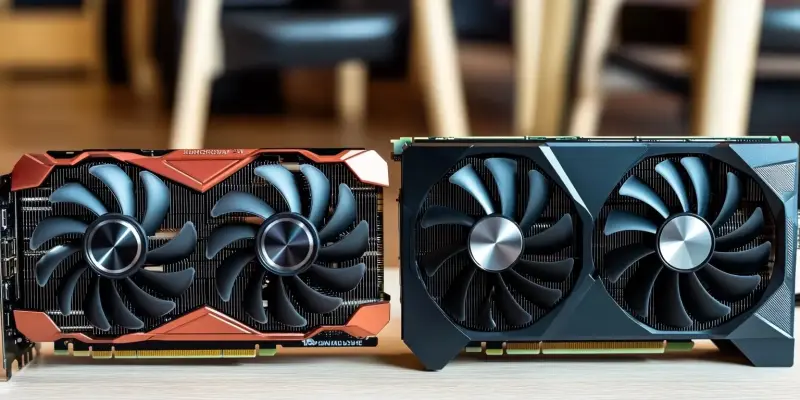
In a market historically dominated by Nvidia and AMD, Intel’s recent entry into the discrete graphics card arena has generated substantial buzz and mixed reactions. The Arc B580, part of Intel’s new Arc series, has quickly become a standout contender against Nvidia’s GeForce RTX 4060. This article explores a detailed comparison between these two budget-friendly GPUs, delving into their architecture, performance metrics, memory configurations, power consumption, cooling efficiency, and market pricing to provide a comprehensive analysis of their standing in the competitive landscape of budget graphics cards.
Intel’s Entry into Discrete Graphics Cards
Intel’s arrival in the discrete graphics card market with its Arc series was met with curiosity and skepticism alike. Entering a domain where Nvidia and AMD have long held sway, Intel’s Arc B580 aims to challenge these established players by offering compelling features and affordability. The Arc B580, a notable performer within Intel’s lineup, promises “best-in-class value for performance,” targeting gaming enthusiasts who seek high-quality graphics without overshooting their budget. Intel’s strategic pricing of the Arc B580 at $250, compared to Nvidia’s RTX 4060 at $299, is a clear effort to attract budget-conscious consumers without compromising much on performance.
The Arc B580 has received notable praise for its price-to-performance ratio. Tech reviewers have recognized the GPU’s potential, particularly given its competitive edge in certain key areas. Some have heralded it as a game-changer in the budget segment, describing it as “the first worthy budget GPU of the decade.” This accolade underscores Intel’s successful foray into a highly competitive sector and indicates a positive market reception for the Arc B580’s blend of affordability and capability.
Core Architectural Differences
The architectural backbone of these GPUs reveals significant distinctions. The Intel Arc B580 leverages the Battlemage architecture, boasting a superior memory configuration that includes 12GB of GDDR6 VRAM paired with a 192-bit memory bus. This setup translates to higher capacity and bandwidth, providing an advantage when handling more complex game textures and assets. In contrast, the Nvidia RTX 4060 features 8GB of GDDR6 VRAM linked to a 128-bit memory bus, which, while efficient, offers less headroom for future gaming demands. This fundamental difference in memory architecture ensures that the Arc B580 can cater to gamers looking for a future-proof investment.
Beyond memory capacity, the architectural nuances between Arc B580 and RTX 4060 extend further. The Arc B580’s design is meticulously engineered to achieve robust performance at an approachable price point. By contrast, Nvidia’s RTX 4060 benefits from Nvidia’s ecosystem of established technologies and solutions that facilitate seamless integration and performance. These core architectural variations not only affect performance benchmarks but also influence the overall value proposition each GPU delivers to the consumer.
Power Efficiency and Cooling
When evaluating GPUs, power consumption and cooling efficiency are critical considerations. The Intel Arc B580, with a thermal design power (TDP) of 190W, appears to consume more power on paper compared to Nvidia RTX 4060’s 115W TDP. However, practical, real-world tests reveal a more nuanced scenario. Various reviews have demonstrated that the Arc B580’s power draw is similar to that of the RTX 4060 during actual usage, with occasional instances of lower consumption. This finding challenges preconceived notions about the Arc B580’s power efficiency.
Furthermore, the Arc B580’s cooling performance stands out, making it an ideal choice for builds with thermal constraints. The GPU’s ability to maintain cooler temperatures under load enhances its suitability for a broader range of systems. Adding to its versatility, the B580 features dual codec engines, as opposed to the single codec engine in the RTX 4060. This is particularly beneficial for content creators who need to manage multiple video streams simultaneously, adding a layer of utility that extends beyond gaming into professional applications.
Gaming at 1440p Resolution and AI-Assisted Features
Intel positions the Arc B580 as an optimal GPU for gaming at 1440p resolution, a claim corroborated by various benchmarks showcasing its competitive performance within this range. The technological suite of the Arc B580 extends beyond mere hardware specifications to include robust software-based enhancements. Central to these enhancements is Intel’s XeSS-SS Super Sampling technology, particularly the XeSS-SR (Super Resolution) feature that can effectively double frames per second (FPS) in certain games. This combination of hardware and sophisticated upscaling algorithms contributes to an enhanced visual experience, especially in resource-intensive titles.
In addition to this, Intel’s proprietary algorithms for reducing latency further enrich the gaming experience, offering a crucial edge in responsiveness and gameplay fluidity. These advancements position the Arc B580 as a capable and budget-friendly option for gamers who desire to play at higher resolutions without sacrificing quality or performance. The inclusion of AI-assisted frame generation solidifies the Arc B580’s standing as a feature-rich option in the budget GPU market, ensuring smoother visual output and heightened immersion in gaming scenarios.
DLSS and Game Compatibility
While Intel has made significant strides with its XeSS technology, Nvidia’s DLSS (Deep Learning Super Sampling) remains a formidable feature, particularly in terms of game compatibility. The RTX 4060 supports DLSS across a wider array of games, providing it with a distinct advantage. This broader compatibility ensures that gamers using the RTX 4060 can benefit from enhanced performance and visual quality in a more extensive catalog of titles. As such, DLSS offers Nvidia an edge in the realm of AI upscaling and frame generation, where game support is a crucial metric of success.
Despite the comparable performance of Intel’s XeSS, the expansive range of DLSS-compatible games significantly bolsters Nvidia’s position. Gamers accustomed to accessing the latest and most advanced features in their favorite games are likely to appreciate the breadth of DLSS support. This facet of game compatibility can be a decisive factor for consumers, particularly those who prioritize seamless integration of AI-enhanced graphics within their gaming experience.
Fabrication Nodes and Real-World Testing
Another crucial point of comparison lies in the manufacturing processes of these GPUs. The Intel Arc B580 is constructed using TSMC’s N5 (5nm) fabrication node, while the Nvidia RTX 4060 employs the more advanced N4 (4nm) node. Generally, a smaller fabrication node is associated with better performance and efficiency, ostensibly giving Nvidia an upper hand. However, Intel’s execution with the Arc B580 has managed to bridge much of this potential disparity, demonstrating robust performance despite the marginally older manufacturing process.
Extensive real-world testing has illustrated the competitiveness of the Arc B580. For instance, tests conducted by various tech entities showed the Arc B580 surpassing the RTX 4060 in several key gaming benchmarks. In titles such as “Final Fantasy XIV,” “Resident Evil,” and “Cyberpunk 2077,” the Arc B580 exhibited commendable performance across different resolutions. Notably, the B580 achieved 31% higher FPS in “Resident Evil” at 4K and a 36% advantage in “Cyberpunk 2077” at 1440p. However, in other games like “Baldur’s Gate 3” and “Starfield,” the performance gap between the two GPUs was relatively narrow, highlighting Intel’s near-equal footing in many real-world gaming scenarios.
Expert Reviews and Consensus
Dissecting expert reviews and consensus from tech publications reveals a nuanced picture of the Arc B580’s competitive stance against the RTX 4060. Recognized tech sites like TechRadar have noted the Arc B580 performing slightly behind the RTX 4060 in ray-tracing applications, yet delivering superior output when ray-tracing is not enabled. Moreover, TechPowerUp highlights a 5% performance advantage of the Arc B580 over the RTX 4060, and a notable 15% edge over AMD’s RX 7600, showcasing the B580’s strong performance metrics within its price bracket.
Furthermore, digital publications like Digital Trends have described the Intel Arc B580 as particularly potent for 1080p gaming, labeling it “one-sided” in favor of Intel. This reflects the B580’s adaptability to mid-range gaming while maintaining a robust performance profile. Similarly, Engadget has heaped praise on the B580, calling it “the new king of $250 GPUs.” This broad acclaim underscores the GPU’s noteworthy blend of competitive pricing, solid performance, and commendable features, positioning it as a strong contender in the budget segment.
Conclusion
In a market traditionally dominated by Nvidia and AMD, Intel’s recent foray into discrete graphics cards has stirred significant interest and varied responses. The Arc B580, from Intel’s new Arc series, is quickly emerging as a strong competitor to Nvidia’s GeForce RTX 4060. This piece provides a thorough comparison between these two budget-friendly GPUs, examining their architecture, performance statistics, memory setups, power consumption, cooling capabilities, and market prices. By evaluating these aspects, the article aims to offer a detailed analysis of their positions in the highly competitive landscape of budget graphics cards. Ultimately, this comparison sheds light on how Intel’s Arc B580 stacks up against Nvidia’s GeForce RTX 4060, helping consumers make informed decisions in the evolving graphics card market. Through this detailed evaluation of specifications, power efficiency, thermal management, and cost, readers can gain a comprehensive understanding of which GPU might best suit their gaming needs and budget constraints.