

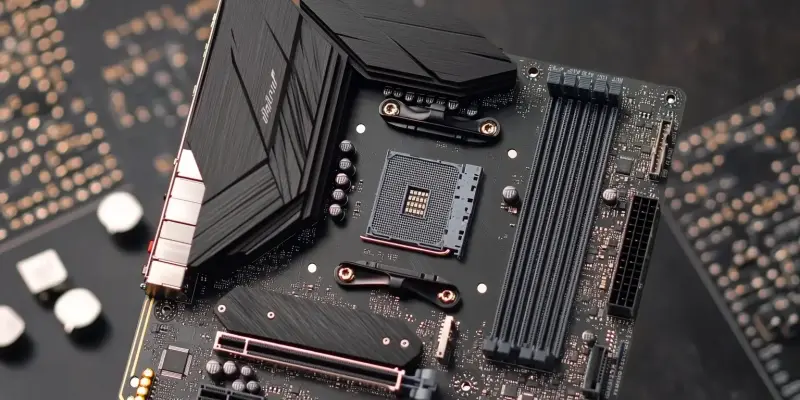
With a significant number of tech enthusiasts and consumers constantly on the lookout for upgrades without spending a fortune, the upcoming CES 2025 is set to be a game-changer. This year, Intel and AMD are gearing up to unveil a new lineup of 800-series motherboards that promise to combine performance with affordability. Intel’s B860 and H810 motherboards, alongside AMD’s B850 and B840 boards, are expected to fill a gap in the market by offering budget-friendly options that do not compromise on essential features.
Both tech giants are scheduled to make these announcements and reveal detailed specifications in mid-January, with an emphasis on making advanced technology more accessible. This launch is particularly noteworthy for Intel, which currently lacks budget-friendly LGA 1851 motherboards. The introduction of the B860 and H810 motherboards is set to make their offerings more competitive in the market. Meanwhile, AMD continues to strengthen its position with its affordable AM5 motherboards, featuring chipsets like X670 and B650, already supporting the latest technologies such as DDR5 memory and PCIe Gen5.
Other Anticipated Product Launches
Beyond the 800-series motherboards, January 2025 is shaping up to be an eventful month for both Intel and AMD, with several high-profile product launches on the horizon. Intel is set to introduce its Arc B570 graphics card, which aims to enhance gaming and multimedia performance at a more accessible price point. This move reflects Intel’s strategy to tap into the mid-range market, making powerful graphics cards available to a wider audience.
AMD, on the other hand, is preparing to showcase its new RDNA 4 graphics card lineup, including the highly anticipated Radeon RX 9070 XT. This flagship model is expected to set new benchmarks in performance, catering to high-end gaming and professional applications. Alongside this, AMD’s announcement of the Ryzen 9 9000X3D at CES 2025 is particularly eagerly awaited. This processor is predicted to offer significant improvements in terms of speed and efficiency, making it an ideal choice for power users seeking top-tier performance.
A Busy Month for Tech Enthusiasts
With many tech enthusiasts and consumers always on the hunt for upgrades that don’t break the bank, CES 2025 is shaping up to be a significant event. Intel and AMD are preparing to introduce their new series of 800-series motherboards, aiming to deliver both performance and affordability. Intel plans to showcase its B860 and H810 motherboards, while AMD will present its B850 and B840 boards, catering to the market’s need for budget-friendly options that still pack essential features.
Both companies are set to reveal these products and their detailed specifications by mid-January, emphasizing the goal of making cutting-edge technology accessible to more people. This release is noteworthy for Intel, as they currently lack cost-effective LGA 1851 motherboards. Introducing the B860 and H810 boards will enhance their competitiveness. At the same time, AMD is solidifying its position with its affordable AM5 motherboards, like the X670 and B650 chipsets, which already support the latest DDR5 memory and PCIe Gen5 technologies, offering consumers advanced capabilities without the premium price tag.