

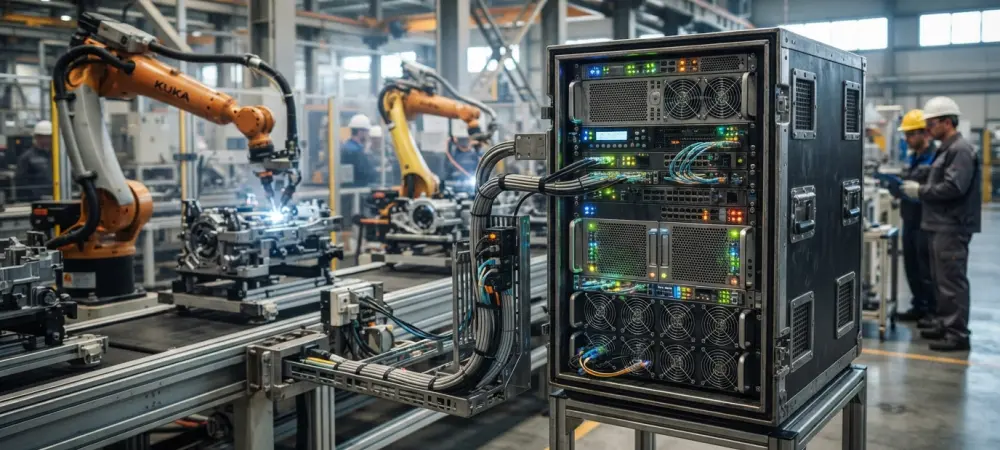
The seamless fusion of high-performance computing with heavy machinery has finally moved beyond theoretical models to become the functional heartbeat of modern manufacturing facilities across the globe. This integration, often termed Physical AI, represents the actualization of the industrial metaverse where digital logic dictates physical force in real-time. Unlike the previous wave of digital transformation that focused on administrative data and remote monitoring, the current 2026 paradigm prioritizes the direct embedding of intelligence into the “muscles” of industry—the turbines, pumps, and conveyor systems that drive the global economy. By moving away from the latency-prone cloud and toward localized edge systems, industries are achieving a level of responsiveness that was technically impossible just a few years ago. This review examines how the strategic convergence of automation expertise and advanced computing is reshaping heavy industry, turning static factories into sentient, self-optimizing ecosystems.
Core Architectural Components and Systems
Edge Computing and Private Cloud Infrastructure
The foundational shift in this technological review is the abandonment of the centralized cloud for the localized edge. Industrial environments require immediate responses that the traditional cloud-based model cannot provide due to the laws of physics and network latency. The architectural solution currently gaining dominance utilizes private cloud frameworks, such as the collaboration between Hewlett Packard Enterprise and NVIDIA, which brings high-performance inference capabilities directly to the factory floor. By co-locating the “brain” with the machinery, plants can process vast streams of sensor data without the risks associated with external connectivity. This localized infrastructure ensures that critical systems remain operational even if external internet connections fail, providing a level of resilience mandatory for the energy and chemical sectors.
Specialized Industrial AI Agents
Above the hardware layer sits a sophisticated ecosystem of AI agents that perform specialized operational tasks. These are not general-purpose chatbots but highly tuned models trained on decades of industrial telemetry and engineering standards. Within platforms like Schneider Electric’s EcoStruxure, these agents function as digital specialists. An Operational Technology Monitoring Agent, for instance, cross-references maintenance logs with real-time vibration data to predict a bearing failure weeks before it occurs. Meanwhile, Energy Optimization Agents analyze the power signature of every motor in a facility, suggesting micro-adjustments to the production schedule that align with peak efficiency periods. This granular control transforms AI from a broad analytical tool into a precise engineering instrument.
Emerging Trends and Technological Shifts
The industry is currently transitioning from a collection of “smart machines” to the holistic “AI Factory” model. This trend treats an entire industrial site as a single, interconnected organism rather than a series of isolated workstations. A key driver of this shift is the adoption of open models, such as NVIDIA’s Nemotron family, which allow engineers to inspect and modify the reasoning logic of the AI. This transparency is critical in high-stakes environments where “black box” algorithms are untrustworthy. Furthermore, the market is seeing a surge in Physical AI sovereignty, where corporations invest heavily in keeping their operational logic entirely within their own firewall. This move reflects a strategic desire to protect proprietary manufacturing secrets from being ingested by third-party cloud models.
Real-World Applications and Sector Implementations
The most profound impact of Physical AI is visible in heavy, continuous-process industries where any downtime results in millions of dollars in lost revenue. In the pulp and paper industry, companies like CMPC Chile have implemented these systems to oversee complex server networks and operational workstations. By utilizing a “single-pane” view of their digital and physical infrastructure, operators can identify bottlenecks across the entire production chain from a centralized hub. Similarly, in the energy sector, AI agents are now responsible for the delicate balancing act between maximizing throughput and adhering to strict sustainability mandates. These systems can identify minute process fluctuations that human eyes might miss, resulting in substantial cumulative energy savings across global operations.
Strategic Challenges and Market Obstacles
Data Sovereignty and Cybersecurity Risks
Despite the clear efficiency gains, the integration of IT and OT introduces a significant expansion of the potential attack surface. Industrial operators face a paradox: they need connectivity for AI to function, but that same connectivity invites cyber threats that could cause physical damage. To address this, the current technological stack includes dedicated Cybersecurity Agents that act as immune systems for the factory. These agents do not just look for known viruses; they monitor for behavioral anomalies. If a high-pressure valve receives a command to open that contradicts the current safety parameters, the AI identifies this as a potential breach and intervenes. However, maintaining this level of security across diverse legacy systems remains a persistent and expensive challenge for many organizations.
Economic Scalability and Technical Hurdles
Scaling these advanced systems across thousands of disparate assets presents a daunting economic hurdle. While edge-based inference reduces data transfer fees, the initial capital expenditure for high-performance hardware is substantial. Furthermore, much of the world’s industrial infrastructure still relies on legacy protocols that were never designed for AI compatibility. Bridging the gap between 1990s-era programmable logic controllers and modern generative models requires sophisticated middleware and standardized communication frameworks. Until these protocols are universally adopted, the “AI Factory” will remain an expensive luxury for the most technologically advanced firms rather than a standard for the entire manufacturing sector.
Future Outlook and Evolutionary Trajectory
The trajectory for the 2026 to 2028 period points toward the realization of fully autonomous industrial operations. We are moving from a “human-in-the-loop” phase to a “human-on-the-loop” paradigm, where the AI manages the majority of routine optimizations and only alerts human specialists for high-level strategic decisions or extreme anomalies. Future developments will likely focus on the use of generative models to not only predict failures but to also output specific mechanical repair procedures or even order the necessary parts autonomously. As computing power continues to miniaturize and become more efficient, the intelligence currently housed in server racks will eventually migrate directly into the sensors themselves, creating a truly decentralized and intelligent industrial grid.
Summary of Industrial AI Advancements
The integration of Physical AI into the industrial sector proved to be a decisive turning point for global manufacturing efficiency. Analysts observed that the shift to edge-based reasoning successfully eliminated the latency barriers that had previously hindered the development of truly autonomous systems. This review confirmed that while the initial financial and security hurdles were significant, the long-term benefits in energy reduction and equipment longevity outweighed the costs. The strategic alignment of computing power with operational technology established a new benchmark for industrial resilience. Looking forward, the focus must remain on standardizing communication protocols to ensure that smaller players in the supply chain can also benefit from these advancements. Ultimately, the transition to Physical AI redefined the relationship between digital intelligence and physical production, marking the beginning of a more sustainable and intelligent industrial era.