

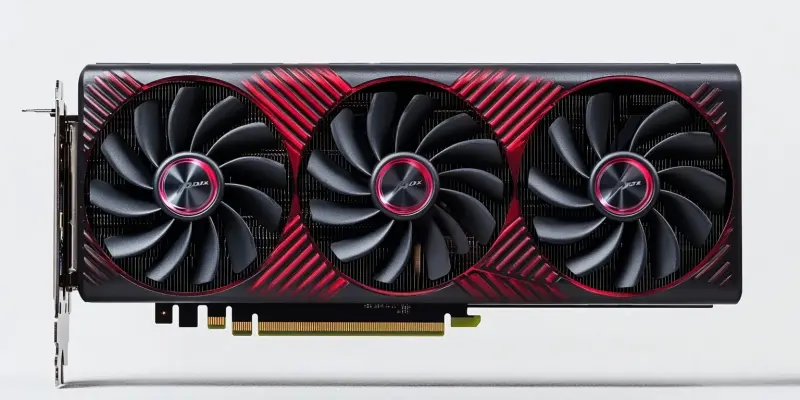
The world of computer graphics and gaming is buzzing with excitement, owing to recent leaks regarding AMD’s much-anticipated RDNA 4-based Radeon RX 9070 GPUs. These benchmarks, revealed by Geekbench, showcase substantial performance improvements and fascinating new capabilities. For enthusiasts and tech specialists alike, the insights into these forthcoming graphics cards promise a thrilling future focusing on higher frame rates, enhanced rendering quality, and increased efficiency.
Benchmark Revelations and Hardware Specifications
The Radeon RX 9070 XT, which is the more robust iteration in the series, boasts 64 compute units (totaling 4096 stream processors) paired with a maximum clock rate of 2570 MHz. The GPU is armed with 16 GB of GDDR6 memory, designed to enhance both capacity and speed when handling complex gaming environments and high-resolution textures. In Geekbench’s benchmark tests, the XT model demonstrated its prowess by scoring a remarkable 177,395 points in Vulkan tests and 179,178 points in OpenCL tests. These scores place it on par with AMD’s RX 7900 GRE, suggesting that the new architecture has achieved a significant leap in sheer performance capabilities.
On the other hand, the Radeon RX 9070, the non-XT variant, isn’t far behind. It contains 56 compute units (3584 stream processors) and a maximum clock rate of 2210 MHz, aligning it closely with the previous generation’s high-end GPUs. This variant also features 16 GB of GDDR6 memory, emphasizing AMD’s commitment to consistent memory performance across the board. The Vulkan benchmark score for this variant was 158,520 points, while its OpenCL performance clocked in at 140,842 points. This positions the Radeon RX 9070 as a comparable alternative to the RX 7800 XT, highlighting significant enhancements in computing power and graphical fidelity.
The Advantages of RDNA 4 Architecture
One of the standout features of the RDNA 4 architecture is its renewed focus on efficiency and functionality enhancements. This architecture promises increased ray tracing capabilities, an aspect crucial for rendering realistic lighting, shadows, and reflections in modern gaming titles. Additionally, AMD has incorporated new artificial intelligence (AI) and machine learning (ML) functionalities into these GPUs. Such advancements are expected to pave the way for software technologies like FidelityFX Super Resolution (FSR) 4, which use AI to upscale resolutions and improve overall video game performance. These enhancements will undoubtedly make the RDNA 4 GPUs attractive for developers and end-users seeking to push the visual envelope.
Another exciting implication of the RDNA 4 architecture lies in its potential for further model diversification. Alongside the Radeon RX 9070 XT and RX 9070, there are credible forecasts about more models in the lineup, such as the Radeon RX 9060 XT and RX 9060. These prospects intrigue both consumers and industry insiders, opening up a broader range of options capable of meeting various performance needs and budget constraints without compromising on the innovations that the RDNA 4 family promises.
Future Market Position and Expectations
The Radeon RX 9070 GPUs are set to significantly elevate the gaming landscape, and Geekbench benchmarks have revealed some impressive details. The benchmarks demonstrate substantial performance improvements, including higher frame rates, enhanced rendering quality, and increased efficiency. For enthusiasts, gamers, and tech specialists, these insights into the new graphics cards suggest a thrilling future. The Radeon RX 9070 GPUs promise to deliver transformative gaming experiences with better visuals and smoother gameplay. Both casual gamers and professionals are eagerly awaiting the official release, convinced that these advancements will mark a new era in gaming technology. The excitement generated by this potential leap in computer graphics performance highlights the continuous innovation in the industry, pointing towards an ever-evolving world of digital entertainment.