

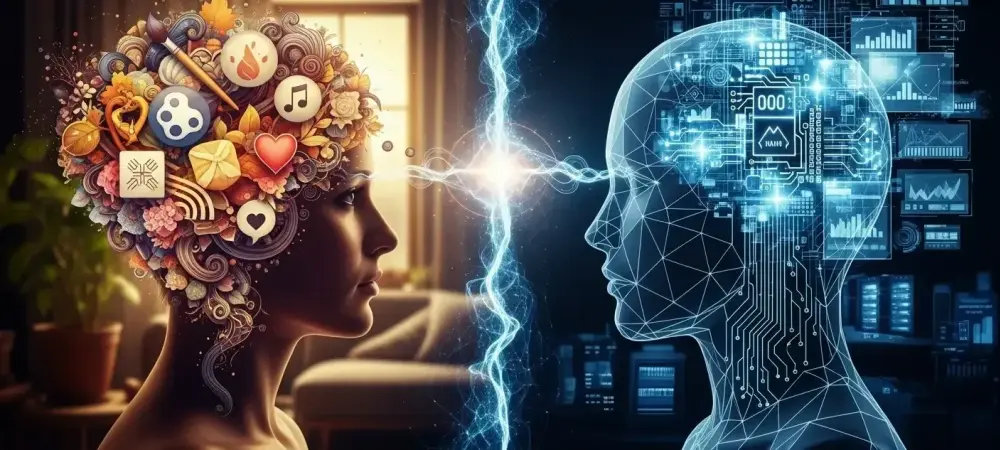
In an era where technology shapes nearly every facet of daily life, a staggering statistic emerges: over 80% of businesses now integrate artificial intelligence to enhance decision-making and efficiency, raising a profound question about how AI reasoning compares to the intricate, nuanced processes of human thinking. Both systems tackle problems, process information, and drive progress, yet their approaches differ fundamentally. This comparison delves into the essence of human cognition and AI’s algorithmic logic, exploring their strengths, limitations, and potential for collaboration. By examining these two pillars of intelligence, a clearer understanding of their roles in solving modern challenges comes into focus.
Understanding Human Thinking and AI Reasoning
Human thinking encompasses the complex interplay of cognition, emotion, and experience that defines how individuals perceive and interact with the world. It involves processes like problem-solving, creativity, and decision-making, often guided by intuition and subjective judgment. Rooted in biological neural networks, this form of intelligence allows for adaptability in diverse, unpredictable scenarios, from navigating social interactions to crafting innovative ideas.
AI reasoning, by contrast, refers to the structured, algorithmic processes employed by artificial intelligence systems to analyze data and generate solutions. These systems, often built on large reasoning models, rely on predefined rules, vast datasets, and logical frameworks to simulate thought-like behaviors. While lacking consciousness, AI excels in tasks requiring precision and speed, positioning it as a powerful tool in fields such as data analysis and automation.
The comparison between these two forms of intelligence is significant, as human thinking serves as the traditional benchmark for what constitutes intellect, while AI represents humanity’s attempt to replicate or augment such capabilities. Human thought drives personal and societal growth through daily choices and artistic expression, whereas AI reasoning transforms industries like healthcare, finance, and education by handling complex computations and optimizing workflows. Understanding their interplay offers insights into harnessing both for maximum impact.
Core Differences and Similarities in Cognitive Processes
Problem-Solving Mechanisms
At the heart of human problem-solving lies a dynamic process involving mental simulation, inner speech, and sudden insights. Individuals often “talk” themselves through challenges, visualizing scenarios or drawing on past experiences to reach conclusions. This approach allows for flexibility, as seen when a person solves a puzzle by trial and error, adapting strategies based on immediate feedback.
AI reasoning, particularly through techniques like chain-of-thought reasoning, mimics this step-by-step logic by breaking down problems into sequential components. For instance, when tackling logic-based benchmark questions, AI systems generate intermediate steps to arrive at answers, paralleling human deliberation. However, while AI follows rigid protocols, it lacks the spontaneous “aha” moments that often characterize human breakthroughs.
A key distinction emerges in adaptability. Humans can pivot based on emotional cues or novel contexts, whereas AI remains bound by its programming and training data. Yet, both share a commonality in their iterative approach to challenges, whether it’s a person rethinking a strategy or an AI model refining its outputs through structured logic. This overlap highlights a shared foundation, even if the execution differs.
Knowledge Representation and Retrieval
Humans store and retrieve knowledge through memory, a deeply personal system shaped by experiences and emotions. Recalling a fact, like the name of the highest mountain peak, often involves contextual cues or associated feelings, making the process both rich and imperfect. This organic method allows for nuanced understanding but can falter under stress or with incomplete recollection.
AI, on the other hand, relies on expansive datasets and predictive mechanisms, such as next-token prediction, to access and present information. When completing a sequence like “The highest mountain peak is Mount Everest,” the system draws on embedded patterns within its training corpus to ensure coherence. This method offers precision and scalability but lacks the depth of personal context inherent in human memory.
The contrast reveals a trade-off between depth and breadth. Human recall is imbued with meaning but prone to error, while AI’s retrieval is accurate yet mechanical, missing the interpretive layers that define lived experience. Both systems, however, demonstrate a form of reasoning—humans through associative thinking, and AI through statistical inference—underscoring their capacity to navigate knowledge in distinct yet functional ways.
Limitations in Complexity and Visualization
Both human thinking and AI reasoning encounter hurdles when faced with highly complex tasks, such as solving large-scale algorithmic problems like the Tower of Hanoi. For humans, cognitive overload can hinder performance, as the mind struggles to track multiple variables simultaneously. Similarly, AI systems may falter when complexity exceeds their working memory or training scope, yet this does not diminish their capacity for thought-like processes.
A notable divergence lies in visualization. Humans often rely on mental imagery to simulate scenarios, picturing outcomes before acting. AI, however, lacks this ability, operating purely through abstract data patterns. Interestingly, this gap does not invalidate AI reasoning, just as conditions like aphantasia—where individuals cannot form mental images—do not negate human thinking. Thought transcends specific modalities in both cases.
Thus, limitations in handling intricate challenges or forming visual representations highlight shared boundaries but not an absence of intellect. Instead, they emphasize that thinking, whether human or artificial, manifests through varied strengths, with each system compensating for weaknesses in unique ways. This perspective reframes complexity as a challenge rather than a definitive barrier.
Challenges and Ethical Considerations
Human thinking, while profound, is not without flaws, often clouded by cognitive biases and memory constraints. Judgments can be swayed by preconceptions or emotional states, leading to inconsistent outcomes. These inherent limitations underscore the need for tools that can mitigate such shortcomings in critical decision-making scenarios.
AI reasoning faces its own set of challenges, heavily dependent on the quality and scope of training data. Without diverse, accurate inputs, systems risk producing skewed or irrelevant results. Moreover, AI lacks true consciousness, raising questions about its ability to grasp intent or moral nuances, a gap that becomes evident when it encounters novel situations outside its programmed parameters.
Ethical concerns further complicate this landscape. Over-reliance on AI for decisions in areas like healthcare or justice could erode human accountability, while misinterpreting AI outputs as reflective of emotion or intent risks dehumanizing critical processes. Balancing these technologies with human oversight remains paramount, as does addressing technical barriers, such as AI’s struggles with uncharted contexts and human difficulties in scaling intuition to massive datasets. These issues demand careful navigation to ensure responsible integration.
Conclusion: Complementary Strengths and Future Outlook
Reflecting on the intricate dance between human thinking and AI reasoning, it becomes evident that each brings unique strengths to the table. Human cognition shines with its depth of creativity and emotional resonance, while AI reasoning stands out for its unparalleled speed and capacity to process vast datasets. The synergy of these capabilities points to a powerful alliance rather than a rivalry.
Looking ahead, a practical step emerges in fostering hybrid models where AI bolsters human efforts in structured domains like medical diagnostics or logistical planning. Meanwhile, humans retain stewardship over ethical and imaginative realms, ensuring decisions reflect moral clarity and innovation. This balanced approach promises to amplify societal benefits.
As AI models continue to evolve, narrowing cognitive divides, the focus shifts to cultivating frameworks for seamless collaboration. Prioritizing education on AI limitations and human biases equips stakeholders to navigate this partnership responsibly. This forward-thinking strategy lays the groundwork for a future where both forms of intelligence enhance each other, driving progress with precision and humanity.