

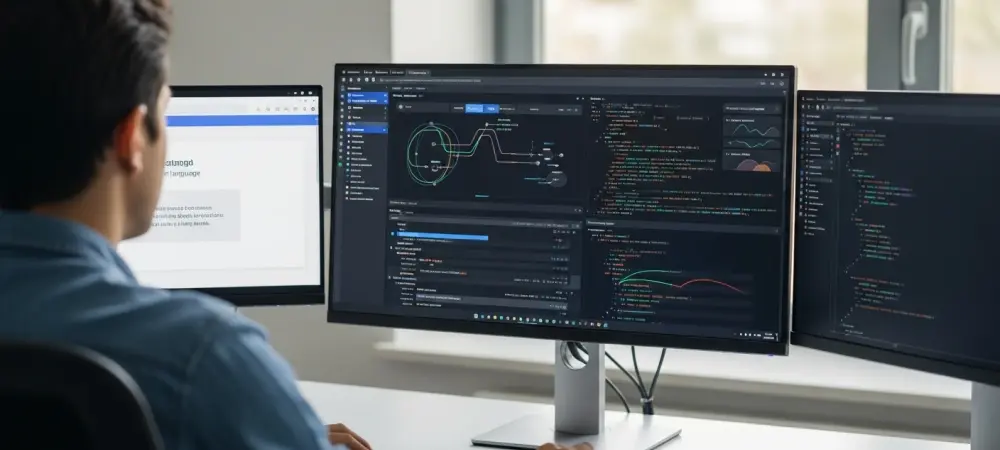
The once-meticulous craft of hand-writing every line of software code is rapidly giving way to a more fluid, conversational process that redefines the very essence of digital creation. This evolution, known as “vibe coding,” represents a fundamental departure from traditional development methodologies. It is not merely a new tool but an entirely new paradigm, shifting the focus from syntactic precision to strategic intent. As this approach matures, it is poised to reshape the roles, tools, and team structures that have defined the software industry for decades, forcing a reevaluation of what it means to be an engineer.
The Current Blueprint: A Look at Modern Software Development
For years, the gold standard of software engineering has been a process of deliberate, line-by-line construction. Developers have been tasked with translating complex business logic into precise, machine-readable syntax, a painstaking effort requiring deep knowledge of specific languages and frameworks. This workflow is inherently iterative but also laborious, with significant time spent on writing boilerplate code, debugging subtle errors, and manually implementing established patterns. The measure of productivity has often been tied to the volume and quality of code authored directly by a human.
This established model, while effective, creates inherent bottlenecks. The speed of innovation is directly limited by the number of hours an engineering team can dedicate to manual coding. Scaling a project often means a linear increase in headcount, bringing with it communication overhead and management complexity. Furthermore, this system creates a high barrier to entry, reserving the power to build sophisticated software for a specialized class of professionals and leaving domain experts dependent on technical teams to bring their ideas to life.
The Paradigm Shift: From Coder to AI Orchestrator
Rise of the Vibe: How AI is Redefining the Development Workflow
Vibe coding inverts the traditional development process. Instead of an engineer meticulously crafting code, the new workflow begins with the engineer describing their intent using natural-language instructions. An AI agent then interprets this “vibe” and generates the corresponding code, from individual functions to entire application scaffolds. The developer’s primary responsibility shifts from writing to verifying the outcome, ensuring the generated software runs correctly, passes automated tests, and successfully fulfills the initial requirements.
This approach dramatically accelerates the development lifecycle. Prototyping and feature iteration, which once took weeks, can now be accomplished in a matter of hours. The process becomes more experimental, allowing teams to explore different solutions quickly without a significant upfront investment in manual coding. Consequently, development becomes less about the mechanics of implementation and more about the creative and logical structuring of a solution, empowering engineers to focus on the “what” and “why” rather than just the “how.”
Augmented, Not Replaced: The Evolving Role of the Human Engineer
A prevailing consensus in the industry is that AI serves to augment, not replace, human developers. By automating the most repetitive and boilerplate-heavy tasks, AI frees engineers to concentrate on higher-value activities that demand critical thinking and domain expertise. This includes designing robust APIs, defining core business logic, authoring sophisticated and comprehensive tests, and ensuring the overall security, performance, and scalability of the system. In this new model, the engineer’s role evolves into that of a system architect and a quality guarantor. Their expertise is redirected toward orchestrating AI tools, critically evaluating their output, and making high-level architectural decisions. This elevation of responsibility democratizes development by enabling experts in fields like finance or biology to build functional tools without a classical programming background, while simultaneously making seasoned engineers more productive and strategic.
Navigating the New Risks: The Challenges of AI-Generated Code
The transition toward AI-generated code is not without significant challenges. A primary risk centers on quality and reliability. AI models are prone to “hallucinations,” generating code that appears plausible but is functionally incorrect, inefficient, or contains subtle bugs that are difficult to detect. Unlike human errors, these flaws may not stem from faulty logic but from the statistical patterns the model learned during its training, making them unpredictable and non-intuitive to debug.
Furthermore, issues of ownership and long-term maintainability present a major hurdle. When a team is tasked with evolving a codebase that no single member wrote, a sense of collective ownership can diminish. Debugging an unfamiliar, AI-generated architecture can be more challenging than troubleshooting human-written code, as the underlying “thought process” of the AI is opaque. This creates a new class of technical debt, where the speed of initial development is traded for future complexity in maintenance and updates.
Building Guardrails: Establishing Governance in the Age of AI Coders
To mitigate the risks associated with vibe coding, a new framework of governance and validation is essential. The focus must shift from manual code reviews to the implementation of rigorous, automated testing and continuous validation pipelines. These systems must be sophisticated enough to not only check for functional correctness but also to analyze performance, identify security vulnerabilities, and ensure adherence to architectural standards. Human oversight remains critical, but it is applied at a higher level of abstraction, focusing on the system’s behavior rather than its line-by-line implementation.
This need for robust governance is driving the development of a new ecosystem of developer tools. AI evaluation dashboards that provide insights into the quality of generated code, automated test-case generators that create comprehensive test suites based on requirements, and integrated security scanners that can analyze AI outputs for potential flaws are becoming indispensable. These tools act as the essential guardrails that allow teams to leverage the speed of AI while maintaining control over quality, security, and reliability.
The Ripple Effect: How Vibe Coding Will Reshape Tech Teams and Tools
The implications of vibe coding extend far beyond individual developer workflows, promising to reshape the broader technology landscape. For instance, Software-as-a-Service (SaaS) platforms can leverage this trend by integrating powerful, on-platform app builders and automated API clients. This empowers their non-technical users to create custom solutions and integrations, significantly increasing the value and stickiness of the core product.
Internally, engineering teams are expected to evolve. The roles of senior and junior developers are being redefined, with senior engineers focusing more on defining intent, designing system architecture, and setting the “vibe” for the AI. Junior developers, in turn, may concentrate more on validating AI-generated code, writing targeted tests, and managing the feedback loop with the AI agent. This shift necessitates a new skill set centered on effective prompt design, AI governance, and system-level thinking.
From Syntax to Strategy: The Final Verdict on a Vibe-Driven Future
The rise of vibe coding marks a pivotal moment in the history of software engineering. It signals a definitive move away from a world where an engineer’s primary value is their fluency in a specific programming language. The new measure of excellence is becoming more strategic, centered on the ability to clearly articulate intent, critically evaluate complex systems, and skillfully orchestrate intelligent agents to achieve a desired goal. This shift places a premium on problem-solving, architectural design, and product vision over rote implementation.
Ultimately, the successful integration of vibe coding depends on building a culture of trust but verify. The future of software development is not a fully automated one, but a collaborative one, where human ingenuity guides artificial intelligence to build more innovative and powerful tools at an unprecedented speed. The most effective engineering teams will be those that master this human-AI partnership, transforming the very nature of how digital products are conceived, built, and maintained.