

The Dawn of a New Storage Era
As the global appetite for data grows unabated, storage manufacturers are in a constant race to deliver higher capacities. In a recent symposium, industry giant Toshiba unveiled an ambitious roadmap that charts a course toward a staggering 55TB hard disk drive (HDD) by the end of the decade. This plan, aimed squarely at the demanding data center market, signals a new chapter in the evolution of magnetic storage. This article will explore the core technological pillars of Toshiba’s strategy, breaking down how the company plans to combine physical engineering and advanced recording methods to achieve this monumental goal, and what it means for the future of data.
From Terabytes to Titans: The Evolution of HDD Capacity
The journey to a 55TB drive is not an overnight leap but the culmination of years of consistent innovation. To appreciate the scale of Toshiba’s ambition, it’s essential to look at the recent trajectory of HDD development. In 2017, 10TB drives were considered high-capacity; by 2024, that number had more than doubled to 24TB. This relentless growth has been driven by the explosive expansion of cloud computing, AI, and big data, all of which rely on cost-effective, high-density storage. The established trend of pushing physical and magnetic limits forms the foundation of Toshiba’s next-generation strategy, making the seemingly futuristic 55TB target a logical, albeit challenging, next step.
The Dual Pillars of Toshiba’s High-Capacity Strategy
Stacking Higher: The Breakthrough 12-Platter Design
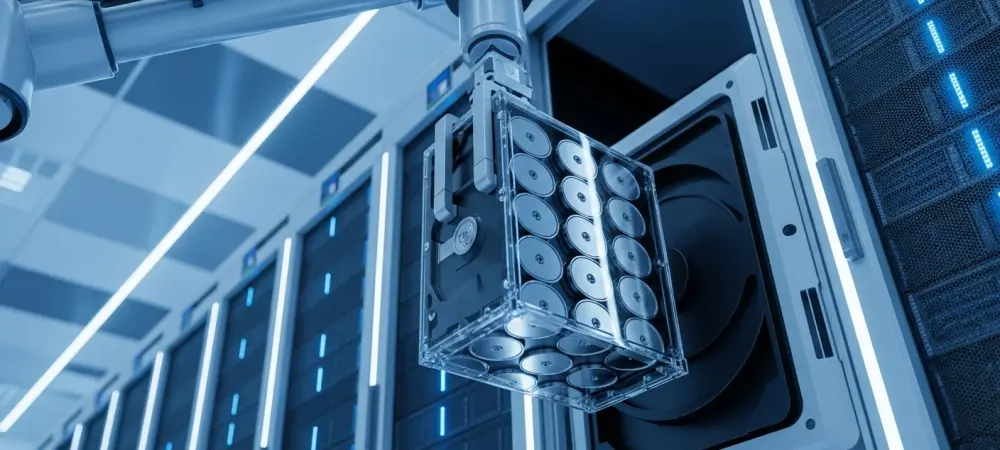
The most direct way to increase a hard drive’s capacity is to fit more storage platters into the same 3.5-inch form factor. Toshiba’s strategy hinges on a significant breakthrough in this arethe successful verification of a 12-platter design, a first for the industry that moves beyond the current 10-platter standard. This feat is made possible by a crucial material shift from traditional aluminum substrates to thinner, yet more durable, glass. Glass substrates allow for finer manufacturing tolerances and a slimmer profile, enabling the addition of two extra platters without compromising stability. Toshiba has even suggested that a 13-platter design could be on the horizon, further pushing the boundaries of physical storage density.
A Tale of Two Technologies: MAMR vs. HAMR Explained
Increasing the number of platters is only half the battle; the other half is boosting the amount of data each platter can hold, known as areal density. To achieve this, Toshiba is pursuing two parallel energy-assisted magnetic recording technologies: MAMR (Microwave-Assisted Magnetic Recording) and HAMR (Heat-Assisted Magnetic Recording). MAMR employs a microwave-generating device to create a precise magnetic field, making it easier to write data to smaller, more stable magnetic bits. HAMR, conversely, uses a tiny laser to momentarily heat a spot on the platter, temporarily reducing its magnetic resistance to allow for data to be written. While both technologies dramatically increase density, the industry widely expects HAMR to offer greater capacity gains in the long term.
Charting the Course: The Roadmap to 55TB
Toshiba’s plan is not just theoretical; it is mapped out with specific milestones. The company intends to leverage its dual-technology approach to phase in these new capacities. The first major step is a 40TB drive utilizing HAMR and 11 platters, projected for release as early as 2026. This will be followed by a separate 40TB drive in 2027, this one based on MAMR with either 11 or 12 platters. Looking further ahead, the roadmap targets a 45TB drive in 2028, culminating in the 55TB model by 2030. Achieving these final milestones will depend on the successful maturation and mass production of both the advanced 12-platter design and the cutting-edge HAMR technology.
What Toshiba’s Roadmap Means for the Future of Data
Toshiba’s public commitment to this roadmap sends a clear signal: the hard disk drive is far from obsolete. In an era often dominated by conversations about solid-state drives (SSDs), this aggressive plan reaffirms the HDD’s critical role as the workhorse for mass data storage in data centers and cloud infrastructure. The dual-track pursuit of both MAMR and HAMR is a savvy strategic move, mitigating the risks associated with developing a single new technology while allowing the company to pivot based on which one proves more reliable and cost-effective at scale. This forward-looking plan will likely spur competitors, accelerating innovation across the entire storage industry and ensuring that the tools to manage our data-rich future are in development today.
A Blueprint for the Future: Actionable Insights for the Industry
The primary takeaway from Toshiba’s strategy is its reliance on a two-pronged attack: mastering the physical dimension by adding more platters and mastering the magnetic dimension with energy-assisted recording. For data center architects and IT procurement managers, this roadmap provides invaluable foresight. It allows for long-term strategic planning, enabling them to anticipate future capacity-per-drive metrics and budget for infrastructure upgrades years in advance. Understanding that 40TB+ drives are on a clear path to market within the next few years helps organizations make more informed decisions about their data growth strategies, ensuring they are prepared for the coming wave of ultra-high-density storage.
Securing the Future of Magnetic Storage
Toshiba’s plan to build a 55TB hard drive is more than just a product announcement; it’s a testament to the enduring power of innovation in a legacy industry. By skillfully combining advancements in material science with next-generation recording physics, the company is laying the groundwork for the future of mass data storage. This ambitious roadmap demonstrates that the HDD will remain the backbone of the digital world for the foreseeable future, providing the massive, affordable capacity needed to store the ever-expanding universe of human and machine-generated information. For a world built on data, this is not just an engineering feat—it is a critical enabler of progress.