

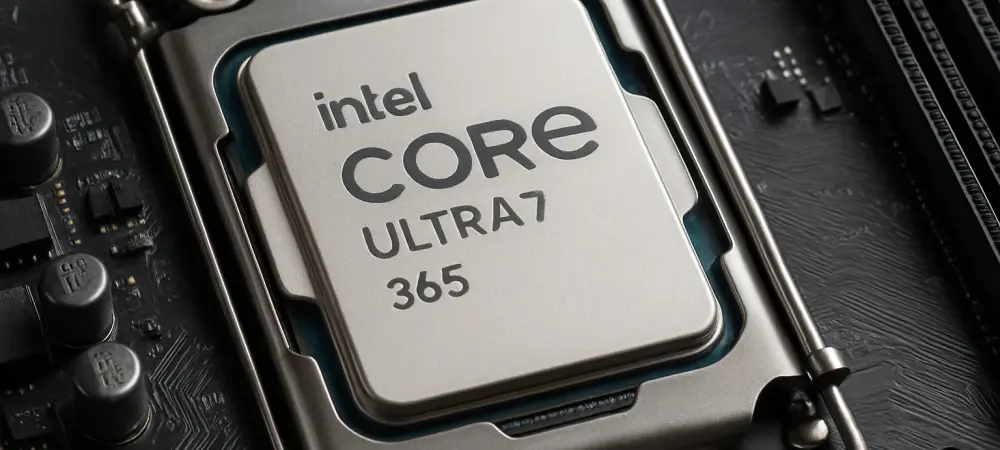
An Early Look at Intel’s Next Gen Efficiency
The relentless march of processor technology often promises straightforward progress, yet occasionally a new generation arrives that challenges our expectations by trading raw computational speed for advancements in other critical areas. This review delves into preliminary benchmark data for the upcoming Intel Core Ultra 7 365, aiming to clarify its position in the competitive landscape of ultra-thin laptops. The central question is whether this Panther Lake chip signifies a meaningful evolution or a surprising step back from its acclaimed Lunar Lake predecessor.
This analysis is designed to help prospective buyers and tech enthusiasts navigate the early, often confusing, pre-release information. By examining the initial performance metrics and architectural details, the goal is to form a coherent picture of the processor’s intended purpose. Understanding its potential strengths and weaknesses is crucial for anyone considering an upgrade to the next generation of portable computing.
Unpacking the Panther Lake Architecture
The Intel Core Ultra 7 365 emerges from the next-generation Panther Lake family, a series of processors engineered specifically for the power and thermal constraints of thin and light notebooks. Architecturally, it maintains a familiar configuration of 4 Performance-cores and 4 Low-Power E-cores, mirroring the structure of the chip it is set to succeed. This hybrid design continues Intel’s strategy of balancing high-octane performance with background efficiency for extended battery life.
However, key specifications revealed in early leaks suggest a notable shift in design philosophy. The Core Ultra 7 365 reportedly features a maximum boost clock approaching 4.7 GHz, a step down from the 5.0 GHz of its predecessor. Furthermore, its reported TDP range of 22W-55W is significantly higher than the previous generation’s 17W-37W envelope. This combination of a lower clock speed and a higher power budget points toward a different tuning target, potentially prioritizing sustained performance or other architectural features over peak single-threaded speed.
Analyzing the Leaked Benchmark Performance
The most concrete evidence of the Core Ultra 7 365’s capabilities comes from an early Geekbench 6.3 result. An engineering sample of the chip achieved a single-core score of 2,451 and a multi-core score of 9,714. When placed side-by-side with the average scores of the preceding Core Ultra 7 268V (Lunar Lake), these figures represent a performance deficit of roughly 6-7%. Such a regression is unusual for a next-generation product and immediately raises questions about Intel’s strategy.
It is crucial, however, to contextualize these numbers. The tested processor was a pre-release engineering sample, which often operates with unoptimized firmware and drivers that can hinder its true potential. Performance is likely to improve as the silicon matures and the software ecosystem is finalized. Moreover, conflicting reports from other testing platforms like PassMark suggest a more competitive performance profile under different workloads, indicating that the full story of the Core Ultra 7 365’s capabilities has yet to be told.
Potential Strengths and Apparent Weaknesses
Based on this initial data, a balanced perspective reveals both promising aspects and clear concerns. A significant potential strength lies in the Panther Lake architecture itself, which is expected to introduce major advancements that are not fully captured by traditional CPU benchmarks. These improvements are anticipated in the integrated graphics (iGPU) and the Neural Processing Unit (NPU), areas increasingly vital for modern AI-driven applications and creative workloads. In contrast, the primary weakness is the observed regression in CPU performance against its direct predecessor in the leaked Geekbench test. This apparent step back, combined with a lower boost clock and a higher thermal design power, creates uncertainty about the chip’s overall efficiency. It remains to be seen how this new balance will translate to real-world user experience, especially within the tight thermal confines of an ultraportable laptop.
The Verdict on This Early Evidence
The Intel Core Ultra 7 365, as seen through the lens of preliminary engineering sample data, presents a confusing and multifaceted picture. It is a component of a promising new architecture that may deliver substantial generational leaps in graphics and AI processing. At the same time, its initial CPU benchmark scores are underwhelming when compared to the processor it is meant to replace.
A definitive verdict must be reserved until final retail units are available for comprehensive testing. Performance could change significantly with finalized hardware and optimized software. At this stage, the processor appears to represent a strategic trade-off, where raw CPU speed may have been de-emphasized to bolster other critical aspects of the platform. This makes it a fascinating, if currently perplexing, entry into the market.
Who Should Keep an Eye on the Core Ultra 7 365
The Core Ultra 7 365 is a processor that technology enthusiasts and prospective buyers of next-generation ultraportables should watch with keen interest. Individuals who prioritize cutting-edge iGPU performance for casual gaming and content creation, or advanced NPU capabilities for emerging AI workflows, may find the final product to be a compelling choice, even if traditional CPU performance is not its main selling point.
Conversely, any user whose primary need is a guaranteed and significant leap in traditional CPU throughput should wait for comprehensive reviews of final retail laptops before making a purchasing decision. Relying on these early and incomplete leaks alone would be premature. The prudent approach is to observe how the Core Ultra 7 365 performs in a complete system, where its architectural trade-offs can be fully and fairly assessed.