

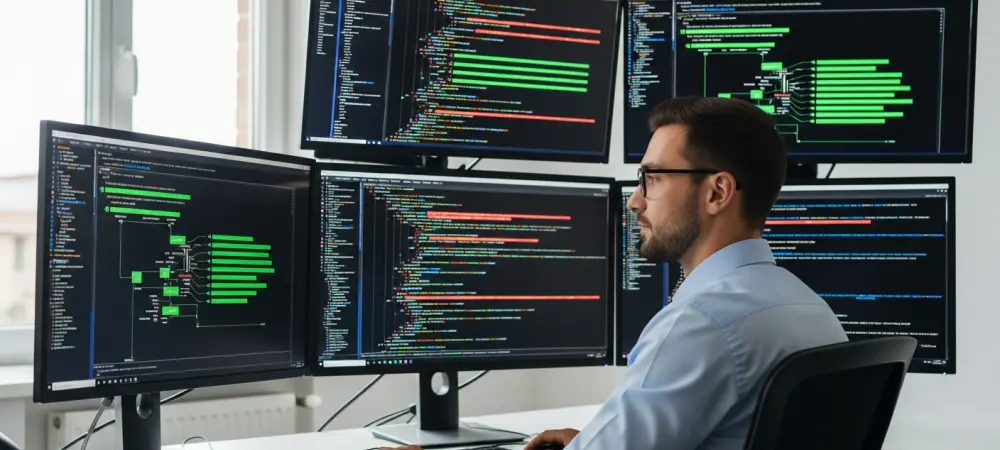
The rapid expansion of AI-assisted software development has created a critical paradox where engineers generate vast quantities of code while security teams remain buried under a mountain of undetected vulnerabilities. This tension has forced a fundamental shift in the cybersecurity landscape, moving away from massive, resource-heavy artificial intelligence toward highly specialized security investigators. Cisco has recently responded to this challenge with the launch of the Antares model family, a strategic pivot designed to address the unique complexities of modern DevSecOps. Unlike general-purpose large language models that attempt to perform every task from poetry to python scripting, Antares focuses exclusively on identifying and mapping software flaws. By prioritizing niche security tasks, these models bridge the widening gap between the sheer speed of AI-driven coding and the necessity for rigorous, cost-effective security oversight within high-velocity development pipelines.
Security Architecture and Diagnostic Logic
Transitioning from massive, multi-billion parameter models to these specialized small-scale alternatives marks a significant evolution in how the industry perceives artificial intelligence efficiency. Large language models often struggle with high latency and significant computational overhead, which makes them less ideal for frequent, iterative security tasks. In contrast, the Antares models are purpose-built to operate as focused investigators, trained on curated datasets that emphasize vulnerability patterns and architectural weaknesses rather than general conversational data. This specialization allows the 1B and 3B models to achieve high accuracy in detecting logic errors and buffer overflows that larger models might overlook due to their broad training scope. By prioritizing depth over breadth, Cisco provides a toolset that is not only faster but also more precise in the context of forensic code analysis, establishing a new paradigm for security-first AI tools.
Tiered Model Strategy: Part 1. Open Weight Accessibility
The Antares family is structured into distinct tiers, each optimized for different operational scales and accessibility needs, ranging from lightweight open-access models to robust proprietary versions. The 350M and 1B parameter versions are offered as open-weight models, allowing the global research community to integrate sophisticated detection logic into local workflows without prohibitive licensing hurdles. This transparency encourages collaboration among security researchers who can fine-tune the models for specific niche vulnerabilities or programming languages. By providing these smaller models to the public, Cisco fosters an environment where independent developers can contribute to the overall safety of the software supply chain. This approach ensures that even smaller entities, which may lack the resources for massive cloud subscriptions, still have access to advanced diagnostic capabilities that can significantly reduce their exposure to common cyber threats.
Tiered Model Strategy: Part 2. Enterprise Proprietary Systems
While the open-weight models serve the broader community, the more powerful 3B parameter version is reserved as a proprietary tool for corporate clients, offering enhanced performance and deeper integration with private enterprise ecosystems. This specific model is designed to handle the heavy lifting required by large-scale organizations that manage millions of lines of proprietary code across diverse environments. The 3B variant incorporates more advanced reasoning capabilities, allowing it to understand the subtle nuances of complex business logic that smaller models might miss. This tiered strategy ensures that large-scale organizations have access to advanced forensic tools that match their specific budgetary constraints and technical requirements. Furthermore, these proprietary versions are regularly updated with the latest threat intelligence, providing enterprise users with a cutting-edge defense mechanism that evolves alongside the sophisticated tactics used by modern adversaries.
Forensic Logic: Part 1. Automated Repository Navigation
Modern software ecosystems are incredibly complex, often consisting of thousands of interconnected files where a single oversight in a library can lead to a systemic failure across the entire application. Antares moves beyond the capabilities of a standard AI assistant by acting as a forensic expert that autonomously navigates these complex repositories to trace potential threats back to their source. When a security operations center identifies a suspicious pattern, the model explores the codebase to find high-risk files and architectural dependencies that match the known threat profile. This capability is vital for managing large, legacy codebases where manual reviews would be impossible within a reasonable timeframe. By mapping the relationships between different modules and identifying how data flows through vulnerable entry points, the system provides a comprehensive view of the attack surface that traditional static analysis tools often fail to capture.
Forensic Logic: Part 2. Evidence Trails and Verification
One of the most significant hurdles in adopting automated security tools is the lack of explainability, which often leaves developers questioning why a specific piece of code was flagged as a risk. Antares addresses this by providing a logical evidence trail for every finding, ensuring that security teams can verify the results without having to manually sift through thousands of lines of code. Instead of simply issuing a generic warning, the model explains the sequence of operations that could lead to an exploit, highlighting the specific variables and functions involved in the potential breach. This transparent approach fosters greater trust between developers and security tools, as it transforms the mitigation process from a guessing game into a targeted surgical operation. By delivering actionable insights alongside technical evidence, the models empower human experts to make faster, more informed decisions, thereby reducing the time spent on triage.
Economic Efficiency and Performance Benchmarks
The financial burden of running comprehensive security scans has traditionally limited the frequency of audits, often relegating deep analysis to the end of the development cycle rather than every update. Antares disrupts this dynamic by significantly slashing the operational costs associated with high-quality AI analysis, making continuous scanning a viable reality for organizations of all sizes. While traditional large-scale models can incur costs exceeding a hundred dollars for a single thorough scan of an expansive repository, Antares achieves comparable or superior results for less than one dollar. This extreme efficiency allows firms to reallocate their security budgets toward proactive defense strategies rather than just maintenance. By lowering the financial barrier to entry, even small startups and independent open-source projects can now implement the same level of rigorous security oversight that was previously reserved for the most well-funded tech giants.
Economic Viability: Part 1. Slashing Operational Overheads
This dramatic reduction in cost facilitates the adoption of a true DevSecOps culture, where security is no longer a separate phase but a fundamental part of the daily heartbeat of software production. When the price of a scan is negligible, development teams are encouraged to run full security audits with every minor code commit or feature update, ensuring that flaws are caught early in the lifecycle. This “shift-left” approach prevents the accumulation of technical and security debt, which can become exponentially more expensive to fix if discovered late in the production process. The economic viability provided by these specialized models transforms security from a luxury or a bottleneck into a standard utility that supports rapid innovation. Consequently, organizations can maintain a high velocity of deployment without sacrificing the integrity of their software, as the financial risks associated with constant oversight have been effectively neutralized.
Future Trajectory: Part 1. Sovereignty and System Resilience
From 2026 to 2028, the industry moved decisively toward these specialized architectures as the limitations of massive, general-purpose models became increasingly apparent in high-stakes environments. Organizations that integrated Antares into their workflows successfully reduced their time-to-remediation while significantly lowering the overall cost of their security operations. Technical leaders prioritized the deployment of these models within their private clouds to protect intellectual property while maintaining high-speed scanning capabilities. This transition ensured that the speed of software innovation did not outpace the ability to secure it, fostering a more resilient digital landscape where automated oversight kept pace with the volume of modern code production. To capitalize on this shift, businesses expanded their internal security protocols to include real-time forensic filtering, which effectively eliminated the noise of false positives and allowed investigators to focus on high-impact risks.