

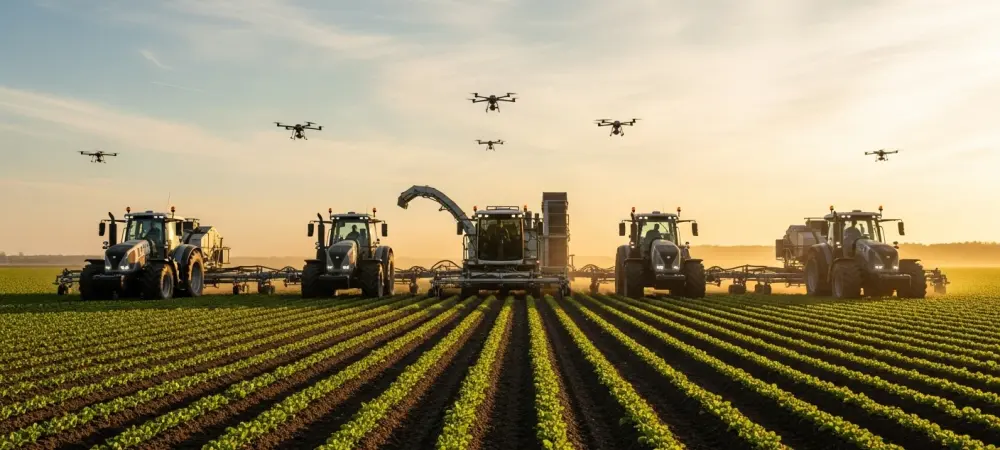
The global agricultural sector is undergoing a systemic transformation, driven by the deep integration of Artificial Intelligence and advanced agricultural technology, ushering in an era where technology is the fundamental bedrock of food security. This paradigm shift is rapidly converting farming from a traditional, labor-intensive business into a sophisticated, data-driven enterprise where success is measured by the creation of resilient supply chains and the delivery of verifiable sustainability. As climate volatility intensifies and consumer demand for transparency grows, this intelligent harvest is no longer a futuristic concept but a present-day imperative, redefining the very essence of how the world feeds itself. The convergence of intelligent systems and farming practices is systematically engineering a more secure, equitable, and transparent food future for a global population that depends on its success. This evolution is not merely about increasing yields; it is about building an entirely new agricultural framework built on precision, proactivity, and profound insight.
The Rise of the Autonomous Smart Farm
Modern farms are rapidly evolving into fully realized, autonomous, and interconnected ecosystems, where technology forms the central nervous system of all operations. Fields are now embedded with vast networks of millions of optical, acoustic, and electromagnetic sensors, functioning as a cohesive “nervous system” for the land. This dense sensor grid generates a continuous, real-time “Health Map” of both soil and crops, providing an unprecedented level of granular detail. It monitors critical variables such as microbial diversity, nutrient composition, and moisture levels on a meter-by-meter basis, enabling a form of hyper-precise resource management that was once unimaginable. By understanding the exact needs of every small section of a field, farmers can allocate water, fertilizer, and other inputs with unparalleled accuracy, maximizing efficiency while minimizing waste and environmental impact. This intricate web of data transforms every acre into a quantifiable, responsive entity within a self-regulating agricultural ecosystem.
This ground-level intelligence is complemented by a multi-layered aerial view that provides a comprehensive perspective on farm health and environmental conditions. High-resolution satellite imagery delivers macro-level “Atmospheric Intelligence,” allowing for the analysis of large-scale crop stress, weather patterns, and regional environmental shifts. This broad perspective is then augmented by swarms of AI-powered drones that perform micro-level “pest and nutrient scouting,” capable of identifying potential issues down to the individual plant. The synergy between these two layers of intelligence is transformative, enabling preemptive interventions long before a problem becomes visible to the human eye. For instance, a satellite might detect a subtle change in chlorophyll levels across a 100-acre field, prompting a drone to investigate and pinpoint an emerging fungal infection in a specific corner. This capability allows farmers to address threats with targeted treatments, preventing widespread crop loss and fundamentally changing the dynamics of farm management.
The adoption of autonomous machinery has reached a critical turning point, with fleets of driverless tractors, robotic harvesters, and specialized drones operating with high levels of agency. Guided by sophisticated AI and the data flowing from sensor networks, these machines navigate complex and uneven terrain to execute tasks with surgical precision. They perform “Variable-Rate” applications, delivering specific amounts of fertilizer or water exactly where needed, a stark contrast to traditional uniform spraying. One of the most significant breakthroughs is in weed management. Specialized robots use high-precision lasers to identify and eliminate individual weeds without disturbing the surrounding crops or soil. This technology has enabled a reduction in chemical herbicide use by as much as 90% in some applications, marking a monumental leap forward in sustainable agricultural practices and reducing the chemical load on the environment.
AI as the Farmer’s Indispensable Partner
Artificial Intelligence has evolved far beyond basic data analysis to become an active and indispensable decision-making partner for the modern farmer. A transformative development is the emergence of generative AI “Farm Agents,” which have replaced complex data dashboards with intuitive, conversational interfaces. Farmers can now engage in a natural dialogue with their farm management system, which not only provides recommendations but also explains the complex reasoning behind them. For example, an AI might advise, “Based on the 70% probability of a late frost and your current soil nitrogen levels, I suggest delaying the corn planting by four days to optimize for a 12% higher yield.” This “Socratic” method empowers farmers with deep, data-backed insights, allowing them to understand the ‘why’ behind each decision rather than simply following an algorithm. This collaborative relationship between human and machine elevates farm management to a new level of strategic precision and understanding.
This proactive approach extends powerfully to pest and disease management, where AI models have shifted the entire agricultural business model from reactive to proactive. By analyzing vast and diverse datasets—including regional weather anomalies, historical pest migration patterns, and real-time sensor data from the field—these systems can predict disease outbreaks and pest infestations weeks in advance. This predictive capability allows farmers to move from a “Crisis Response” footing, where they scramble to contain an outbreak that has already taken hold, to one of “Proactive Prevention.” Armed with advance warning, they can deploy targeted, preventative measures precisely when and where they will be most effective. This not only saves immense resources that would otherwise be spent on broad-spectrum pesticides but also secures yields that might have been lost, enhancing both profitability and food security. The focus is no longer on fighting fires but on preventing them from starting in the first place.
Beyond the scope of day-to-day operations, AI is also dramatically accelerating the pace of biological innovation. Researchers are now using advanced AI algorithms to run billions of virtual “Environmental Stress Tests” on digital crop models. This process allows them to efficiently identify the specific genetic traits that confer resistance to a wide range of challenges, including drought, floods, and newly emerging pathogens. Instead of years of slow, painstaking trial and error in physical fields, scientists can simulate decades of environmental pressures in a matter of days. This computational approach significantly shortens the “Seed-to-Market” timeline for developing new, climate-resilient crop varieties. As a result, the agricultural sector can adapt more quickly to a changing global climate, ensuring that our food supply remains robust and secure in the face of unprecedented environmental challenges.
Reshaping Agribusiness and Consumer Trust
The technological revolution has necessitated a parallel revolution in business operations and marketing strategies, which are now centered on the principles of data, transparency, and resilience. The focus of AgTech marketing has shifted decisively from selling machinery to selling trust. Consumers now demand “Radical Transparency,” and marketers are leveraging AI-driven blockchain platforms to provide a “Digital Passport” for every single food item. By scanning a QR code with a smartphone, a consumer can instantly access the product’s entire journey, from farm to shelf. This digital record can include detailed information on its carbon footprint, the amount of water used in its cultivation, its exact harvest date, and its complete transportation route. This “Trust and Traceability” has become a primary marketing asset, allowing brands to build a direct and verifiable connection with their customers and command a premium for proven sustainability.
This data-driven approach has also redefined the internal structure and financial stability of agricultural businesses. AI provides “Revenue-Grade Precision” in yield forecasting and real-time crop health monitoring. This verifiable, high-quality data allows farmers to secure better credit terms from financial institutions and access innovative “Parametric Insurance” products. Unlike traditional insurance, which requires a lengthy and often bureaucratic claims process after a loss occurs, these policies automatically trigger payouts based on verified data points, such as a specific number of days without rain or a measured drop in soil moisture below a critical threshold. This system eliminates delays, providing farmers with immediate capital when they need it most and enhancing the overall financial resilience of their operations against unpredictable climate events.
Furthermore, technology has unlocked entirely new business models and revenue streams that integrate agriculture more deeply into the broader economy. Urban Vertical Farming, powered by AI-controlled environments, has achieved yields 300% higher per square meter than conventional farming, allowing for the large-scale production of fresh produce within city centers. This model drastically reduces “Food Miles,” strengthens local food security, and supports a “Circular Economy” where urban organic waste can be repurposed as fertilizer. Concurrently, agriculture has transitioned into a major “Carbon Sink.” AI analytics can now precisely quantify the amount of carbon sequestered in soil through regenerative farming practices. This allows farmers to verify their environmental contributions and sell these as carbon credits on international markets, effectively turning sustainability into a profitable and scalable revenue stream.
Overcoming Hurdles in the Digital Revolution
Despite the immense progress, this digital agrarian revolution faced significant hurdles that required strategic investment and professional attention. A critical tipping point for widespread adoption was contingent on ubiquitous and reliable internet access. Many rural areas still lacked the necessary broadband infrastructure to support data-intensive operations, creating a digital divide. This challenge spurred a business mandate for developing “Offline-Capable” AI systems that could process data locally and function effectively in low-connectivity environments. Furthermore, a substantial “Technical Skills Gap” emerged, necessitating the creation of new training programs to equip the agricultural workforce with the data literacy and technical expertise required to manage these advanced systems. These initiatives were crucial for ensuring that the benefits of the technological revolution were accessible to all farmers, not just a select few.
Amid the rise of automation, it was stressed that the “Human Element” remained indispensable to the future of agriculture. The ultimate goal was not to replace farmers but to achieve “Human-Centered Automation,” a model where technology handles the repetitive, data-intensive, and physically demanding tasks, thereby freeing up human professionals to focus on strategic planning, ethical considerations, and complex problem-solving. Human judgment and experience served as the final arbiter in the system, ensuring that technology was deployed in service of long-term human and ecological goals. This vision positioned farmers as technologists and strategic managers, leveraging powerful tools to cultivate a more resilient, transparent, and secure food future for the global population. The fusion of technology and human insight had elevated agriculture into one of the world’s most critical high-tech industries.