

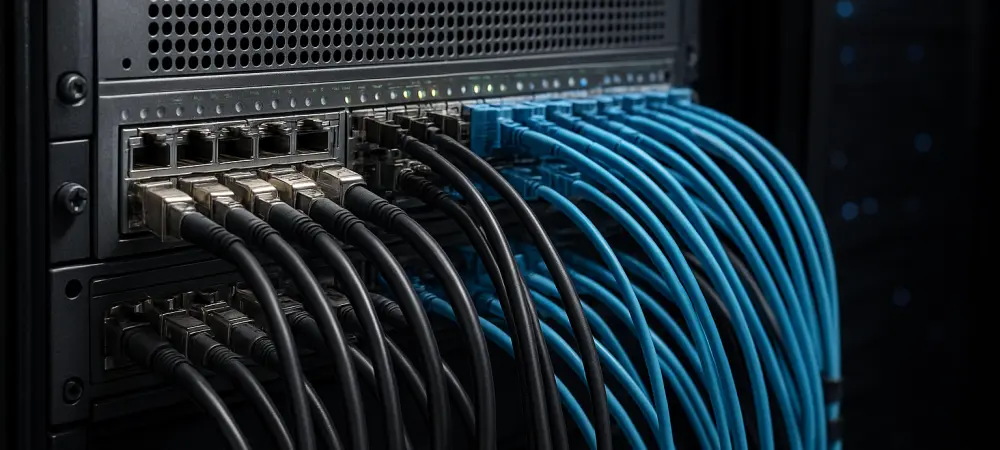
The sheer velocity of data throughput required by modern clusters has rendered traditional cabling nearly obsolete, forcing an entire industry to reconsider the fundamental laws of thermodynamics and signal propagation within the data center. As the transition to 1.6 Terabit Ethernet (1.6TbE) accelerates, it is becoming clear that this is much more than a standard incremental speed upgrade. Previous generations of networking technology allowed for a “drop-in” replacement model—where faster switches could be installed into existing racks with minimal structural changes—but the 1.6TbE era shatters this paradigm. This transition is being driven by the relentless demands of large-scale artificial intelligence and machine learning workloads, which require massive bandwidth, ultra-low latency, and unprecedented power density.
This architectural inflection point serves as a fundamental reset for the modern data center. While organizations once viewed networking as a separate silo from facilities and power management, the 1.6TbE era requires these domains to be inextricably linked. As enterprises prepare for the widespread ratification of the latest IEEE standards, they must confront a reality where physical topology, power delivery, and thermal management are no longer independent variables. The move to 1.6TbE is not just a faster way to move bits; it is the blueprint for the next generation of global computing infrastructure, requiring a full-stack renovation that begins at the silicon level and extends to the very structure of the building.
Shattering the Paradigm of Incremental Networking Upgrades
The shift toward 1.6TbE marks the end of an era where network engineers could rely on simple, predictable hardware refreshes to meet growing data demands. In the past, moving from 100GbE to 400GbE involved manageable changes in power consumption and cabling requirements, allowing for a gradual evolution of the data center floor. However, the move to 1.6TbE is a disruptive event because it pushes the physical properties of existing infrastructure beyond their breaking points. The complexity of managing eight lanes of 200Gbps traffic creates a technical hurdle that cannot be overcome by simply improving existing manufacturing processes; it requires a complete rethink of how data is transmitted.
This departure from incremental upgrades is forced by the fact that traditional signaling methods and copper-based interconnects are losing their viability at these extreme speeds. When a single network interface is pushing 1.6 trillion bits per second, every millimeter of trace on a circuit board and every inch of cable becomes a potential point of failure due to electromagnetic interference and signal attenuation. Consequently, the transition is forcing a “clean sheet” design approach. Data center operators are finding that their existing rack layouts and cable management systems are fundamentally incompatible with the precision required for 1.6TbE, leading to a broader overhaul of the entire facility’s logical and physical structure.
The AI Inflection Point: Why 800GbE Is No Longer Sufficient
While 800GbE provided a temporary reprieve for growing data demands, the explosive rise of generative artificial intelligence has quickly exhausted its capacity. Modern AI training environments rely on massive “east-west” traffic, where thousands of graphics processing units must constantly synchronize their states during complex gradient calculations. In these high-performance clusters, the network is often the primary bottleneck, and any delay in data transmission—known as tail latency—can cause expensive compute resources to sit idle. This idle time translates directly into millions of dollars in wasted capital expenditure and delayed model deployment, making the move to 1.6TbE a financial necessity for AI-driven organizations.
The current scaling laws for large language models suggest that the demand for bandwidth is growing at a rate that far outpaces the improvements in 800GbE efficiency. As clusters grow from hundreds to tens of thousands of nodes, the sheer volume of data moving between them creates congestion that standard networking protocols struggle to manage. 1.6TbE provides the necessary headroom to handle these massive bursts of traffic without dropping packets, ensuring that the entire compute fabric remains fully utilized. Moreover, the transition to 1.6TbE allows for higher radix switches, which simplifies the network topology by reducing the number of hops required for data to traverse the cluster, further lowering the total latency of the system.
Mastering High-Speed Signaling with Co-Packaged Optics
At the heart of the 1.6TbE transition is a significant challenge in physics that centers on the move to 200Gbps-per-lane signaling. As signaling speeds increase, the distance that data can travel over traditional electrical interfaces shrinks dramatically, and the amount of signal degradation—referred to as the optical loss budget—becomes incredibly tight. Traditional pluggable transceivers, which have been the mainstay of networking for decades, are struggling to manage the heat generated by the electrical-to-optical conversion process. This concentration of thermal energy at the front panel of the switch makes it nearly impossible to maintain the necessary signal integrity for 1.6Tbps throughput. To address this, the industry is pivoting toward Co-Packaged Optics, a technology that integrates the optical engines directly onto the package substrate with the switch silicon. By moving the optical interface closer to the source of the data, manufacturers can drastically reduce power dissipation and improve signal quality, as the electrical signals no longer have to travel across long, noisy PCB traces. This shift fundamentally alters the serviceability of networking hardware, as the modularity of pluggable components is sacrificed for the extreme efficiency of integrated optics. While this presents a challenge for traditional maintenance models, it is becoming a mandatory design choice to ensure that 1.6TbE systems can operate within reasonable thermal and power envelopes.
The Collapse of Air Cooling and the Move to Liquid-Cooled Facilities
Perhaps the most visible impact of the 1.6TbE transition is the total collapse of air-cooling efficacy in high-performance computing clusters. Current AI training environments are pushing rack power densities beyond 80kW, a figure that is nearly ten times higher than the design capacity of most legacy data centers. At these levels, air is no longer a viable medium for heat transfer; it simply cannot move fast enough or carry enough thermal energy to keep high-speed networking silicon and GPU accelerators from throttling or failing. This makes the move to liquid cooling an absolute requirement for any facility hosting 1.6TbE-enabled infrastructure.
Transitioning to liquid cooling involves a massive overhaul of the facility’s physical infrastructure, requiring the installation of coolant distribution units, manifolds, and specialized plumbing systems. This shift does not just affect the compute racks; the 1.6TbE switches themselves, especially those utilizing Co-Packaged Optics, require liquid cooling to manage their own concentrated thermal loads. This creates a cascading effect where the entire networking row must be replumbed to match the requirements of the compute row. The move from fans to fluid-based cooling represents a permanent change in how data centers are constructed, prioritizing thermal efficiency and density over the traditional raised-floor, air-cooled designs of the past decade.
Relocating the Switch: The Shift Toward Distributed In-Rack Topology
The limitations of cable reach and signal integrity at 1.6TbE are forcing a departure from the traditional three-tier network hierarchy and even the standard leaf-spine architecture. When high-speed signaling is restricted to just a few meters to maintain 1.6Tbps speeds, switches can no longer sit at the end of a long row of racks in a centralized location. Instead, the networking hardware must move physically closer to the compute nodes it serves, leading to the emergence of distributed switching models. In this new configuration, switches are positioned directly within the compute cabinet or in an immediately adjacent networking pod to minimize the distance data must travel.
This proximity is essential for managing the massive amount of data moving between nodes during AI training. By relocating the switch into the rack, operators can use short-reach copper cables or active electrical cables, which are more cost-effective and energy-efficient than long-range optical links. However, this change requires a significant redesign of the rack layout, as space must be allocated for both high-density compute and high-capacity networking in a single enclosure. This shift toward a distributed topology also complicates the management of the network fabric, as it increases the number of physical switch locations that must be monitored and maintained across the data center floor.
Surviving the Energy Gap with Enhanced Power Delivery and Efficiency
The 1.6TbE transition is occurring against a backdrop of severe global power constraints, where the demand for electricity is quickly outpacing the ability of utility grids to provide it. Modern 1.6TbE networking components add significant power overhead on top of already power-hungry GPU clusters, creating a structural gap that threatens to stall data center expansion. Because utility companies cannot bring new grid-connected power online fast enough, some operators are looking for radical solutions to stay operational. Efficiency gains provided by 1.6TbE and co-packaged optics are therefore no longer just about performance; they are essential survival mechanisms for staying within strict power envelopes.
To combat this energy gap, data center architects are exploring off-grid power solutions and advanced power delivery systems. By 2030, a significant portion of the industry may be forced to rely on on-site generation, such as fuel cells or small modular reactors, to meet the needs of 1.6TbE-enabled clusters. Within the rack, the shift from 12-volt to 48-volt power delivery is becoming standard to reduce resistive losses and handle the massive current required by the latest switches and processors. These improvements in power delivery, combined with the inherent efficiency of 1.6TbE fabrics, allow operators to pack more compute power into their existing footprint, maximizing the utility of every watt of electricity available to the facility.
Industry Projections: Ethernet’s Rise and the 1.6TbE Adoption Timeline
For many years, InfiniBand was the preferred interconnect for high-performance computing due to its low latency and lossless nature, but the maturation of 1.6TbE is positioning Ethernet as a formidable competitor in the AI space. The development of protocols like RDMA over Converged Ethernet (RoCE) has allowed Ethernet to close the performance gap, providing the low-latency communication required for distributed training. As 1.6TbE enters volume production, many organizations are shifting toward Ethernet-based fabrics because of their broader ecosystem, better interoperability, and the massive scale that traditional Ethernet architectures can support.
The timeline for this transition is incredibly compressed, reflecting the urgent need for higher bandwidth in the AI market. Major silicon vendors are expected to move from initial sampling of 1.6TbE chips in late 2026 to volume production and deployment by 2027. Despite the complexity of the hardware, surveys indicate that more than a third of organizations are planning large-scale deployments within the next year. This rapid adoption is being led by hyperscalers and specialized AI providers who are building entirely new facilities designed from the ground up to support the high-density, liquid-cooled, and high-bandwidth requirements of the 1.6TbE era.
Strategic Recommendations for Navigating the Full-Stack Architectural Reset
To successfully navigate this transition, stakeholders must move beyond purchasing individual hardware components and start investing in integrated systems. For vendors, the path forward involves providing clear roadmaps for co-packaged optics and validated reference architectures that account for the unique thermal and electrical challenges of 1.6TbE. Customers need to know exactly how these high-speed switches will fit into liquid-cooled environments and what the specific limitations of their cabling will be. Integrating thermal management tools with network design software is no longer a luxury but a necessity for ensuring that these systems can be deployed reliably at scale. For data center operators, the first priority was the auditing of current facility infrastructure for what is known as power and cooling debt. If a facility cannot support the weight of liquid-cooled racks or lacks the electrical capacity for 80kW densities, it is not ready for the 1.6TbE era. Successful implementation required a full-stack approach where networking, compute, and facilities teams worked together to co-optimize the architecture from the outset. Organizations that fostered this cross-functional collaboration were the only ones able to avoid costly retrofits and ensure that their infrastructure remained competitive as the demands of artificial intelligence continued to reshape the global technological landscape.
The shift to 1.6TbE served as the catalyst for a total transformation of the modern data center. It exposed the limitations of decades-old design philosophies and forced a direct confrontation with the harsh realities of physics and energy constraints. By integrating co-packaged optics, adopting liquid cooling, and embracing distributed network topologies, the industry successfully built a new foundation for the era of pervasive artificial intelligence. Moving forward, the most effective strategies involved a proactive move toward 48-volt power delivery and the early adoption of liquid-to-chip cooling systems. These actions ensured that facilities could handle the extreme densities required for 1.6TbE while maintaining the operational stability needed for global compute workloads. Ultimately, the transition proved that networking is no longer just a support function but the central nervous system of a unified, high-performance computing entity.