

Embracing a New Era of Reliable Autonomy in Enterprise Intelligence
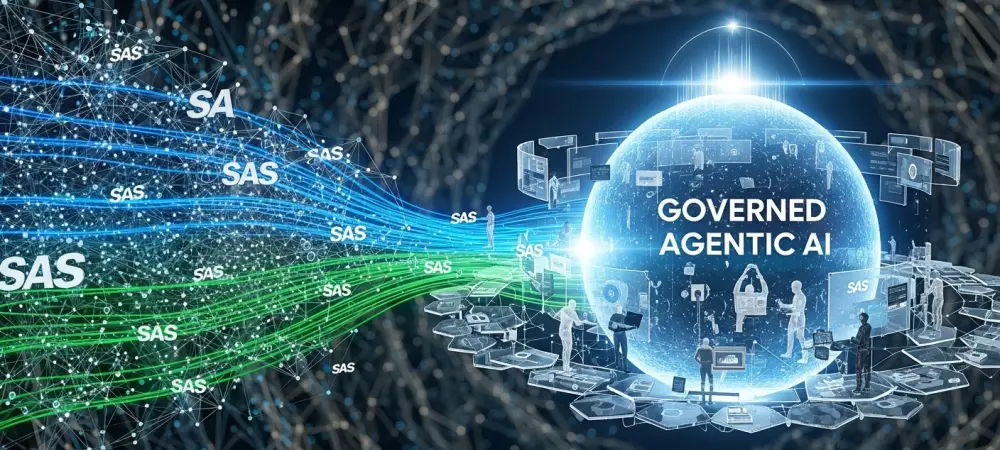
The rapid transformation of artificial intelligence from a passive advisory tool into an autonomous agentic force has caught many global enterprises unprepared for the resulting operational risks. As artificial intelligence transitions from a novelty to a core operational necessity, the focus of global enterprises is shifting from simple automation to the complex world of agentic systems. SAS, a long-standing leader in analytics, is redefining this landscape by integrating rigorous governance with “agentic AI”—autonomous systems capable of executing multi-step workflows and making real-time decisions. This analysis explores how SAS is moving beyond informative AI to create a framework where agents can act independently while remaining firmly under human oversight. By examining the convergence of trust and technology, the industry can uncover how SAS aims to bridge the gap between high-level technical capabilities and the organizational need for accountability.
The significance of this evolution lies in the capacity for AI to move from observation to execution. In the current market, the mere ability to generate text or summarize data is no longer a sufficient competitive differentiator. Instead, the value has shifted toward the reliability of the actions these models perform. SAS is positioning its platform not just as a computational engine, but as a regulatory and ethical filter that ensures every automated step aligns with corporate and legal standards. This focus on “governed agency” provides a stabilizing force for industries that are otherwise hesitant to deploy autonomous systems due to the potential for unmonitored errors or security breaches.
The Evolution of Analytics: From Passive Insights to Active Agency
Understanding the current trajectory of AI requires a look back at how data has traditionally served the enterprise. For decades, the industry operated on “informative AI,” where models were designed to summarize historical data, predict trends, and provide insights that humans would then manually act upon. This era laid the foundational concepts of data integrity and statistical modeling that SAS helped pioneer. However, the emergence of Large Language Models and decentralized data environments has catalyzed a shift toward agentic systems. These modern agents do not just report; they perform tasks, navigate fragmented databases, and trigger external tools without requiring a human to click every button.
This historical shift has created a significant “tech asymmetry” within the global market. While the technical capacity for AI to act has exploded, the frameworks to manage these actions have frequently lagged behind. SAS recognizes that the risks associated with unmonitored agents—such as data leakage, biased decision-making, and regulatory non-compliance—could outweigh their benefits if left unchecked. Consequently, the strategic pivot observed in the industry is rooted in the belief that the future of AI belongs to those who can govern it. By transforming the “wild west” of autonomous agents into a structured, visible, and highly reliable corporate asset, the market is moving toward a model where innovation is inseparable from oversight.
Navigating the Shift Toward Human-Governed Agentic Frameworks
Empowering Users Through the SAS Viya Copilot Family
A critical component of this strategy is the SAS Viya Copilot, which redefines how humans interact with complex analytical lifecycles. Rather than acting as a simple chatbot, the Copilot serves as a deeply integrated expert assistant that facilitates code generation, workflow navigation, and conversational analytics. By producing explainable, documented code, it ensures that even as the AI handles the “heavy lifting” of data processing, the human developer understands the logic behind every action. This transparency is vital for maintaining auditability in high-stakes environments where “black box” logic is unacceptable.
Furthermore, the technology is tailored for industry-specific applications, such as financial risk management and clinical research. These specialized copilots demonstrate that agentic AI is most effective when it is grounded in the specific terminology and regulatory requirements of a particular sector. For instance, in clinical data discovery, the agent must adhere to strict privacy protocols while navigating massive datasets. By ensuring that “human-in-the-loop” remains a functional reality rather than a mere slogan, SAS allows organizations to scale their operations without losing the critical touch of human judgment.
Standardizing Interactions via the Model Context Protocol
As enterprises adopt a variety of AI models—ranging from proprietary internal systems to external platforms like GPT or Claude—interoperability becomes a major hurdle. SAS addresses this complexity through the Model Context Protocol (MCP) server. This infrastructure acts as a universal translator, standardizing how external agents interact with sensitive internal data and models. By implementing a unified protocol, the system prevents the creation of “siloed” agents that operate outside the company’s security perimeter. This approach not only streamlines integration but also ensures that every agent, regardless of its origin, adheres to the same rigorous governance controls.
This move toward standardization is a vital step in democratizing AI, allowing business analysts and high-code developers alike to deploy agents within a secure, governed environment. In the past, connecting disparate AI tools required custom, fragile integrations that often bypassed security layers. The MCP server changes this dynamic by providing a formal gateway. This ensures that when an external model requests data or attempts to trigger a workflow, it does so within the bounds of established permissions, maintaining the integrity of the corporate data ecosystem while still benefiting from the latest advancements in external model capabilities.
Centralized Oversight with the SAS AI Navigator
Looking toward the long-term management of AI ecosystems, the SAS AI Navigator represents the pinnacle of the current governance vision. Functioning as a comprehensive SaaS platform, the Navigator serves as a centralized command center for an organization’s entire AI inventory. It addresses the overlooked complexities of risk management by allowing leaders to balance the trade-offs between cost, efficiency, and reputational risk. It provides an end-to-end view of every model in use, mapping AI usage against internal ethical policies and evolving global regulations.
By clearing the fog of uncertainty that often leads to organizational rigidity, the Navigator provides a clear roadmap for scaling agentic AI without sacrificing digital sovereignty or public trust. This platform makes responsible AI “irresistible” for businesses by turning governance from a manual checklist into an automated, insightful dashboard. It allows executives to see exactly where their AI budget is being spent and which models are providing the best return on investment, all while ensuring that no agent is operating in a way that could expose the firm to legal or ethical liabilities.
Emerging Trends and the Future of Autonomous Governance
The future of governed agentic AI is being shaped by several emerging trends that prioritize data locality and integrity. One of the most significant shifts is the move toward “in-place” analytics, where AI processing is brought directly to the data source rather than requiring massive migrations to the cloud. Technologies like SpeedyStore are facilitating this by preserving digital sovereignty, allowing firms to maintain control over their data while leveraging high-speed processing. This trend is particularly relevant for global organizations that must navigate differing data protection laws across various jurisdictions.
Additionally, we are seeing a trend toward “governance by design,” where transparency and lineage are baked into the data from the moment of ingestion. As global regulations become more stringent, the ability to provide a clear audit trail for every autonomous decision will likely become a non-negotiable requirement for any enterprise operating at scale. This involves not just tracking what the AI did, but also why it did it, which data it used, and which policy it followed. The convergence of high-speed storage and governance-first modeling is creating a more resilient foundation for the next generation of autonomous business processes.
Strategic Recommendations for an AI-Driven Future
For organizations looking to thrive in this new landscape, the findings from this strategic pivot offer several actionable insights. First, companies must view trust and governance as a competitive advantage rather than a hurdle; a transparent system is inherently more scalable than an opaque one. Second, it is essential to prioritize interoperability by adopting standard protocols like the MCP to avoid vendor lock-in and security gaps. Third, businesses should focus on “grounding” their AI agents in high-quality, trusted data environments to prevent hallucinations and ensure the accuracy of autonomous decisions.
Applying these principles ensures that as agents become more autonomous, they remain aligned with corporate values and regulatory mandates. Leaders should begin by auditing their current AI “inventory” and identifying areas where human oversight can be enhanced by specialized copilots. Furthermore, investing in platforms that provide a centralized view of AI activities will be critical for maintaining control as the number of active agents within the enterprise grows. The goal is to move from a state of reactive monitoring to proactive governance, where every AI action is intentional and accounted for.
Conclusion: Setting the Standard for Trustworthy Agency
SAS fundamentally reshaped the future of governed agentic AI by proving that innovation and oversight were not mutually exclusive. By providing the tools to manage, standardize, and navigate the active role of AI, the company offered a stabilizing force in a volatile market. The significance of this topic lay in the realization that the power of an AI model was only as valuable as the framework that controlled it. As the industry progressed, the focus remained on creating a sustainable ecosystem where agents acted with confidence and humans led with clarity. This shift moved the market away from purely experimental AI toward a mature environment characterized by digital sovereignty and ethical accountability.
The transition from passive insights to active, governed agency established a new benchmark for corporate intelligence. Organizations that adopted these structured frameworks found themselves better equipped to handle the complexities of decentralized data and multi-model environments. Ultimately, the vision transformed the challenge of governance into a distinct business advantage, ensuring that the next generation of AI was as responsible as it was revolutionary. Moving forward, the most successful enterprises will be those that continue to prioritize human-in-the-loop systems and standardized communication protocols to maintain a clear line of sight over their autonomous assets.