

Dominic Jainy is a seasoned IT professional whose expertise sits at the intersection of artificial intelligence, machine learning, and blockchain technology. With a career dedicated to navigating the complexities of emerging tech, he has become a leading voice on how embodied AI—or physical AI—is moving beyond the digital realm of chatbots into the tangible world of heavy industry and manufacturing. His insights provide a roadmap for organizations looking to transition from virtual simulations to autonomous, real-world execution.
In this conversation, we explore the structural shift toward physical AI, the critical infrastructure required to support high-performance edge computing, and the evolving economic landscape of industrial robotics. We also delve into the technical nuances of low-latency networking, such as 5G and Wi-Fi 7, and the essential strategies for managing the human element of the automated workforce.
With a significant majority of organizations planning to adopt physical AI within the next two years, how will this shift redefine warehouse and manufacturing workflows? What specific operational efficiency metrics should leaders track to justify the high initial investment in robotic arms or autonomous mobile robots?
The shift toward physical AI is already well underway, with 58% of organizations currently utilizing these systems and a staggering 80% expected to follow suit within the next two years according to recent industry reports. In a warehouse or manufacturing setting, this redefines the workflow by replacing static automation with autonomous mobile robots and AI-driven arms that can select, assemble, and transport items dynamically. To justify the initial capital expenditure, leaders should move beyond simple output counts and focus on metrics such as defect rate reduction and the identification of production anomalies before they escalate. By using image analysis and video streams, these systems outperform human inspection, so tracking “seconds per pick” alongside “accident reduction rates” provides a clear picture of how efficiency and safety are being enhanced simultaneously. Ultimately, these systems meet the exponential increases in supply-chain demands by working in environments that might be hazardous for humans, effectively de-risking the frontline operations.
Physical AI development involves distinct stages from initial perception to continuous learning. How can engineers ensure that data flows seamlessly from sensors like lidar to the execution of direct actions at the edge? What steps prevent bottlenecks when a device must self-adjust based on new experiences?
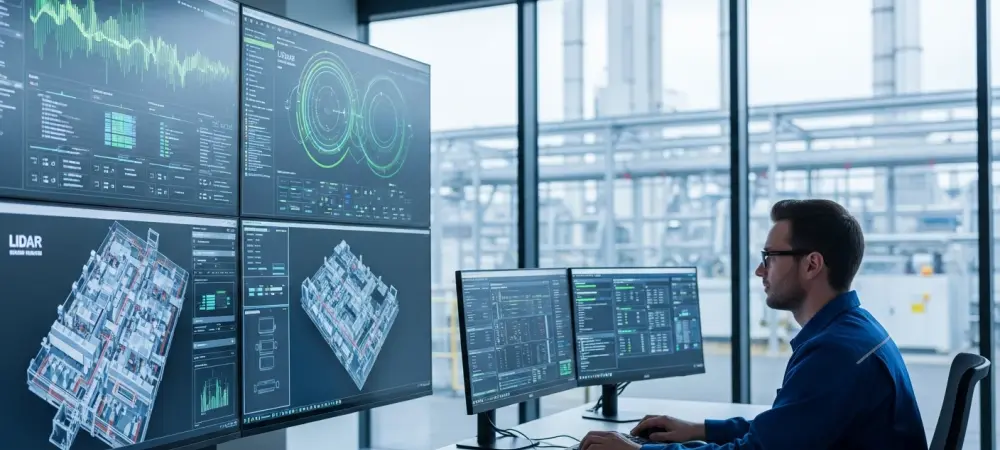
Ensuring a seamless flow from perception to execution requires a robust bridge between digital reasoning and the edge device’s physical movements. Engineers must prioritize a data-centric architecture that utilizes APIs and localized, static RAM to minimize data movement, which is often a primary source of lag. When a robot uses lidar or computer vision to perceive its environment, the “adaptive reasoning” stage must draw conclusions instantly, and any bottleneck here can be mitigated by mapping data flows and identifying if the system requires additional connectivity or sensors. To allow for continuous learning without a complete retraining of the model, we utilize neural processing units that enable the robot to self-adjust based on new experiences in real-time. This oversight involves a “human-in-the-loop” strategy where administrators evaluate the decision-making process to ensure the machine isn’t just acting, but learning correctly from the unstructured data it encounters.
Advanced hardware like GPUs and neural processing units is critical for real-time training simulations. How do you balance the need for high-performance edge computing with the variable power demands and thermal management required for remote devices? Please share a step-by-step approach for managing these energy-intensive systems.
Managing the power intensity of physical AI is a complex balancing act, as edge processors must often switch from low-power idling to maximum compute bursts in milliseconds. My approach starts with deploying hybrid cloud-edge architectures that shift the heaviest processing tasks to the device itself to reduce data transmission costs while using managed resources for energy efficiency. Second, for use cases involving high-performance GPUs, it is essential to integrate dedicated thermal management systems to prevent hardware degradation during parallel processing tasks. Third, we look toward the prevalence of battery power and renewable energy sources to support on-device computing, which provides a more sustainable footprint for remote deployments. Finally, by implementing software-defined WANs and localized processing, we can ensure that the high energy consumption of training simulations is concentrated only when and where it is strictly necessary for autonomous operations.
Ultra-low latency is vital for collision avoidance and autonomous navigation. How do technologies like 5G and Wi-Fi 6/7 transform isolated robots into a unified, interactive platform? What specific networking infrastructure must be in place to support sub-millisecond processing for geographically widespread sensor networks?
The transformation from isolated machines to a distributed compute platform is made possible by the massive interconnectivity of 5G and Wi-Fi 6/7. These technologies allow for the ingestion of massive amounts of real-time data from dense sensor networks, which is critical for sub-millisecond processing in collision avoidance scenarios. To support this, organizations must implement a mesh networking infrastructure and Ethernet time-sensitive networking to deliver the reliable wireless communication that autonomous vehicles and cobots require. We are moving toward a reality where telecom radio access networks and 5G base stations act as the backbone for geographically widespread systems, ensuring that a robot in one corner of a facility is perfectly synced with a sensor network in another. This level of networking readiness is the determining factor for AI success, as it allows for the “embodied” reasoning to happen almost instantaneously across a hybrid environment.
While hardware costs for humanoid robots are projected to drop by nearly half by 2030, high entry costs remain a major barrier. How should businesses structure their pilot programs to mitigate financial risk? What hidden costs, such as cybersecurity or data architecture updates, often surprise organizations during full-scale deployment?
While it is true that the cost of a humanoid robot is expected to fall from $35,000 in 2025 to around $17,000 by 2030, the entry barrier remains significant due to the surrounding infrastructure. Businesses should structure pilot programs using an incremental adoption strategy, starting with controlled rollouts that integrate with legacy IT equipment rather than attempting a total overhaul. The hidden costs often lie in the edge AI hardware market, which is projected to grow to over $107 billion by 2034; this includes the price of high-end GPUs, neural processing units, and the complex cybersecurity measures needed to safeguard hardware at the edge. Furthermore, updating data architecture to handle vast amounts of unstructured data often catches leaders off guard, necessitating a move toward hybrid cloud models that can be expensive to maintain. By focusing on a “structured integration” during the pilot phase, companies can evaluate whether they need additional sensors or connectivity before committing to a full-scale, multi-million dollar deployment.
Successful deployments often require human-in-the-loop oversight and clear change management strategies. How can leadership prepare a workforce to collaborate effectively with intelligent cobots? What specific communication strategies help workers understand the safety benefits of these systems rather than fearing displacement?
Leadership must prioritize transparency and demonstrate how physical AI adds value to the human worker’s experience rather than replacing it. Clear communication should highlight how these systems, or “cobots,” take over the most hazardous and repetitive tasks, thereby reducing frontline worker exposure to high-risk environments. By emphasizing “human-in-the-loop” controls, leaders can show that human oversight is actually the final safeguard for risk management and reliability, making the human role more analytical and supervisory. Organizational readiness assessments are vital to ensure teams are prepared to process information from these AI systems, and controlled deployment pilots help build trust by showing the technology’s reliability in various conditions. When workers see that the AI is there to detect anomalies and improve overall safety, the narrative shifts from displacement to a collaborative partnership that enhances the entire production ecosystem.
What is your forecast for physical AI?
My forecast for physical AI is one of rapid convergence where agentic AI and physical robotics become indistinguishable, leading to a global edge AI hardware market worth $107.5 billion by 2034. We will see a shift where machines no longer just follow programmed paths but possess an “embodied” understanding of their environment, allowing them to reason and interact with the real world with the same fluidity as a human operator. As hardware costs for humanoids drop toward that $17,000 mark by the end of the decade, the barrier to entry will lower, making autonomous systems a standard fixture not just in heavy industry, but in energy retail and healthcare as well. Ultimately, the success of this technology will depend on our ability to build a data-centric infrastructure that can handle sub-millisecond inferencing at scale, turning our physical environments into living, intelligent networks.