

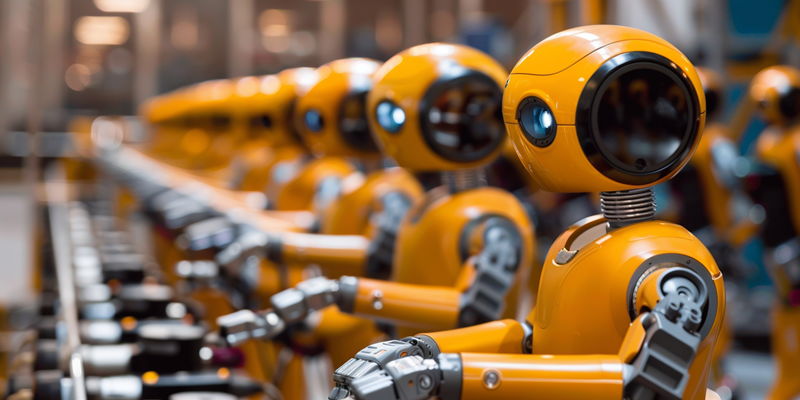
The relentless pursuit of innovation in industrial automation has led to significant strides in robotics, efficiency, and productivity. Among the latest advancements is KUKA’s KMP 1500, an Autonomous Mobile Robot (AMR) that epitomizes the adaptability and effectiveness necessary for modern manufacturing landscapes. Through the KMP 1500, KUKA introduces exceptional capabilities in material handling, marking an evolution within the field of smart automation.
Enhanced Industry 4.0 Manufacturing Operations
Revolutionary Payload Capacity and Precision
When discussing the capabilities of the KUKA KMP 1500, its payload capacity and precision stand out, offering solutions that were once infeasible. With the ability to carry an impressive 1500 kilograms, the KMP 1500 opens up possibilities for heavier and more substantial automation tasks in various industries. Its cutting-edge KUKA omniMove drive technology provides the AMR with the unique ability to maneuver in any direction – a feature especially useful when navigating through confined spaces or integrating into pre-existing workflows that require flexibility. Precision is also paramount, as the robot boasts an accuracy of +/- 5 mm, ensuring that tasks are executed with meticulous detail.
The KMP 1500 excels in delivering materials and tools to their destinations with exceptional reliability. Its ability to interact seamlessly with automated systems and human operators alike makes it an indispensable component in the modern manufacturing milieu. Its introduction into the factory environment represents a tangible leap toward the goals set forth by Industry 4.0, pushing manufacturing capabilities beyond the current norms.
Adaptable to Matrix Production Setups
Matrix production setups represent a significant evolution in manufacturing efficiency, characterized by their grid-like configuration of categorized production cells. The KUKA KMP 1500 slots in perfectly into such systems with its autonomous operation, transporting materials from one cell to another with ease. This AMR takes on the role of a logistical linchpin without requiring constant human oversight, enhancing overall production fluidity.
Within these matrix layouts, the KMP 1500 doesn’t just play a part; it transforms logistics by executing the transport of workpieces and tools needed for various processes such as welding, assembling, or punching. It represents a mobile and dynamically reconfigurable component of the manufacturing process, capable of being tailored to specific tasks with ease. As businesses strive for leaner and more flexible production lines, the KMP 1500 is well-positioned as a game-changer.
Intelligent Integration into Smart Factories
Streamlined Connectivity and Control
The KMP 1500 leverages advanced wireless interfaces for communication, which are critical for its integration into the smart factory. This connectivity affords operators the convenience of remote configuration and control, effectively enhancing the robot’s autonomy and synergizing it with other smart systems within the facility. The forward-thinking design of the KMP 1500 facilitates its incorporation into the existing infrastructure, allowing it to quickly become an integral part of the production flow, thus embodying the interconnectedness that is at the heart of Industry 4.0.
KUKA’s Navigation Solution Basic, integrated into the KMP 1500, also plays a significant role in navigating complex factory layouts. This AMR can traverse facilities without reliance on artificial markers, avoiding obstacles and ensuring a collision-free journey. The implementation of such technologies promotes a safer, more efficient operational environment, minimizing downtime, and enhancing productivity.
Safety and Battery Efficiency
The KMP 1500 incorporates essential safety features that comply with rigorous industry standards, ensuring the well-being of human workers operating in close proximity. Infrared sensors and safety scanners help the KMP 1500 detect and navigate around obstacles, contributing to a secure working space.
Moreover, the AMR’s battery efficiency is a testament to its modern design. Quick charging capabilities and an extended operational lifespan lower the downtime associated with recharging, maintaining a continuous production flow. This efficiency not only reduces energy consumption but also underscores the KMP 1500’s role in sustainable manufacturing practices.
KUKA’s KMP 1500 symbolizes the remarkable progress yielded by the drive for innovation in industrial automation, particularly in robotics. Standing at the forefront of this advancement, the KMP 1500 serves as a stellar example of flexibility and efficiency in today’s manufacturing environments. As an AMR, it offers superior material handling capabilities and illustrates the progression in smart automation. This robot independently navigates through manufacturing spaces to optimize workflow and productivity while adapting fluidly to dynamic operational needs. KUKA’s deployment of the KMP 1500 signals a new era where intelligent automation is not merely a bonus but an essential component of industrial success, redefining performance and innovation benchmarks in factories worldwide. With such developments, industries are poised to meet the challenges of contemporary production demands more adeptly.