

Dominic Jainy stands at the intersection of emerging technology and industrial evolution, bringing years of expertise in artificial intelligence and machine learning to the table. As an IT professional deeply invested in the practical applications of high-speed connectivity and automation, he has closely monitored how nations modernize their critical infrastructure to meet the demands of a digital-first economy. In this discussion, he explores the massive shift in Japan’s “Local 5G” landscape, where the focus has moved from experimental lab settings to the gritty, high-stakes reality of ports, gas plants, and disaster zones. Jainy provides a deep dive into the numbers and the human-centric innovations that are defining this new era of Japanese telecommunications.
Japan has recently crossed a significant threshold from multi-year demonstration experiments to large-scale operational deployments. How would you describe the momentum currently driving this shift in the Japanese market?
The transition has been quite dramatic, moving from a period of cautious testing in the early 2020s to a phase of aggressive, practical implementation. We are looking at a market that is projected to grow at a staggering 55 percent CAGR through 2030, which indicates a massive level of confidence from end users like port operators and manufacturers. This isn’t just about faster internet for consumers; it is about deploying Band n79 and Band n257 networks to solve real-world problems that traditional wireless solutions simply could not handle. You can almost feel the industrial landscape vibrating with change as these organizations realize the technology is finally ready for the heavy lifting of daily operations and long-term investment.
The diversity of applications in Japan seems to span from heavy industry to specialized agriculture. Could you share some insights into how specific sectors are leveraging this connectivity to overhaul their traditional, manual workflows?
It is fascinating to see the departure from manual labor toward automated precision, such as at the Port of Osaka’s Yumeshima Container Terminal. They have completely replaced the old-fashioned, error-prone pen-and-paper processing with local 5G-connected terminals and AI-based identification systems that streamline the movement of goods. Similarly, Hiroshima Gas is introducing unmanned robots that glide through production plants to sniff out gas leaks or detect abnormal temperature spikes that a human inspector might miss. Even in the agricultural sector, we’re seeing image analytics being used for Wagyu beef farming and AI-enabled bear warning systems, proving that “Local 5G” is becoming the backbone for Japan’s most iconic and culturally significant industries.
We often hear about digital twins and remote robotics in theory, but how are companies like Ricoh or NEC making these sophisticated concepts a daily reality on the factory floor?
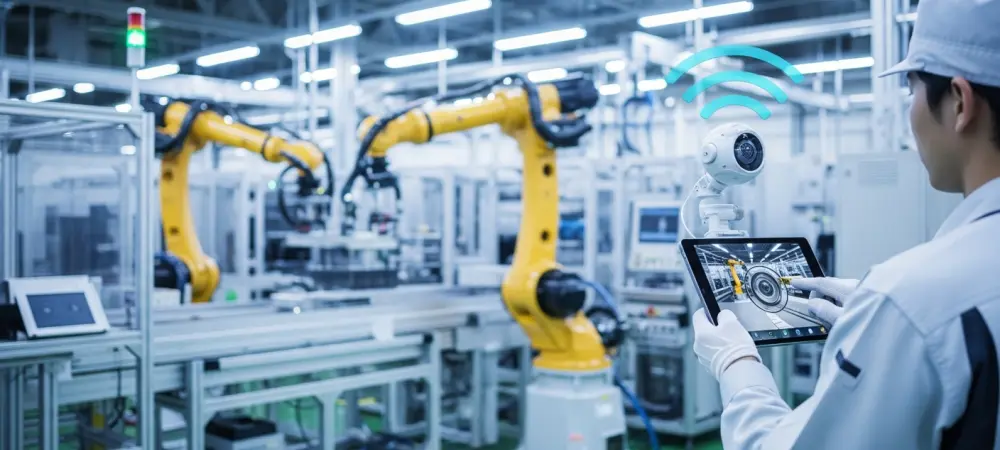
These companies are setting a global standard by using real-time 4K video footage from 360-degree cameras to allow for remote factory tours and inspections, which saves immense time and improves operational transparency. At Ricoh’s Tohoku Plant, they are not just looking at the floor; they are using a digital twin of the entire workspace for worker safety monitoring and training physical AI models on hand movements for future collaboration with humanoid robots. NEC is doing something equally impressive by using local 5G to provide the rock-solid wireless stability needed for autonomous transport systems to zip around their manufacturing facilities without a hitch. This level of integration creates a sensory-rich environment where physical AI and human expertise can finally merge seamlessly in a high-tech dance of productivity.
Beyond the commercial sector, Japan seems to be prioritizing 5G for public safety and national interests. How is the technology being adapted to handle more specialized or unpredictable environments, such as disaster relief?
The Japanese market is unique because it treats local 5G as a national priority for multi-modal disaster preparedness, which is a very forward-thinking approach to social safety. We are seeing drones launched for aerial surveillance and autonomous mobile robots being used in environments too dangerous for humans, adding a protective layer to the country’s emergency response capabilities. In the world of sports and media, the J.League and various broadcasters are using these private networks for live production, ensuring that high-stakes moments are captured in crystal clarity without the lag associated with public networks. These deployments show that the technology is robust enough to handle everything from a sudden landslide to the frantic energy of a championship football match.
What is your forecast for Japan’s private 5G ecosystem as we move toward the end of the decade?
I anticipate that annual spending on these networks will cumulatively account for close to $1.1 billion by the end of 2030, driven by a much more mature ecosystem of both domestic and foreign equipment suppliers. We will likely see a move toward even more complex technical feats, such as 5G-TSN for time-sensitive networking and the use of AI-optimized glass substrate repeaters to solve the coverage issues inherent in millimeter-wave frequencies. The sheer volume of companies involved—from giants like Toyota and Honda to specialized construction firms like Obayashi Corporation—suggests that local 5G will become as ubiquitous and essential as electricity in the Japanese industrial sector. It is a future where Level 4 autonomous driving and multi-vendor robot orchestration in warehouses are no longer experiments, but the standard, reliable way of doing business.