

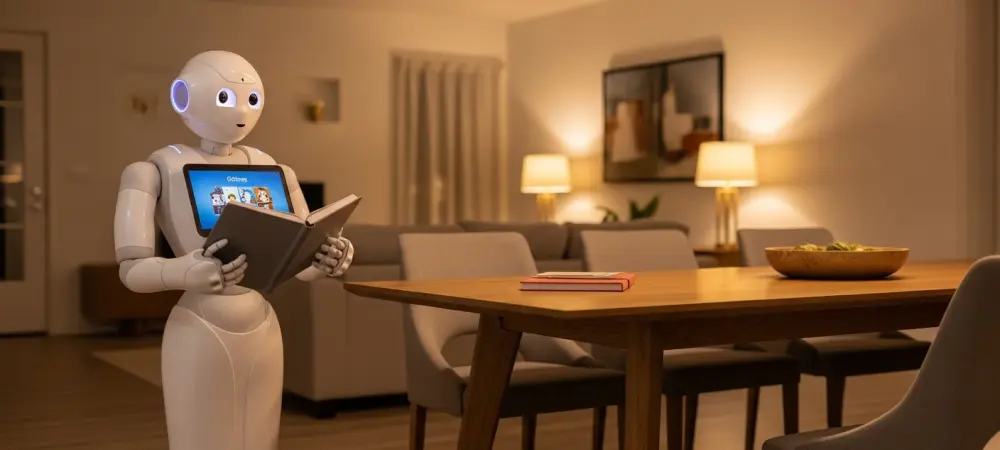
The once-distant silhouette of a mechanical being walking among humans has shifted from a cinematic trope into a tangible market reality, fundamentally altering the trajectory of global technology. For years, artificial intelligence existed in a “Voldemort stage”—a powerful but invisible force operating behind screens and within complex algorithms. While generative AI and large language models redefined how we process information, they remained confined to the digital realm. The emergence of Embodied AI represents a fundamental shift in this paradigm, moving intelligence from virtual interfaces into physical, humanoid forms. This revolution is not merely about making machines look like people; it is about granting AI the ability to perceive, navigate, and interact with the physical world in real time. As we transition through the current landscape, the “Robot Revolution” is moving beyond laboratory experiments to become a tangible part of our social, cultural, and professional fabric.
The Dawn of Physical Intelligence: Why Embodied AI Matters Now
The transition toward physical agency marks the end of AI’s period as a disembodied consultant and the beginning of its role as a physical participant. In the past, software could predict the weather or write poetry, but it could not pick up a glass of water or navigate a crowded sidewalk. Embodied AI provides the “brain” for the mechanical “body,” allowing for sensory feedback loops that enable machines to learn from physical mistakes. This integration is crucial because it unlocks the massive potential of the labor market, moving beyond digital tasks into physical services that require dexterity and spatial awareness.
Furthermore, the convergence of high-speed connectivity and advanced sensory hardware has created a fertile ground for this evolution. Modern sensors now allow humanoid forms to achieve a level of proprioception that was previously impossible, giving them a sense of balance and touch that rivals human capability. This shift matters now because the global economy is facing unique demographic challenges, such as aging populations and labor shortages in essential sectors. Embodied AI is being positioned not just as a luxury or a curiosity, but as a critical infrastructure component that will support the next decade of economic productivity.
From Strategic Games to Physical Viability: The Evolution of Autonomous Machines
The journey to the present day is marked by a transition from intellectual superiority to physical viability. In the previous decade, the victory of AI over world champions in strategic games proved that machines could master the depths of a closed system. However, the real world is far more chaotic than a game board. The current industry shift centers on “embodied intelligence,” which allows robots to handle the unpredictability of human environments. Foundational shifts in manufacturing and computer vision have enabled companies like AGIBOT to move past the limitations of “narrow AI” and enter a phase where machines can generalize their learning across various physical tasks.
Understanding this history is crucial because it illustrates that the current surge in humanoid development is not a sudden fad, but the logical culmination of rapid advancement in machine learning and hardware engineering. While early robotics relied on rigid programming for specific factory lines, the current generation utilizes neural networks to adapt to new surroundings. This evolution has moved the industry from “scripted motion” to “autonomous behavior,” allowing humanoids to function in unmapped homes and dynamic public spaces without constant human intervention.
Bridging the Gap Between Digital Logic and Physical Action
Cultural Normalization: The Influence of High-Profile Platforms
A critical aspect of the humanoid revolution is the move from industrial utility to cultural presence. Historically, the public viewed robots through a lens of skepticism or fear. To counter this, the industry has turned to high-fashion and social media to drive emotional acclimation. For instance, the appearance of the AGIBOT A2 robot at the Met Gala alongside prominent designers served as a deliberate strategy to frame these machines as avant-garde participants. By placing humanoid robots in arenas dedicated to art and identity, manufacturers are successfully shifting public perception from “scary machine” to “sophisticated accessory.”
These machines are being framed as intentional parts of the human experience rather than mere tools, helping to bridge the “uncanny valley.” When a robot is seen on a red carpet or featured in a high-fashion campaign, it undergoes a process of social de-risking. This normalization is essential for widespread adoption, as it prepares the general public to see robots not as intruders in their homes, but as helpful extensions of a modern lifestyle. The cultural narrative is moving toward an aesthetic of “helpful elegance,” where the design of the robot is as important as its processing power.
Performance and Reliability: Navigation in Unstructured Human Environments
Beyond aesthetics, the revolution is defined by physical milestones that demonstrate real-world endurance. Recent athletic demonstrations, such as the Beijing E-Town Humanoid Half-Marathon, showcased humanoids like “Lightning” setting records for physical navigation and speed. Such events serve as a comparative analysis between traditional robotics and modern embodied AI. While older models struggled with balance and varying terrain, current iterations can compete alongside human athletes. These demonstrations prove that robots are becoming capable of handling open-world complexities where physical dexterity is paramount.
The ability to maintain stability on uneven surfaces and navigate through moving crowds represents a significant technical hurdle that has finally been cleared. This level of reliability is the baseline requirement for robots to enter the logistics and emergency response sectors. In these environments, a robot must be able to recover from a trip or a push without shutting down. As these machines prove their durability in the sporting arena, they gain the trust of industrial partners who require high uptime and low maintenance costs in unpredictable working conditions.
Global Competition: The Shift in the Technology Hierarchy
The humanoid landscape is also defined by regional shifts and disruptive innovations. While certain regions remain hubs for software development, other markets are rapidly dominating the manufacturing and market share of humanoid hardware. This regional competition has led to a diversification of use cases, from social media appearances with influencers to the vision of “Plato,” a robot intended to serve as a domestic educator. A common misconception is that these robots are intended solely for repetitive factory labor; in reality, the trend points toward multipurpose assistants capable of social interaction.
This shift in the tech hierarchy suggests that the next generation of “Big Tech” might emerge from the manufacturing sector rather than the software sector. Companies that can scale the production of complex mechanical joints and tactile sensors are becoming the new gatekeepers of innovation. The diversification of the market also means that different cultural approaches to robotics are emerging—some focusing on the robot as a “pet-like” companion and others as a “stoic” laborer. This variety ensures that the technology will find a foothold in multiple demographics simultaneously.
The Trajectory of Integration: Future Economic and Social Impacts
Looking forward, the integration of physical robotics is expected to mirror the historical adoption of the internet. Just as most professional roles today require a computer, future workplaces will likely view physical computing as indispensable. We are approaching a technological rite of passage where embodied AI will transition from a novelty to a necessity. This shift will likely trigger significant regulatory and economic changes as governments grapple with the implications of a robot-integrated workforce.
Expert predictions suggest that once these machines achieve a certain level of domestic utility, their proliferation will be impossible to halt. The economic impact will be profound, as the cost of physical labor begins to decouple from human time. This could lead to a massive deflationary pressure on services, making household help, elderly care, and personalized tutoring accessible to a much wider portion of the population. However, it also necessitates a rethink of social safety nets and tax structures to account for a world where “employees” may increasingly be mechanical rather than biological.
Navigating the Robot-Integrated Landscape: Key Takeaways and Strategies
The analysis of the current humanoid revolution offers several strategic insights for businesses and professionals. First, organizations should recognize that physicality is the new frontier of AI; software alone is no longer the ceiling of innovation. Second, the normalization of these technologies is being led by cultural and athletic demonstrations, suggesting that public acceptance is growing faster than previously anticipated. For consumers and businesses alike, the best practice is to move past science fiction skepticism and begin exploring how these utilities can be integrated into daily operations. Embracing “embodied educators” and personal assistants early on can provide a competitive advantage as physical AI becomes a staple of the modern economy. Companies should audit their physical workflows to identify tasks that require “human-like” presence but are currently underserved. Furthermore, investing in “robot literacy”—the ability for human staff to collaborate effectively with humanoid assistants—will be a defining skill in the coming years. Strategy should focus on “augmentation” rather than “replacement,” finding ways for robots to handle the mundane physical load while humans focus on high-level decision making.
Embracing the New Reality of Human-Machine Interaction
The transition from virtual intelligence to embodied reality was a defining technological movement. By moving from the strategic depth of software to the physical presence of humanoids in high-profile social arenas, the industry successfully entered the realm of cultural presence. This shift represented a permanent restructuring of how humans and machines interacted, blurring the lines between digital information and physical labor. As these forms became increasingly common in schools and homes, the significance of this transformation reached every level of society. The industry moved toward a future where the interaction with AI was no longer a conversation through a screen, but a shared experience in the physical world. This change necessitated a new framework for ethics and design, ensuring that as robots took on more human roles, they remained aligned with human values and social structures. Professionals who anticipated this shift were able to integrate these new tools into their lives with minimal friction, setting a precedent for the next era of technological cooperation.