

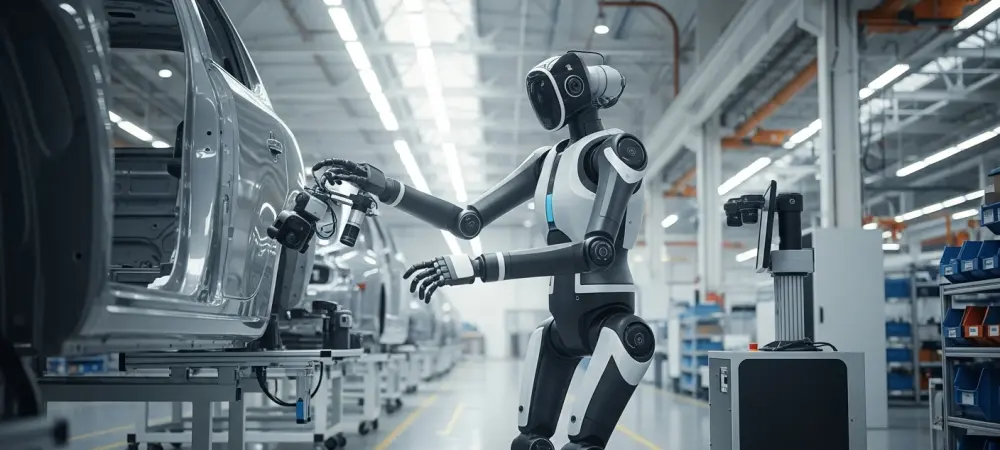
The sight of sophisticated humanoid machines gliding across a factory floor has transitioned from a science fiction trope to a concrete industrial reality within BMW’s manufacturing network. This shift is most evident at the Leipzig plant in Germany, where the automotive giant is deploying the AEON humanoid robot to handle complex tasks that were once the exclusive domain of human workers. Unlike previous iterations of robotics that focused on repetitive, stationary movements, these new “physical AI” units are mobile, adaptable, and designed for heavy-duty industrial application rather than mere exhibition. By prioritizing functional utility over anthropomorphic aesthetics, the company is signaling a broader move toward a more flexible manufacturing environment. This initiative represents a pivotal moment in European automotive history, as it successfully migrates advanced robotics technology from experimental testing grounds in North America and East Asia into the heart of a high-volume European assembly line, fundamentally changing how luxury vehicles are constructed.
Building on Proven Success in the United States
The current deployment of humanoid systems in Europe was made possible by the extensive research and practical success achieved during a massive testing phase in South Carolina. Throughout 2025, the Spartanburg facility served as a live laboratory for the Figure 02 robot, which operated in grueling 10-hour shifts to support the production of the popular BMW X3 model. During this period, the machines successfully processed and placed more than 90,000 individual components, proving that humanoid forms could handle the physical demands of a high-speed assembly line without significant downtime. This rigorous evaluation period allowed engineers to fine-tune the interactions between human workers and autonomous machines, ensuring that the robots could navigate tight spaces safely. The empirical evidence gathered from these tens of thousands of cycles provided the necessary validation for the company to justify the significant capital investment required to bring these advanced systems to its more technologically complex facilities.
This wealth of operational data from the United States essentially served as the blueprint for the current European rollout, allowing the German facilities to skip the initial trial-and-error phase. By analyzing how the robots handled various textures, weights, and spatial constraints in South Carolina, the development team created highly specialized algorithms that are now being used to train the AEON units for the Leipzig plant. This data-driven approach has significantly reduced the integration time, as the machines are arriving on the factory floor with a pre-existing library of movements and problem-solving capabilities. This transition highlights a fundamental shift in corporate strategy, where local successes are rapidly digitized and scaled across the global manufacturing network. The focus has moved from asking whether humanoid robots can work to determining how quickly they can be optimized to perform tasks that require a human-like range of motion, such as reaching into deep vehicle cavities or manipulating flexible materials that traditional robotic arms often struggle to manage.
Prioritizing Functional Design Over Human Appearance
A core philosophy driving the integration of the AEON robot is the prioritization of industrial efficiency over a strictly bipedal, human-like form. While many experimental robots attempt to mimic human walking, which is notoriously difficult and energy-intensive to replicate, the AEON utilizes a wheeled base that offers superior stability and speed on the flat surfaces of a modern factory. Standing approximately 5.4 feet tall and weighing 132 pounds, the robot is designed to move at a brisk pace of 2.5 meters per second, ensuring it does not become a bottleneck in the production flow. This design choice reflects a pragmatic approach to robotics, where the goal is to enhance the workflow rather than create a visual spectacle. The machine’s torso remains modular, allowing it to be outfitted with various specialized grippers or high-resolution scanning tools depending on the specific requirements of the assembly station, making it a truly versatile tool that can be reconfigured for different production cycles as needed.
To achieve total spatial awareness and ensure the safety of its human colleagues, the AEON unit is equipped with a sophisticated array of 22 sensors, including peripheral cameras and time-of-flight infrared technology. This sensor suite provides the robot with a 360-degree view of its environment, allowing it to navigate autonomously and react to unexpected obstacles in real-time. Furthermore, the inclusion of Simultaneous Localization and Mapping (SLAM) cameras enables the robot to build a mental map of the factory floor, which is crucial for maintaining precision during complex quality inspections. The ability to autonomously swap its own battery in under 30 seconds further enhances its utility, allowing for near-continuous operation across multiple shifts. By focusing on these high-performance technical specifications rather than aesthetic mimicry, the partnership between BMW and Hexagon Robotics has produced a machine that is perfectly tuned for the specific mechanical and environmental challenges of automotive assembly, rather than one that is simply built to look like a person.
The Digital Backbone and Long-Term Strategic Vision
The successful integration of these physical AI units is deeply dependent on a robust digital infrastructure that spans the company’s entire global network. To facilitate this, the manufacturing team has utilized NVIDIA’s Isaac simulation platform to train the robots in a virtual environment before they ever touch the factory floor. This “digital twin” approach allows for millions of iterations of a task to be performed in a matter of hours, identifying potential failures and optimizing movement paths without risking damage to expensive hardware or disrupting live production. By leveraging the processing power of the Jetson Orin onboard computers and the scalability of Microsoft Azure, these robots can process complex environmental data locally while simultaneously contributing to a centralized learning model. This ecosystem ensures that when one robot learns a more efficient way to handle a component in Leipzig, that knowledge can be instantly shared with other units across the globe, creating a collective intelligence that grows more capable with every vehicle produced.
In an effort to institutionalize these advancements, the organization established a dedicated Centre of Competence for Physical AI in Production to serve as a central hub for robotics expertise. This facility was tasked with creating standardized protocols for the adoption of new technologies, ensuring that the lessons learned from the AEON deployment could be applied to future automation projects. By the time the full-scale pilot phase was launched in the summer of 2026, the company had successfully moved beyond the experimental stage and into a phase of permanent operational integration. The strategic decision to focus on high-voltage battery assembly and exterior component production proved that humanoid robots could handle high-stakes manufacturing tasks with precision. Ultimately, the project demonstrated that the successful use of humanoid robotics required more than just advanced hardware; it demanded a complete transformation of the digital and organizational structures that supported the assembly line, providing a clear roadmap for other industrial sectors seeking to adopt physical artificial intelligence.