

AI sovereignty has emerged as a critical priority for firms needing to keep proprietary training data within their own jurisdictional and security boundaries to maintain competitive advantages. This paradigm shift has fundamentally altered how corporate leaders view the data center, moving away from the era where the public cloud was seen as the inevitable destination for all workloads. In this current landscape, the infrastructure underlying modern enterprise computing is undergoing a strategic reinvention. The traditional playbook for private cloud is being rewritten to move the industry beyond the limitations of legacy Hyperconverged Infrastructure toward a more flexible, automated, and disaggregated model. Organizations are now forced to confront the reality that AI workloads place unprecedented stress on compute, storage, and networking, demanding a level of performance that older, rigid frameworks cannot provide. This reset is not merely a technical adjustment but a wholesale transformation of the digital foundation, prioritizing economic control and technical flexibility to ensure that proprietary data remains a protected competitive differentiator. The shift represents a sophisticated rebalancing of where workloads reside, ensuring that the local data center operates with the transparency of on-premises costs while retaining the operational ease of a cloud-like environment. By focusing on these core tenets, enterprises are building a future-proofed architecture capable of sustaining the next decade of intelligent innovation.
Transitioning From Hyperconverged to Disaggregated Systems
The transition from traditional Hyperconverged Infrastructure to disaggregated architecture represents a significant departure from the hardware strategies that dominated the last decade. For years, HCI was the gold standard for private clouds because it bundled compute, storage, and networking into a single, easily managed block. However, the unique demands of artificial intelligence have exposed the inherent flaws in this tightly coupled model. AI workloads do not scale symmetrically; a specific model might require a massive increase in processing power or GPU acceleration without needing a corresponding increase in storage capacity. In a traditional HCI environment, an organization would be forced to purchase more storage just to obtain the necessary compute nodes, leading to significant resource waste and inefficient capital expenditure. Disaggregated systems solve this by breaking these components apart, allowing IT teams to scale resources independently based on the specific requirements of their AI pipelines. This architectural shift provides the granular control needed to optimize for high-throughput data ingestion or intense mathematical computation, ensuring that every dollar spent on hardware is maximized for performance rather than lost to unused capacity.
Despite the move toward separate components, modern enterprises are unwilling to sacrifice the administrative simplicity that made HCI popular in the first place. The primary challenge for modern infrastructure providers is to deliver the technical flexibility of disaggregated hardware while maintaining a “single-pane-of-glass” management experience. Leading platforms have achieved this by implementing sophisticated software layers that abstract the underlying hardware complexity. This allows administrators to manage an entire fleet of disparate compute and storage nodes as if they were a single, unified system. By providing this unified management layer, companies can avoid the “system integrator” trap of the past, where IT departments spent more time wiring and configuring individual components than they did delivering services to the business. The goal is to provide a platform that is as easy to consume as a public cloud service but resides within the controlled environment of a private facility. This blend of disaggregated performance and centralized management enables organizations to build highly customized hardware stacks that remain agile enough to pivot as AI models evolve from training to inference and back again.
Embracing Multi-Stack Flexibility and the Virtualization Escape Hatch
Modern private clouds are increasingly defined by their ability to remain agnostic regarding the software layers they support, a concept often referred to as “optionality.” In the previous era of IT, many organizations found themselves locked into a single hypervisor or operating environment, which limited their ability to react to changing market conditions or licensing shifts. Today’s infrastructure is designed to serve as a universal foundation, supporting a variety of environments including VMware, Red Hat OpenShift, Nutanix, and Microsoft Azure Local. This multi-stack compatibility acts as a strategic “escape hatch,” ensuring that companies can change their virtualization or container strategy without the need to replace their underlying physical hardware. This is particularly relevant for AI initiatives, which often rely on containerized microservices and Kubernetes orchestrators like OpenShift rather than traditional virtual machines. By maintaining a flexible hardware base that can host any of these stacks simultaneously, enterprises can adopt a hybrid approach that uses the best tool for each specific application, whether it is a legacy database or a cutting-edge generative AI model.
This decoupling of hardware from a specific software vendor is a fundamental requirement for future-proofing investments in an era where software-defined environments are the norm. When infrastructure is built on open principles, it allows for the seamless migration of workloads between different cloud environments, effectively breaking down the silos that once hindered innovation. For instance, an organization might start training an AI model in a containerized environment on-premises but eventually decide to shift certain management tasks to a global platform like Azure Local to leverage specific integrated services. The ability to do this without a complete infrastructure overhaul is what characterizes a modern, intelligent private cloud. This openness ensures that the private cloud remains a dynamic engine for innovation rather than a static repository for legacy applications. As the AI software ecosystem continues to shift at a rapid pace, this flexibility allows organizations to integrate new AI frameworks and orchestration tools as soon as they emerge, maintaining their competitive edge without being held back by rigid infrastructure requirements.
Driving Data Center Efficiency Through High-Density Storage
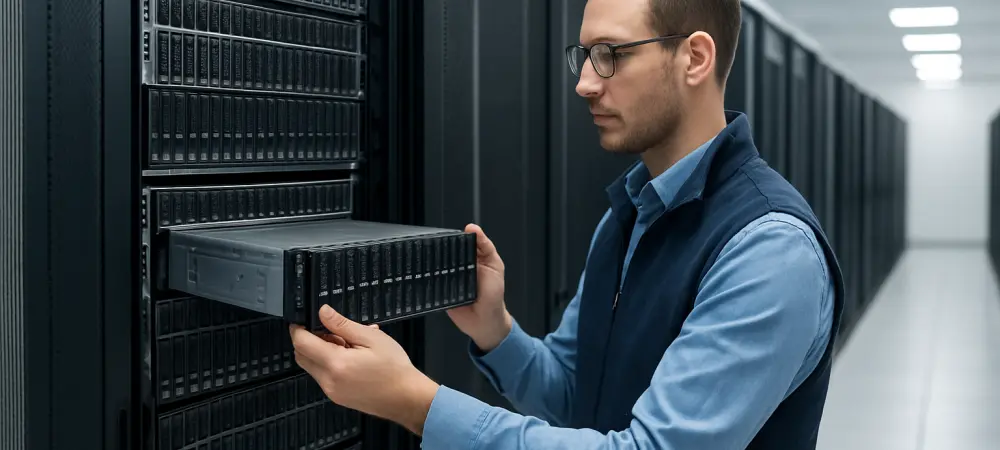
The storage layer of the private cloud has undergone a massive overhaul to accommodate the sheer volume of data required by modern intelligence systems. Modern storage platforms are now achieving extreme levels of density, delivering significantly higher performance and efficiency than previous generations of hardware. This is achieved through advanced data reduction techniques, such as 6:1 reduction ratios, which allow organizations to store massive datasets in a fraction of the physical space previously required. This level of efficiency is no longer just a “nice-to-have” feature; it is a critical necessity when data center real estate is at a premium and power availability is strictly limited. By consolidating petabytes of data into smaller physical footprints, such as 3-rack unit form factors, enterprises can reclaim valuable rack space and power capacity that was previously consumed by older, less efficient arrays. This reclamation of physical resources is a game-changer for the modern data center, as it allows the facility to support the intense requirements of AI without expanding its physical footprint or increasing its total power draw. The energy and space saved through storage innovation act as a direct subsidy for the heavy physical requirements of AI compute nodes. High-performance GPUs used for model training generate immense heat and require significant power density, often exceeding the capabilities of traditional data center racks. When the storage infrastructure is modernized to be more efficient, that “freed up” power and cooling capacity can be redirected to the GPU-heavy servers that drive intelligence. In this way, the innovations in the storage layer are what physically enable the deployment of advanced AI hardware within the existing constraints of a corporate data center. Furthermore, modern hardware designs have moved critical components like NVRAM and battery backups to the controllers while utilizing standard OCP network interface cards. This increases modularity and ensures that the entire front of the storage system is dedicated to high-speed storage bays, maximizing the utility of every inch of hardware. This holistic approach to efficiency ensures that the private cloud can handle the massive data ingestion rates required by AI while remaining sustainable and cost-effective to operate.
Achieving Autonomy Through Advanced Infrastructure Automation
To manage the inherent complexity of disaggregated and high-density systems, the industry has moved toward the concept of autonomous infrastructure. Modern automation platforms now handle the entire lifecycle of the hardware, from the initial validation of components and networking preparation to the automatic installation of hypervisors and the provisioning of storage. These platforms utilize deployment blueprints that eliminate the possibility of human error and significantly reduce the time required to stand up new environments. Research indicates that using these automated deployment strategies can lead to time savings of up to 66% compared to traditional, manual three-tier management methods. This efficiency is vital because it allows IT teams to respond to the needs of AI developers at the speed of the business. Instead of waiting weeks for infrastructure to be provisioned, developers can have access to the resources they need in a matter of hours, accelerating the development cycle for new AI models and services.
Intelligence is also being embedded directly into the hardware components themselves, moving the needle from “managed” infrastructure to a truly “autonomous” state. Modern storage systems, for example, now feature technologies like dynamic node affinity, which allows the system to make real-time decisions about data placement and pathing based on current workload conditions. The storage array no longer waits for a human administrator to optimize its performance; it monitors its own internal traffic and shifts data to the most efficient paths automatically. This level of internal intelligence ensures that AI applications always have the lowest latency access to the data they need, even as workloads change throughout the day. By embedding this type of decision-making into the platform, organizations can ensure peak performance for their most critical AI applications without requiring constant human intervention. This shift toward autonomy is what allows a modern private cloud to scale effectively, as the management burden does not increase linearly with the amount of hardware added to the environment.
Strategic Implementation and the Evolving Role of the IT Workforce
As autonomous agents and software-defined platforms have taken over routine operational tasks, the role of the IT administrator has undergone a major shift. The era of the specialized “storage admin” who focuses exclusively on manual provisioning, patching, and hardware configuration is rapidly fading. In its place, a new role has emerged: the infrastructure manager who oversees AI-based agents and sophisticated orchestration layers. This evolution was particularly necessary as a generation of experienced specialists reached retirement, leaving a gap that could only be filled by more intuitive, automated tools designed for IT generalists. Modern platforms are now built with this new workforce in mind, offering graphical interfaces and natural language processing tools that make complex infrastructure tasks accessible to a broader range of professionals. This human-centric transformation has ensured that organizations can maintain high-performance environments without needing a massive team of niche experts, allowing the existing workforce to focus on higher-level strategy rather than low-level maintenance.
To capitalize on these advancements, successful organizations adopted a structured approach that prioritized long-term scalability and data sovereignty. They began by auditing their existing legacy environments to identify the bottlenecks that were most likely to hinder AI performance, specifically targeting rigid HCI blocks for replacement with disaggregated systems. They then implemented a multi-stack software strategy, ensuring that they were not locked into a single vendor and had the “escape hatch” necessary to pivot their virtualization strategy as needed. These firms also prioritized storage density as a means to reclaim power and rack space, effectively subsidizing the deployment of the high-performance GPUs required for modern intelligence. Finally, they embraced autonomous management tools to reduce operational overhead and empower their IT teams to become strategic partners in the business. By following these steps, enterprises secured a competitive position that allowed them to harness the full power of artificial intelligence while maintaining complete control over their proprietary data and costs. This proactive transition ensured that the private cloud became a dynamic, intelligent partner in the corporate digital strategy rather than a mere cost center.