

The Invisible Trench: Why Your Fingers Might Finally Forget the Fold
For nearly a decade, the tactile sensation of a central dip has defined the foldable phone experience, acting as a constant reminder of the mechanical compromise behind the glass. While display panels have become vibrant and sharp, the “trench” remains a functional obstacle that disrupts the user experience. The Oppo Find N6 aims to break this tactile barrier, shifting the focus from a display that merely looks flat to one that actually feels flat under the fingertip.
The Engineering Hurdle: Solving the Longevity of Flexible Glass
Repeated bending inevitably leads to material fatigue, causing a permanent indentation that disrupts the user experience. This mechanical “set” interferes with fluid navigation and stylus precision, creating a significant hurdle for professional users. Oppo addressed this by rethinking how flexible materials react to stress over hundreds of thousands of cycles, moving beyond standard manufacturing limits.
Micro-Leveling: The Science of 3D Liquid Printing
The “zero-feel” surface was achieved through microscopic additive engineering. High-precision lasers scan the display for variations, which are then corrected using 3D liquid printing to apply precise layers of photopolymer. This process levels the surface to a microscopic variation of just 0.05 mm, making the crease imperceptible. An increased waterdrop fold radius further minimized the physical strain on the panel during closure.
Redefining Reliability: The Million-Fold Milestone
Certified by TÜV Rheinland, the device is rated for 1 million folds, doubling the current industry standard for durability. This ensures that internal components withstand years of heavy use without structural failure. Oppo guaranteed that the crease depth would remain unchanged for at least 600,000 folds, addressing the long-term wear-and-tear anxiety that has historically plagued the foldable market.
Maximizing the Seamless Surface: The Oppo AI Pen
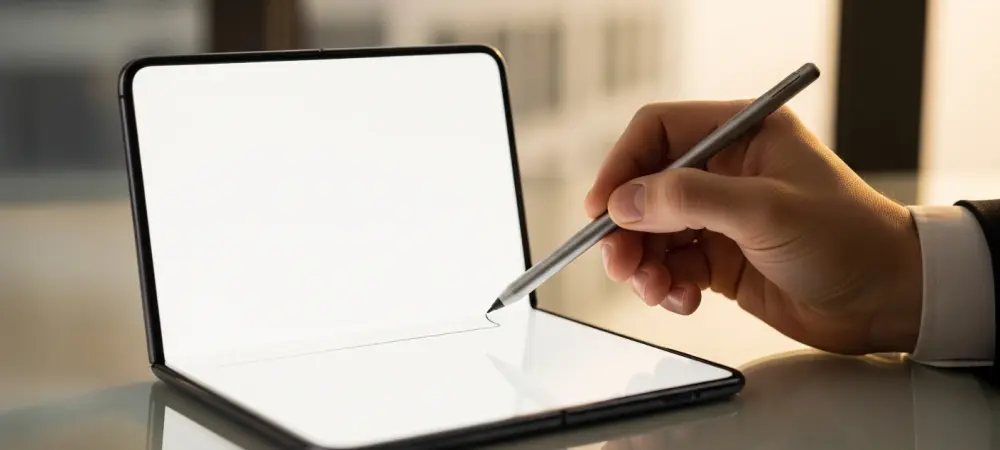
The flat interior display facilitated a productivity framework centered on the Oppo AI Pen. Because the “zero-feel” crease eliminated the typical bump, the stylus glided across the 7.8-inch surface without resistance. This allowed users to engage with AI-driven features like smart note-taking and precision editing. Combined with an 80W fast charger, the device ensured that the productivity cycle remained uninterrupted and fluid.
Future-Proofing the Fold: The Shift Toward Resilience
The arrival of the Find N6 signaled a shift where engineering precision finally caught up with consumer expectations for tactile perfection. By prioritizing microscopic leveling and enhanced hinge mechanics, the design overcame the long-standing physical limitations of flexible materials. This development ensured that the foldable form factor moved from a niche experiment to a reliable standard. As the industry progressed, the emphasis on a seamless surface provided a new benchmark for high-performance mobile devices.