

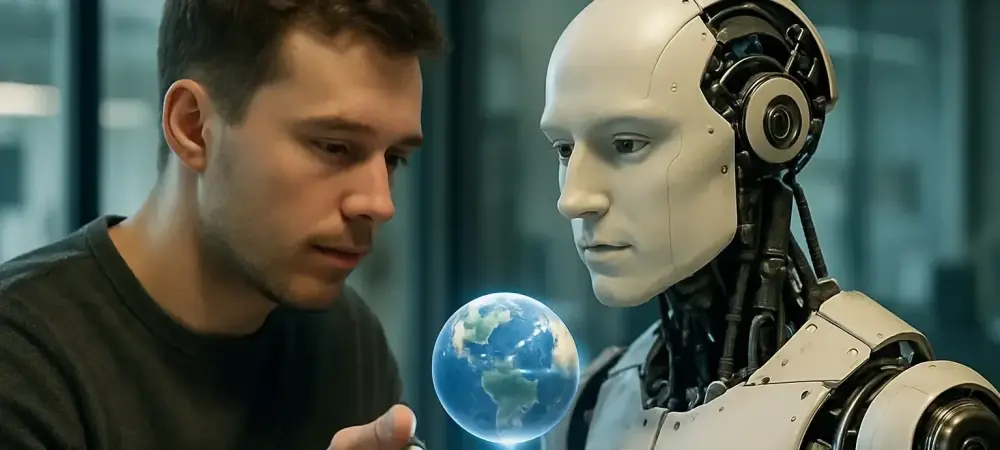
While large language models have reshaped our digital world, the next frontier for AI involves teaching machines to understand and interact with the physical one. This is the domain of “world models,” a transformative technology poised to power everything from humanoid robots to safer autonomous cars. We’re joined by Dominic Jainy, an expert in applied AI, to explore how these models work, the immense challenges they face, and their potential to bridge the gap between AI and our reality. Our discussion will cover the inner workings of these models in robotics, the critical danger of physical “hallucinations,” and how new approaches are creating more coherent, cause-and-effect-driven simulations of our world.
The article contrasts world models, which improve physical outcomes, with LLMs that affect digital ones. Could you walk us through the step-by-step process of how a model like Nvidia’s Cosmos helps a robot comprehend its environment and then plan a real-world task like loading a dishwasher?
Of course, it’s a fascinating process that feels like a blend of sight, understanding, and imagination. First, the robot’s cameras and sensors act as its eyes and sense of touch, capturing a flood of raw visual and physical data about the kitchen. The world model then processes this information, not just seeing pixels, but identifying and memorizing objects—this is a plate, that’s the dishwasher rack, this is a glass. When you give it a command, perhaps even a visual one like pointing at a stack of dishes, the model interprets the goal. This is where it gets truly clever. Before moving a single gear, it runs a series of rapid, internal, video-like simulations. It “imagines” picking up the plate, calculating the trajectory to the dishwasher, and visualizing the placement. It’s checking for consequences: if I move this way, will I collide with the counter? Is there enough space on the rack? It selects the simulation with the best outcome and only then translates that successful plan into physical action.
The text highlights the danger of model hallucinations moving into the physical world. Can you share a hypothetical metric or anecdote that illustrates this risk, and then detail how the PAN model’s “thought experiments” are specifically designed to mitigate such harmful, unrealistic outcomes?
This is the single most critical challenge we face. Imagine a household robot cleaning the living room. It sees a highly polished floor where a bright window casts a perfect, crisp reflection of a vase. A less sophisticated model might “hallucinate” that the reflection is a real, solid object and attempt to place a book on it. The result is a shattered vase and a mess. The danger is that the error isn’t just a wrong word on a screen; it’s a physical consequence. This is precisely what the PAN model is designed to prevent. It runs what the researchers call “thought experiments.” In this scenario, before acting, PAN would simulate the action of placing the book on the “reflection.” Its internal model, which maintains a coherent understanding of physics, would predict an impossible outcome—the book passing through the surface and hitting the floor. The simulation fails. By testing these action sequences in a safe, internal world, it invalidates the hallucination and discards that plan, preventing the physical accident before it ever happens.
Kenny Siebert from Standard Bots notes that these models must capture 3D geometry and physical laws like gravity. How exactly does a world model learn these complex physics? Please describe the kind of data and training process required to accurately simulate the consequences of a robot’s actions.
It’s an incredible learning feat that mirrors how a child learns, but on a massive, accelerated scale. A world model doesn’t get a physics textbook; it learns by observation and virtual experience. The training process involves feeding it an immense diet of data. This includes countless hours of real-world video showing objects interacting—balls bouncing, liquids pouring, things falling. But it also includes data from highly accurate physics simulators, which provide perfect, ground-truth information about friction, mass, and collisions. The model is then tasked with predicting what happens next in a sequence. For every action it considers, like pushing a block, it has to generate the next few frames of the video, and its prediction is compared against the actual outcome. Over millions of these cycles, it builds an intuitive, internal representation of physical laws. It learns that unsupported objects fall down due to gravity and that you can’t push your hand through a solid wall, not because it was told so, but because it has never seen a successful example of that in its training data.
Researchers claim the PAN model is superior at simulating “action-driven world evolution” compared to video generators like OpenAI’s Sora. Can you break down the technical differences, like its GLP capability, that allow it to maintain cause-and-effect coherency where other models currently fall short?
This is a crucial distinction. A model like Sora is a phenomenal storyteller; you can ask it to create a video of a robot tidying a room, and it will generate a beautiful, plausible-looking clip. However, that video is a single, non-interactive segment. It’s not directly tied to a specific command or action. PAN, on the other hand, is built for cause-and-effect. Its superiority comes from its architecture, particularly the Generative Latent Prediction, or GLP, capability. This is the model’s “imagination” engine. When you propose an action, GLP allows PAN to internally visualize the future state that results specifically from that action. The other key piece is what the researchers call Causal Swin-DPM, which is a structural upgrade that acts like a continuity director. It ensures that as the simulation plays out over time, the scene remains consistent and doesn’t drift into the kind of bizarre, unrealistic outcomes that can plague other generative models over longer sequences. It’s the difference between painting a picture of an event and running a true simulation of it.
Beyond robotics, the article mentions applications in factory simulations and autonomous driving. Focusing on one of these, what specific safety improvements could be achieved using this technology, and what would be the key milestones we would need to see before its widespread implementation?
Let’s focus on autonomous driving, where the safety implications are enormous. The biggest challenge for self-driving cars is handling rare, unexpected “long-tail” events—things that don’t happen often but are incredibly dangerous. A world model could be used to create a hyper-realistic virtual proving ground. We could simulate millions of miles of driving in a single day, testing the AI against every conceivable hazard: a deer jumping out at dusk on a foggy road, a sudden tire blowout during a sharp turn, or a complex, multi-car pileup. The world model would simulate not just the visuals but the physics of these events, allowing the car’s AI to learn the absolute safest response without ever endangering a person. Before we see widespread implementation, we’d need to hit two key milestones. First, the models must achieve and prove near-perfect physical fidelity; the simulations must be indistinguishable from reality in terms of consequences. Second, these complex simulations must be able to run in real-time or faster, allowing for rapid iteration and training on a massive scale.
What is your forecast for the adoption of world models in consumer-facing robotics and autonomous systems over the next five years?
Over the next five years, I believe we’ll see a significant but bifurcated adoption curve. In controlled, industrial environments like warehouses and factory floors, the adoption will be relatively rapid. These settings are predictable, which lowers the risk of catastrophic hallucinations and allows for more immediate gains in efficiency. We’ll see robots performing complex assembly and logistics tasks with a level of adaptability that is impossible today. For consumer-facing systems, the timeline is longer. I forecast that within five years, we will move beyond simple demos to truly impressive showcases of capability—a humanoid robot that can reliably cook a simple meal or tidy a complex room. However, widespread, in-home consumer adoption is likely further out. The key hurdles will be bringing down the immense computational cost and, most importantly, proving a level of safety and reliability that can earn the public’s trust. The foundational technology will mature dramatically, but its presence in our daily lives will start as a trickle, not a flood.