

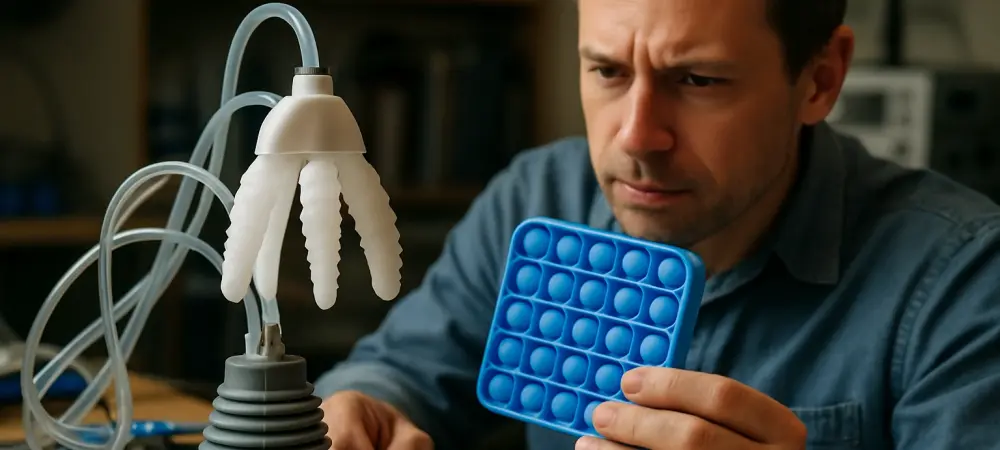
In a world where robots are expected to navigate treacherous terrains, from the crushing depths of the ocean to the uncharted surfaces of distant planets, a surprising source of inspiration has emerged from an unlikely corner: a child’s toy. Fidget poppers, those small, satisfying gadgets that snap between shapes with a flick of a finger, have caught the attention of engineers at Purdue University. This playful object, often seen as a mere distraction, is now sparking a revolution in soft robotics, offering solutions to challenges that rigid, electronics-dependent machines struggle to overcome. What hidden potential does this unassuming toy hold for the future of technology?
From Toy to Tech: Uncovering the Unexpected Power of Fidget Poppers
At first glance, fidget poppers seem like nothing more than a trendy stress reliever, captivating children and adults alike with their tactile appeal. Yet, beneath the surface of this simple design lies a principle that has intrigued researchers in mechanical engineering. The toy’s ability to switch effortlessly between two distinct shapes has become a blueprint for innovation, revealing possibilities far beyond mere entertainment.
This unexpected connection began when scientists at Purdue University recognized parallels between the toy’s mechanics and natural systems like the rapid snap of a Venus flytrap. By studying these everyday objects, the team uncovered a pathway to create robotic components that mimic such adaptability. The journey from a child’s plaything to a technological breakthrough highlights how inspiration can strike from the most ordinary places.
What started as a curious observation has now evolved into a serious pursuit, with fidget poppers serving as a model for designing systems that can operate in environments where traditional robots falter. This shift in perspective demonstrates the value of looking beyond conventional tools, proving that even the simplest ideas can reshape complex fields like robotics.
Why Soft Robotics Matters in Today’s World
The demand for robots capable of tackling extreme conditions has never been more urgent. From inspecting hazardous nuclear reactors to exploring the icy moons of Jupiter, modern missions require machines that can endure crushing pressures, extreme temperatures, and unpredictable terrains. Rigid robots, often laden with delicate electronics, frequently fail under such stress, leading to costly setbacks.
Soft robotics offers a promising alternative, prioritizing flexibility and resilience over traditional, hardwired designs. Unlike their stiff counterparts, soft robots can bend, stretch, and adapt to their surroundings, making them ideal for tasks where precision and durability are paramount. This emerging field addresses critical gaps, providing solutions for scenarios where human intervention is impossible or too dangerous. Statistics underscore the urgency of this shift, with studies indicating that equipment failure in deep-sea and space missions accounts for over 60% of mission delays. By drawing inspiration from unconventional sources like fidget poppers, engineers are crafting systems that could dramatically reduce these failures. The focus on adaptable, electronics-free designs signals a transformative step forward in addressing real-world challenges.
Breaking Down the Science: Bistability and Fidget Popper Mechanics in Robotics
Central to Purdue’s groundbreaking work is the concept of bistability, a property that allows a structure to rest in two stable states with minimal energy input. Fidget poppers exemplify this idea through their convex-to-concave snapping motion, a mechanism that requires only a slight push to transition between forms. This efficient design mirrors natural phenomena, such as the sudden closure of a Venus flytrap, providing a perfect model for robotic applications.
Using custom 3D-printed designs, researchers have replicated this snapping action to develop soft robotic components like grippers and legs. Pneumatic actuation, powered by compressed air, controls the sequence of these transitions, enabling a gripper to curl inward for delicate object handling or a robotic leg to mimic walking through incremental pops. Such innovations eliminate the need for complex electronic circuits, enhancing reliability in harsh settings like underwater or extraterrestrial environments.
The implications of this technology are vast, particularly in scenarios requiring precise movements without the risk of electronic failure. For instance, a bistable gripper can securely hold fragile marine samples at ocean depths where pressure would crush conventional systems. This scientific advancement showcases how a toy’s basic mechanics can translate into sophisticated solutions for some of engineering’s toughest problems.
Voices from the Field: Insights from Purdue’s Research Team
Professor Andres Arrieta, leading the team at Purdue University, has described bistability as a “game-changer” for robotic actuation, especially in creating systems free from electronic dependencies. His perspective sheds light on why this approach is revolutionary, emphasizing that the simplicity of fidget popper mechanics allows for robust designs that traditional methods can’t match. This insight reveals the profound impact of thinking outside conventional engineering boundaries.
Members of the research group have shared stories of the moment they realized a child’s toy could solve long-standing robotic challenges. One engineer recalled the excitement of watching a 3D-printed popper mimic a walking motion during testing, a breakthrough that felt like “unlocking nature’s secret code.” These personal accounts add a human dimension to the technical feats, illustrating the passion driving this innovation.
The team also envisions far-reaching effects across industries, from disaster response to space exploration, where bistable systems could redefine operational capabilities. Their optimism is tempered by a focus on practical hurdles, such as scaling these designs for widespread use. Such candid reflections provide a balanced view of both the potential and the challenges that lie ahead in this pioneering field.
Applying the Innovation: Practical Uses for Fidget Popper-Inspired Robotics
The real-world applications of bistable soft robotics are as diverse as they are impactful, offering tailored solutions for some of the most demanding environments. In deep-sea exploration, for example, robotic grippers inspired by fidget poppers can delicately retrieve sensitive specimens without the risk of damage, even under immense pressure. This capability addresses a critical need for precision in missions where every sample is invaluable.
Beyond underwater tasks, these innovations show promise in extraterrestrial settings, where robotic legs using sequential popping mechanisms can navigate rocky, uneven terrain on distant planets. Such systems, powered by pneumatic control, offer a low-cost, durable alternative to electronic actuators, ensuring functionality where repairs are not an option. Engineers can integrate these designs into existing frameworks, adapting them for specific mission requirements with minimal complexity.
To implement these solutions, practical strategies focus on refining pneumatic systems for consistent performance across varied conditions. Collaboration between designers and field experts is essential to customize bistable components for niche applications, such as handling radioactive materials in nuclear facilities. This adaptability positions fidget popper-inspired robotics as a versatile tool, ready to meet the unique demands of multiple high-stakes sectors.
Reflecting on a Playful Breakthrough
Looking back, the journey of fidget popper-inspired robotics at Purdue University stands as a testament to the power of unconventional thinking, blending childlike curiosity with rigorous engineering. The transformation of a simple toy into a foundation for resilient robotic systems marks a significant milestone, proving that innovation often stems from the most unexpected sources. Each step, from conceptualizing bistability to testing practical applications, highlights a commitment to solving pressing technological challenges.
Moving forward, the focus shifts toward scaling these designs for broader adoption, with researchers and industry leaders encouraged to explore collaborative efforts in refining pneumatic controls. The potential to integrate such systems into disaster response, deep-sea research, and space missions opens new frontiers for exploration. As this field continues to evolve, the challenge remains to balance simplicity with sophistication, ensuring that future robotics can withstand the harshest environments.
Ultimately, this breakthrough urges a rethinking of how everyday objects can inform cutting-edge solutions, inspiring engineers to look beyond traditional paradigms. The next steps involve rigorous testing in real-world scenarios, paving the way for technologies that are not only innovative but also accessible. This legacy of creativity and resilience promises to shape the trajectory of robotics for years to come, rooted in the humble snap of a fidget popper.