

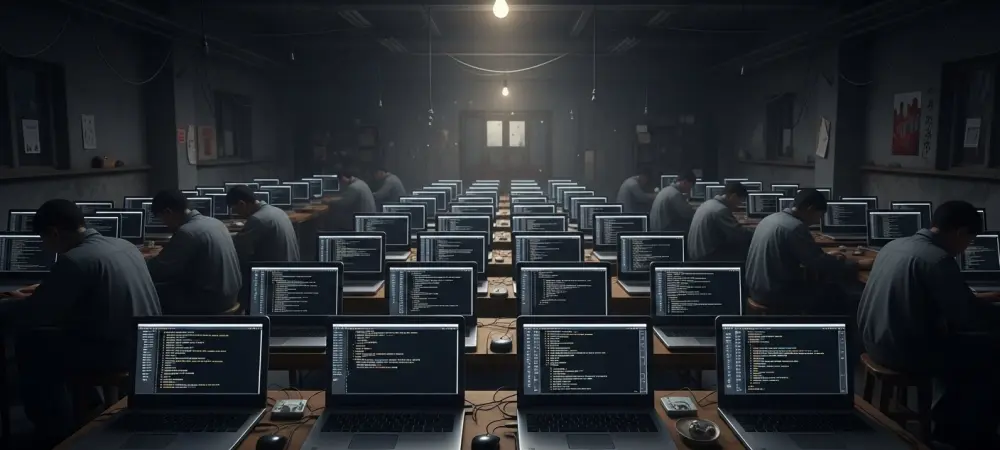
A quiet suburban home in New Jersey might appear unremarkable, yet behind its closed doors, a fleet of corporate laptops was fueling a multi-million dollar funnel directly to the North Korean regime. This operation represents a pivotal shift in state-sponsored activity where foreign actors prioritize steady employment revenue over traditional one-time data breaches.
The Rise of Domestic Laptop Farms in Global Cyber Espionage
The mechanics of laptop farms allow foreign operatives to mask their true locations by routing their digital footprints through hardware physically situated within the United States. By using remote access software, North Korean workers interacted with American company networks as if they were sitting in a local apartment. This technological bridge effectively neutralized geographical security protocols and firewalls designed to block foreign traffic. The scope of this specific operation involved over $5 million in illicit revenue generated by targeting vital American infrastructure. Key market players, including Fortune 500 companies and military contractors, inadvertently facilitated this scheme by shipping proprietary hardware to residential addresses. These unintended facilitators provided the very tools necessary for the Democratic People’s Republic of Korea to compromise national security and the integrity of the remote labor market.
The Evolution of Sophisticated State-Sponsored Employment Fraud
Emerging Trends in Identity Theft and Remote Work Deception
The strategy of the North Korean regime has evolved from aggressive hacking to a more subtle model of legitimate employment fraud. Operatives now utilize stolen American identities to apply for high-paying IT positions, bypassing initial background checks that rely on domestic documentation. This shift turns the trust-based remote hiring model into a significant vulnerability for unsuspecting corporations.
To maintain this deception, the operatives established complex networks of shell companies to mask financial trails and launder money. These entities allowed the fraudsters to receive salary payments from victimized businesses without raising immediate red flags. As corporate behaviors favor remote work, the reliance on digital credentials has created a fertile ground for such sophisticated state-sponsored deception.
Quantifying the Economic and Operational Scale of the Scam
The operational scale of this fraud was staggering, with more than 100 victimized companies unknowingly hiring these foreign agents. Federal investigations revealed that approximately 80 individual American identities were compromised to build a massive workforce of proxy employees. This data highlights a growing trend of state-sponsored IT worker schemes designed to circumvent international sanctions.
As global sanctions tighten, the funneling of $5 million to the regime serves as a critical performance indicator for the success of these covert hardware hubs. Federal task forces have intensified their tracking efforts to dismantle these networks before they reach projected growth levels. The performance of the FBI in identifying these hubs remains the primary defense against the continued expansion of illicit revenue streams.
Navigating the Complexities of Verification in a Borderless Workforce
Detecting proxy employees presents a unique challenge because the hardware they use mimics a local presence perfectly. Organizations often struggle to differentiate between a legitimate remote employee and a foreign operative relaying through a domestic laptop farm. This ambiguity allows agents to gain deep access to sensitive systems while appearing as a standard domestic hire. The risks associated with this access extend far beyond financial loss, encompassing the theft of proprietary source code and intellectual property. High-security organizations must now develop strategies to validate the actual physical location of their remote assets. Overcoming these technological hurdles is essential to preventing corporate espionage and maintaining control over sensitive data environments.
The Regulatory Response and the Push for Enhanced Compliance
The legal response to this threat resulted in significant federal prison sentences for those managing the domestic hardware. Kejia Wang received a 108-month term, while Zhenxing Wang was sentenced to 92 months for their roles in the conspiracy. These sentences reflect the gravity of wire fraud and aggravated identity theft within the context of international security.
The role of the FBI and the Department of Justice has shifted toward stricter enforcement of sanctions within the domestic tech sector. New standards for background checks and multi-factor identity verification are being pushed to address the vulnerabilities exposed by this case. Enhanced compliance is no longer optional for firms operating in the remote era, as the legal consequences for negligence become more severe.
The Future of Remote Security and State-Sourced Cyber Threats
Emerging technologies in biometric verification and hardware-based location tracking are becoming the new frontline of defense. These tools aim to ensure that the individual accessing a corporate network is truly the person hired for the role. Future growth in the cybersecurity sector will likely focus on insider threat detection as decentralized workforces create new surfaces for foreign intelligence.
The pursuit of illicit revenue by the DPRK is heavily influenced by global economic conditions and the effectiveness of current sanctions. As these state actors become more desperate, their methods for infiltrating the American labor market will likely become more sophisticated. Cybersecurity firms are prioritizing the development of platforms that can identify the subtle patterns of remote access relaying.
Strengthening Corporate Defenses Against Transnational Fraud
The sentencing of the Wang brothers demonstrated that domestic collaborators were essential to the success of this transnational scam. Federal authorities emphasized that the involvement of local residents allowed foreign agents to maintain the illusion of a domestic presence. This realization led to a fundamental reassessment of how Fortune 500 companies handled their remote onboarding processes.
Corporate leaders recognized the necessity of ongoing collaboration with federal agencies to identify active co-conspirators still operating within the system. The legal system successfully dismantled a major revenue source for a sanctioned regime, yet the threat of similar hardware hubs persisted. This case established a new standard for economic integrity by proving that physical hardware remains a critical point of failure in a digital economy.