

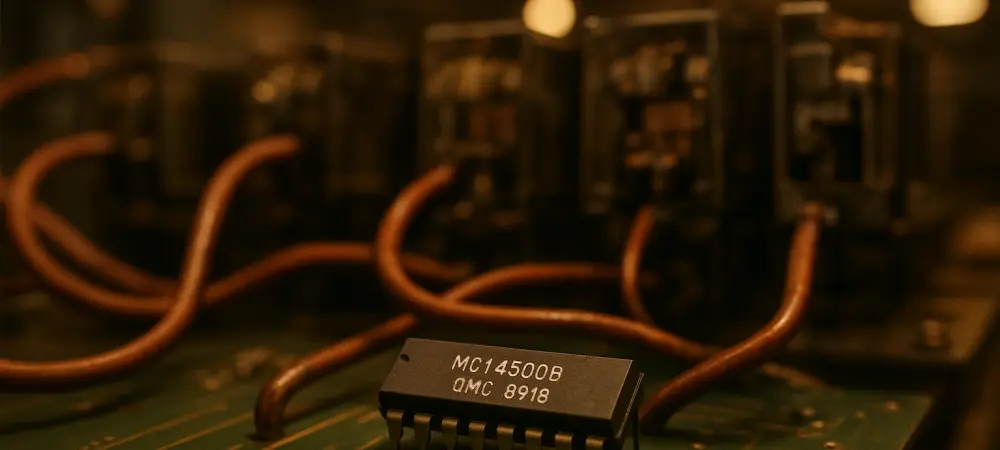
Long before the sleek microprocessors of the modern era began orchestrating every facet of our digital lives, a tiny piece of silicon proved that raw power mattered far less than finding the perfect balance between cost and functional necessity in a rugged environment. While the technology landscape of the late 1970s witnessed the arrival of complex 8-bit giants, a different kind of revolution was quietly taking hold within the grease-stained walls of heavy manufacturing. Factory managers were not interested in high-level mathematics or word processing; they desperately needed a way to replace massive, heat-generating cabinets of mechanical switches that were prone to failure. The answer arrived in the form of a component so simple it only understood two states: on and off. This minimalist approach did not just provide a cheaper alternative to general-purpose computing; it established a new philosophy of industrial efficiency that prioritized reliability over raw speed.
The Massive Impact: A Half-Cent Part in a Two-Hundred-Dollar World
The economic realities of the mid-1970s created a massive barrier between high-tech innovation and practical industrial application. At the time, cutting-edge 8-bit processors like the Zilog Z80 were marvels of engineering, packing over 8,000 transistors into a single package, but they carried a steep price tag of roughly $200 per unit. For a manufacturer looking to automate a simple hydraulic press or a basic conveyor system, spending that much on a single chip was an impossible expense. This price gap left many factories stuck in a mechanical past, unable to justify the overhead of a computer that was essentially overqualified for the task at hand. In contrast, the Motorola MC14500B entered the market in 1977 as a radical exercise in cost-cutting and simplification. By utilizing only 500 transistors, the chip was manufactured for a fraction of the cost of its peers and sold for just $5. This made the technology accessible to every level of industry, from small machine shops to massive assembly lines. It proved that the democratization of automation did not require more powerful computers, but rather more focused ones. The success of this 1-bit marvel demonstrated that the true value of a tool is found in its ability to solve a specific problem without adding unnecessary layers of complexity or expense.
Bridging the Gap: Mechanical Relays and Modern Automation
Before the integration of microchips, the backbone of every assembly line consisted of enormous walls of electromagnetic relays. These systems operated through hard-wired logic, where the physical connection of wires determined the behavior of the machinery. While effective, these setups were notorious for their fragility and high maintenance requirements. Mechanical wear frequently caused contacts to stick or fail, and the “spaghetti wiring” inside the control cabinets made troubleshooting a nightmare that could stall production for days. Any change to the manufacturing process required a team of electricians to manually rewire the entire system, a process that was both slow and expensive.
The transition toward electronic control became a matter of survival for companies facing global competition. The MC14500B emerged as the perfect intermediary, specifically designed to function as an Industrial Control Unit. It did not try to behave like a standard computer; instead, it was built to mimic the binary nature of the switches and sensors already present on the factory floor. By bridging the gap between old-world mechanical logic and the digital future, this chip allowed engineers to modernize their operations without needing to retrain their entire workforce or rebuild their infrastructure from scratch.
The Architecture of Minimalism: Inside the Motorola MC14500B
To achieve its $5 price point, the MC14500B was stripped of almost every luxury found in a typical CPU. The most striking feature was its 1-bit data bus, which reflected the fundamental reality of industrial hardware where a valve is either open or closed. This narrow focus allowed the architecture to be incredibly lean, utilizing a mere 16 internal instructions. These instructions were dedicated almost entirely to Boolean logic operations, which are the building blocks of decision-making in automated systems. Because there was no need to handle complex arithmetic, the chip could cycle through its logic at a pace that was more than sufficient for controlling physical machinery.
Motorola further reduced costs by externalizing much of the chip’s “brain.” Unlike modern microcontrollers, the MC14500B lacked an internal program counter or memory, meaning it could not run on its own. While this might seem like a disadvantage, it allowed for maximum flexibility in design. Clever designers even found ways to simulate sequential logic—the ability for a system to remember its previous state—by feeding output signals back into the input stream. This feedback loop turned a simple logic gate into a sophisticated controller capable of managing intricate production sequences.
Practical Engineering: Translating Industrial Needs Into Bitwise Logic
The true genius of the 1-bit processor was how it simplified the relationship between a technician and the machine. Programming the device often involved Ladder Logic, a symbolic language that looked exactly like the electrical circuit diagrams that factory engineers had used for decades. This meant that a person who understood how to wire a relay could also understand how to program the MC14500B. Instead of moving physical wires to change a machine’s behavior, they simply updated a few lines of code. This flexibility revolutionized the assembly line, making it possible to adapt to new product designs in a matter of hours rather than weeks.
Reliability was another hallmark of this minimalist design. In the electrically noisy and physically harsh environments of heavy manufacturing, the MC14500B was incredibly robust because it had so few points of failure. It could withstand the vibrations of a stamping press and the electrical spikes of a heavy-duty motor without skipping a beat. By doing less, the chip actually achieved more, proving that in the world of industrial engineering, simplicity is often the most sophisticated solution available.
Lessons From the Past: Modern Recreations and the Legacy of Efficiency
The resurgence of interest in 1-bit computing, championed by modern hardware enthusiasts like Nicola Cimmino, underscored the timeless value of minimalist engineering. Many modern recreations began by identifying these overlooked chips on discarded industrial boards, pulling them from the trash to give them a second life. By using a combination of traditional wire-wrapping techniques and modern circuit board design, hobbyists demonstrated that the fundamental principles of the MC14500B remained as functional today as they were decades ago. These projects highlighted a growing realization that the best tool for a job is the one that solves the problem with the least amount of waste. The engineering community recognized that the obsession with multi-core performance often obscured the utility of specific, narrow-purpose hardware. This realization prompted a shift toward designing systems that prioritized long-term stability from 2026 onward, proving that the minimalist ideals of the 1970s remained relevant for industrial safety and energy efficiency. Practitioners discovered that by revisiting the logic of the $5 chip, they identified new ways to reduce the power consumption of modern automation. This historical perspective encouraged a design philosophy that valued durability over raw speed, ensuring that the legacy of 1-bit logic continued to inform the development of sustainable technology for the next generation.