

The modern auditory environment has reached a point where a simple phone call from a loved one or a voice memo from a colleague can no longer be trusted at face value. As we navigate this year, the sheer realism of generated speech has effectively neutralized the human ear as a reliable judge of authenticity. Digital trust is no longer a passive state but a high-stakes frontier where every sound must be verified. This shift represents a fundamental change in how society interacts with media and communication, turning voice detection from a specialized security tool into an essential component of social stability.
The current landscape is defined by a sophisticated defense-in-depth strategy where forensic technologies must outpace increasingly accessible cloning tools. By examining the current suite of detection methods—ranging from biological rhythm monitoring to deep-layer acoustic analysis—it becomes clear that the battle for the truth is being fought in the frequencies we cannot hear. This roundup explores the multifaceted layers of modern audio authentication, providing a roadmap for navigating a world where the voice is no longer a biological certainty.
The End of Auditory Certainty: Why Voice Verification Is the New Digital Frontier
In this era, generative audio models have achieved a level of “perfect” synthesis that bypasses the natural suspicion once triggered by robotic tones. Because these voices can replicate the precise emotional cadence and timbre of any specific individual, the psychological impact of audio misinformation has skyrocketed. Consequently, the reliance on manual verification has been replaced by automated forensic layers that sit between the speaker and the listener. These systems act as a modern filter, ensuring that the convenience of digital communication does not come at the cost of absolute vulnerability.
The transition toward a “detect-first” mentality is now visible across all sectors of the economy. Financial institutions and government agencies treat unverified audio as a critical security risk, much like an unencrypted data packet. This paradigm shift requires a foundational understanding of the defensive technologies that now safeguard our conversations. These tools do not just listen for errors; they actively seek out the mathematical signatures of artificiality that remain invisible to human perception but glaringly obvious to a trained neural network.
Beyond the Human Ear: The Science of High-Fidelity Forensic Detection
Decoding the Digital Fingerprint: Aliasing and Sub-Perceptual Acoustic Artifacts
Even the most advanced generative models in use today leave behind a trail of microscopic mathematical anomalies known as aliasing. These artifacts occur during the digital reconstruction of sound waves, creating tiny frequency gaps that do not exist in the fluid, analog nature of human vocal cords. Forensic detectors today scan these high-frequency bands to identify the “steppiness” of a synthetic wave. While a human hears a smooth sentence, the software sees a series of calculated approximations that signal a non-biological origin.
Case studies from the past few months have demonstrated that while AI can mimic a person’s accent, it often fails to replicate the chaotic nature of biological vocalization. Synthetic outputs tend to be “too clean,” lacking the random acoustic noise generated by the physical movement of air through a human throat. Detectors leverage this irony, using the very perfection of the AI model as a primary indicator of its synthetic nature. By isolating these sub-perceptual markers, analysts can distinguish between a high-fidelity clone and a genuine human recording with near-perfect accuracy.
The Rise of Liveness Testing: Monitoring Biological Rhythms in Real-Time
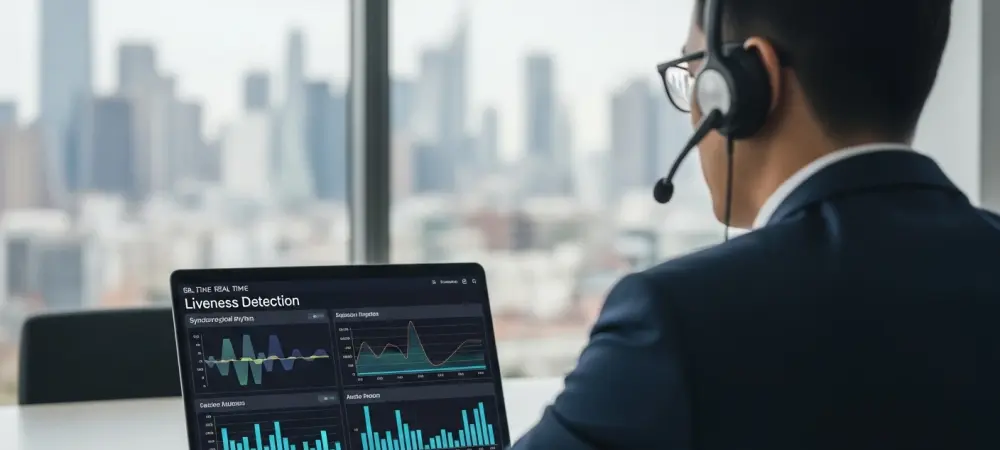
A major trend this year is the move toward “Biometric Liveness,” a method that prioritizes the physiological process of speaking over the sound itself. Authentic human speech is inextricably linked to breathing patterns, mouth movements, and idiosyncratic pitch shifts that occur as a person tires or changes posture. Advanced platforms now monitor these subtle “micro-rhythms” to ensure the voice is being generated by a living person in real-time. This prevents the use of pre-recorded “replay attacks” where a hacker uses a genuine recording to bypass static security filters.
Enterprise-level security, such as the Pindrop Pulse system, has become a standard for securing high-value financial transactions. These platforms are designed to detect “voice swapping” mid-conversation, a tactic where a fraudster begins a call with a real voice and then switches to an AI clone once the initial identity check is passed. By constantly analyzing the liveness of the audio stream, these systems provide a continuous loop of verification. This prevents a single moment of authentication from being weaponized by a malicious actor later in the session.
Cross-Platform Defense vs. Ecosystem Silos: The Battle for Standardization
The industry currently faces a tension between specialized tools and universal aggregators. Some platforms, such as the ElevenLabs AI Speech Classifier, are exceptionally effective at identifying content generated within their own proprietary environments. These “Sincerity Scores” provide a high level of confidence for creators who stay within a specific ecosystem. However, they can struggle when faced with obscure, open-source cloning models. This has led to the rise of multi-model aggregators like Reality Defender, which synthesize data from dozens of different detection engines to provide a more comprehensive verdict.
Globally, the implementation of “Fakeprints” is becoming a standard practice for establishing a mathematical paper trail of audio origins. Different regions are experimenting with these digital watermarks to ensure that every synthetic voice carries a traceable signature from the moment of its creation. While this helps with transparency, the existence of “dark” AI models that bypass these standards remains a challenge. The struggle for standardization continues as developers attempt to create a unified detection framework that can cover the entire spectrum of proprietary and decentralized cloning technologies.
Explainable AI (XAI): Moving From Binary Verdicts to Visual Forensic Heatmaps
The era of the simple “Real or Fake” label is ending, replaced by the rise of Explainable AI (XAI). Users now demand to know the “why” behind a detection result, leading to the development of forensic heatmaps. Tools like Sentinel provide these visual representations, highlighting exactly which parts of an audio clip show signs of manipulation or synthesis. This transparency is crucial for journalists and fact-checkers who must defend their findings in the public eye. It transforms detection from a “black box” process into a verifiable forensic science.
Looking ahead, this level of transparency is being integrated directly into the communication tools used by millions every day. Integration into platforms like Zoom or Microsoft Teams allows users to see a “trust indicator” during a meeting, backed by a detailed report if anomalies are detected. This shift from post-facto analysis to real-time, explainable feedback is essential for maintaining trust in professional environments. By providing a clear visual explanation of acoustic inconsistencies, these tools empower individuals to make informed decisions about the information they are receiving.
Implementing an Audio Defense Strategy: Actionable Steps for the Modern Era
To stay ahead of the rapid evolution of deepfakes, organizations are adopting a multi-layered defense strategy that goes beyond software. Integrating “voice-as-a-password” protocols is a critical first step, but it must be paired with real-time liveness checks to be truly effective. Best practices now involve a combination of automated detection and human-in-the-loop verification for high-stakes decisions. This approach ensures that even if one layer of technology is bypassed, secondary biological markers or procedural checks remain in place to catch the deception.
Individual users also have a role to play by utilizing accessible, high-speed classifiers to verify content before sharing it on social media. Many of these tools are now optimized to process short audio samples, making it possible to check a viral clip in seconds. Developing a habit of “forensic skepticism” is just as important as the tools themselves. By combining the speed of modern classifiers with a disciplined approach to information consumption, individuals can protect themselves from the emotional and financial manipulation that often accompanies synthetic media.
Restoring Trust in a World Where Hearing Is No Longer Believing
Forensic tools have become the essential antivirus of the synthetic age, providing the necessary guardrails for a society that communicates primarily through digital audio. The long-term implications of these technologies extend far beyond security, affecting the very foundations of democratic processes and personal identity. By maintaining a mathematical grip on reality, these systems allow for the continued use of generative AI as a creative tool while neutralizing its potential as a weapon of mass deception.
Navigating the blurred lines of this auditory reality required a commitment to technological vigilance and the adoption of robust authentication standards. Organizations that prioritized the integration of multi-model detection and real-time liveness checks effectively mitigated the risks of identity theft and misinformation. Individuals who embraced explainable forensic reports developed a deeper understanding of the digital artifacts that define synthetic media. Ultimately, the successful management of synthetic audio was achieved by shifting the burden of proof from the listener to the forensic infrastructure, ensuring that digital communication remained a viable space for authentic human connection.