

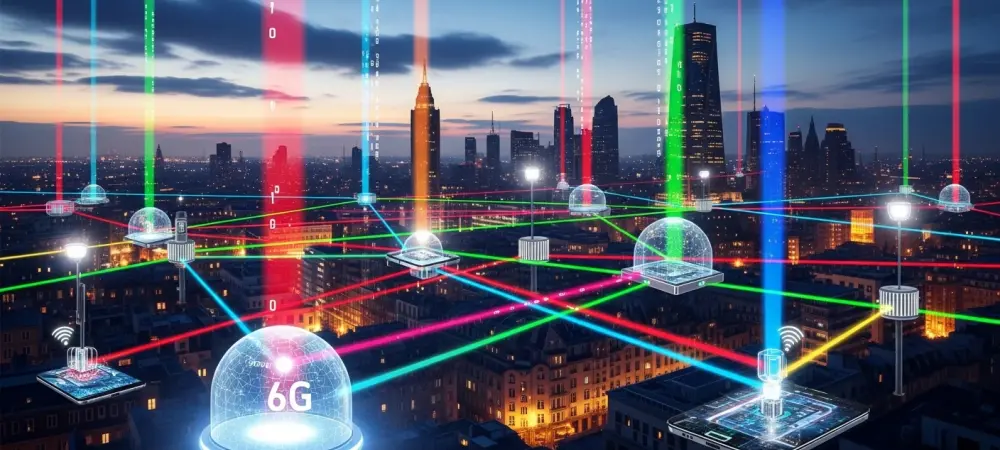
Dominic Jainy is a leading figure in the evolution of optical wireless technologies, bringing a wealth of expertise in high-speed data transmission and next-generation network architectures. With the telecommunications industry shifting toward 6G, his work has become instrumental in exploring the 380-780 nm optical spectrum to overcome the limitations of traditional radio-frequency bands. By bridging the gap between hardware innovation and advanced signal processing, he is redefining how we approach connectivity in environments ranging from deep-sea exploration to inter-satellite links.
The following discussion explores the technological leap from standard LEDs to high-bandwidth laser diodes, the implementation of physics-informed deep learning for channel management, and the architectural scaling required for Terabit-level capacities. We also delve into the integration of space-air-ground-sea networks and the role of neural networks in overcoming the physical constraints of light-based communication.
Transitioning from standard LEDs to laser diodes has pushed single-channel speeds beyond 36 Gbps. What specific hardware optimizations are necessary to reach these GHz-level bandwidths, and what thermal or design limitations must be managed to ensure long-term stability?
To move beyond the limitations of conventional LEDs, we have focused heavily on structural design and cavity-length optimization within laser diodes (LDs) and micro-LEDs. These modifications allow us to achieve bandwidths in the GHz regime, which is a massive jump from the MHz range of standard lighting components. Specifically, reducing the parasitic capacitance and optimizing the active region of the device are essential steps to sustain single-channel data rates exceeding 36.5 Gbps. However, operating at such high frequencies generates significant heat, so we must implement advanced thermal management to prevent wavelength shifting or catastrophic optical damage. By utilizing large-scale device arrays, we can distribute the load and enhance system parallelization, ensuring the transmitter remains stable even during continuous high-speed operation.
Managing complex channels now involves physics-informed deep learning rather than just traditional estimation methods. How do these models adapt to high-interference environments, and what specific training datasets are required to ensure they can handle nonlinear signal distortions effectively?
Physics-informed deep learning represents a paradigm shift because it combines traditional mathematical channel models with the adaptive power of neural networks. In high-interference environments, such as a crowded indoor space or a turbulent underwater link, these models use physical laws to constrain the learning process, making them much more accurate than “black box” algorithms. To handle nonlinear signal distortions, we require diverse training datasets that include various modulation schemes, such as high-order QAM, and a range of environmental conditions like atmospheric scintillation or water turbidity. This allows the model to predict how the signal will warp and apply corrective measures in real-time. By training on these multi-scenario datasets, the system learns to characterize complex channels with a level of precision that traditional estimation methods simply cannot match.
Combining wavelength, spatial, and polarization multiplexing is essential for reaching Terabit-level capacities. What practical trade-offs occur when scaling these multidimensional architectures, and how do multi-aperture receivers improve resilience against atmospheric or underwater turbulence?
When we scale these architectures toward the 800 Gbps and Terabit-per-second thresholds, the primary trade-off is the increased complexity of the optical alignment and the potential for crosstalk between channels. For instance, combining wavelength-division multiplexing (WDM) with polarization and spatial modes requires extremely precise filtering and beamforming to keep the signals distinct. This is where multi-aperture receivers become vital; they act as a spatial diversity tool, capturing the light signal from different angles to mitigate the “fading” caused by turbulence. Whether it is air pockets in the atmosphere or thermal gradients underwater, the multi-aperture design ensures that if one path is blocked or distorted, others can still maintain the link. This redundancy is the backbone of our effort to build a robust, high-capacity system that doesn’t collapse at the first sign of environmental interference.
Integrating space, underwater, and ground networks is a core goal for future connectivity. What are the primary differences in transmitter requirements for inter-satellite links versus underwater communication, and what metrics best measure the reliability of these hybrid systems?
The requirements for these two environments are almost polar opposites due to how light interacts with the medium. For inter-satellite links, the transmitter must prioritize high-power laser diodes with exceptional beam pointing accuracy to cover thousands of kilometers in a vacuum. In contrast, underwater communication requires wavelengths specifically in the blue-green spectrum to minimize absorption, and the transmitters must be designed to handle intense scattering and pressure. To measure the reliability of these hybrid systems, we look at metrics such as latency, bit error rate (BER), and “link availability” time. Because 6G aims for a seamless space-air-ground-sea integrated network, the ultimate metric is how effectively the system can hand off data between an optical satellite link and a terrestrial VLC network without a drop in throughput.
Hybrid equalization strategies now combine pre- and post-processing to overcome bandwidth constraints. How do neural networks specifically improve this compensation process, and could you walk us through the implementation steps for deploying these algorithms in a live network?
Neural networks excel at hybrid equalization because they can model the specific nonlinearities of the transmitter and receiver components simultaneously. While pre-equalization prepares the signal to survive the hardware’s frequency roll-off, post-equalization uses neural networks to clean up any remaining inter-symbol interference or noise. To deploy this in a live network, we first perform an offline training phase using a representative sample of the hardware’s behavior. Next, we implement a “pilot” signal phase where the network learns the current channel state in real-time. Once the weights are optimized, the algorithm is integrated into the digital signal processing (DSP) unit, where it performs high-speed inference on every incoming packet. This two-stage approach allows us to push the hardware far beyond its native physical bandwidth by using “math” to fix the signal at both ends of the pipe.
What is your forecast for visible light communication?
I believe VLC will transition from a niche experimental technology to a primary pillar of the 6G ecosystem, specifically as we master optical field manipulation and chip-level integration. We are moving toward a future where our lighting infrastructure, satellites, and even underwater drones are all part of a single, unified optical network capable of Terabit-level speeds. Within the next decade, the convergence of GaN-based photodetectors and AI-driven predictive communication will allow us to deploy these systems in ways we are only just beginning to imagine. My forecast is that VLC will eventually solve the “spectrum crunch” by offloading massive data traffic from radio frequencies to the visible spectrum, making ultra-high-speed connectivity as ubiquitous as the light in our rooms.