

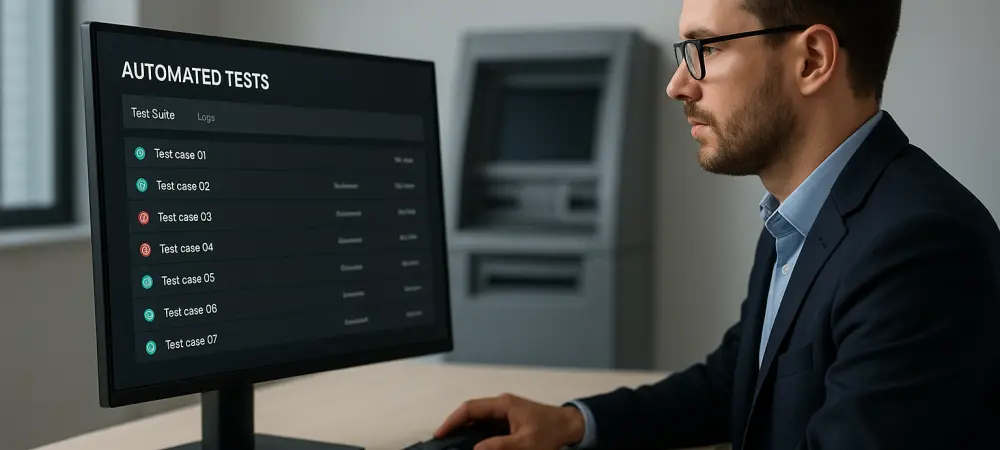
Scaling testing capacity no longer requires purchasing additional physical machines because virtualized ATM instances can be cloned on demand to provide every tester with a private environment. In the current landscape of 2026, financial institutions must prioritize rapid innovation to keep pace with changing consumer habits and emerging payment technologies. Traditional testing methodologies, which rely heavily on physical hardware availability and manual intervention, often create significant delays in the development cycle. By adopting virtualization, banks can effectively decouple their software testing from the limitations of physical assets, allowing for a more streamlined and responsive approach. This transition not only enhances the speed of delivery but also improves the overall quality of the software by allowing for more exhaustive testing scenarios. As the industry moves toward more integrated and automated ecosystems, the ability to replicate a complex banking environment in a virtual space has become an essential capability for any forward-thinking organization.
1. Differentiating Between Virtualization and Simulation
Simulation focuses on imitating the external behavior of a system, providing an approximation that can be useful for basic functional checks but often lacks the depth required for high-stakes validation. In contrast, virtualization creates a comprehensive digital twin of the ATM by lifting the entire software stack directly from the hardware. This includes the underlying operating system, specialized banking applications, unique configurations, and necessary log files. Because virtualization runs the actual code that exists on the physical machine, it offers a level of fidelity that simulators simply cannot replicate. For engineering teams in 2026, this means that the results seen in the virtual lab are directly applicable to the real-world fleet, reducing the risk of unforeseen issues appearing during production deployment. This deep technical accuracy allows for the verification of complex interactions between the software and simulated hardware components, ensuring that every protocol is followed precisely.
The shift to a virtualized environment brings a variety of operational advantages that significantly lower the total cost of ownership for testing labs. One of the most immediate benefits is the provision of constant, remote access, enabling global teams to work around the clock without needing to be physically present in a laboratory. This eliminates the need for expensive real estate and the maintenance costs associated with power and cooling for dozens of physical machines. Furthermore, virtualization naturally supports integration into modern CI/CD pipelines, allowing for automated testing at every stage of the development process. Teams can programmatically control virtual ATMs through APIs, triggering thousands of automated regression tests every night. This level of scaling ensures that software remains robust even as new features are added. Additionally, virtualization provides a safe harbor for negative testing, where hardware faults can be induced digitally without any risk of damaging physical parts.
2. Establishing the Foundation Through Verification and Profiling
The first critical step in the virtualization journey involves ensuring that the source machine is in perfect working order. Any existing software defects or configuration errors present on the physical ATM will be faithfully captured and duplicated in the virtual image, potentially leading to confusion during the testing phase. Therefore, it is imperative to verify that the machine is running the most current software versions and that all transactions complete successfully before the capture process begins. This preparation stage serves as the baseline for the entire project, establishing a known-good state that ensures the digital twin is a reliable representation of the production fleet. By conducting thorough pre-checks, engineers can avoid the common pitfall of troubleshooting legacy issues within the virtual environment that were actually inherited from the physical unit. This disciplined approach ensures that subsequent testing focuses on new code changes rather than existing environmental flaws.
Once the source machine is validated, the next phase focuses on recording the specific hardware configuration of the target ATM. This process involves using a dedicated profiling tool to scan all internal components, including the encrypting PIN pad, card readers, currency dispensers, and various sensors. These components often interact with the software through specialized XFS layers, and capturing these details is essential for creating an accurate digital map of the hardware’s capabilities. The profiler identifies firmware versions and specific hardware capacities, ensuring that the virtualized environment knows exactly how to respond to software commands. This step bridges the gap between the physical and digital worlds, allowing the software stack to believe it is still communicating with actual mechanical parts. In 2026, as hardware diversity grows within fleets, having an automated way to catalog these configurations ensures that every virtual unit is a true reflection of the specific models deployed in the field.
3. Capturing System Data and Converting to Virtual Appliances
With the hardware profile secured, the technical team proceeds to create a comprehensive system image using standard industry tools. This stage involves taking a bit-for-bit snapshot of the entire operating environment, including the Windows or Linux OS, core banking applications, and all associated configuration data. It is vital to ensure that no critical files or hidden partitions are missed during this process, as the virtualized unit depends on the complete integrity of the software stack to function. This imaging step essentially freezes the state of the machine, turning it into a portable data package that can be moved and manipulated within a software-defined infrastructure. In modern testing workflows, this ability to treat an entire ATM as a single, immutable file simplifies version control and allows teams to revert to specific software states almost instantly. By maintaining a library of these images, organizations can quickly pivot between different software builds or regional configurations.
The transformation of the captured image into a functional virtual appliance is where the digital twin truly comes to life. This process involves merging the system image with the previously recorded hardware profile within a virtualization platform. Once the appliance is built, it undergoes a verification phase to prove its fidelity against the original physical machine. Engineers re-run the same set of test transactions used in the initial preparation phase to confirm that the virtual version behaves identically to its physical counterpart. This cross-validation is a mandatory gate that ensures the virtualization process has not introduced any discrepancies or performance lags. If the virtual unit completes the transactions successfully and produces the same logs and host messages as the physical machine, it is considered ready for production use. This rigorous conversion process guarantees that the virtual ATM is a high-performance asset capable of supporting even the most demanding automated testing scenarios.
4. Implementing Scalable Operations and Strategic Next Steps
The final step in the transition involves the distribution and expansion of the virtualized assets into a centralized production lab environment. From this point, the organization can generate multiple clones of the virtual ATM on demand, providing every individual tester or development team with their own isolated environment. This eliminates the friction of scheduling time on shared physical machines and allows for massive parallelization of testing efforts. Large-scale regression suites that previously took weeks to complete on physical hardware can now be finished in a matter of hours by running them across dozens of virtual instances simultaneously. This scalability is a game-changer for maintaining high security standards, as it allows for rapid testing of emergency patches across a wide variety of simulated hardware configurations. As the virtual lab matures, it becomes a strategic hub for innovation, enabling the exploration of new user interface designs without the logistical constraints of a physical facility.
The successful virtualization of the ATM testing lab provided a clear roadmap for organizations seeking to modernize their payment infrastructure while maintaining quality standards. Decision-makers recognized that the transition necessitated a move away from legacy manual processes toward a more automated, software-centric paradigm. To fully leverage these advancements, teams established clear protocols for regular hardware profile updates and image maintenance to ensure continued parity with the physical fleet. This shift allowed for the implementation of robust CI/CD pipelines where security updates and new features were validated in hours instead of days. Future considerations focused on integrating cloud-based orchestration to further enhance the accessibility and scalability of these virtual environments across global regions. By prioritizing these digital twins, banks effectively future-proofed their testing operations, keeping them responsive to both market demands and security threats.