

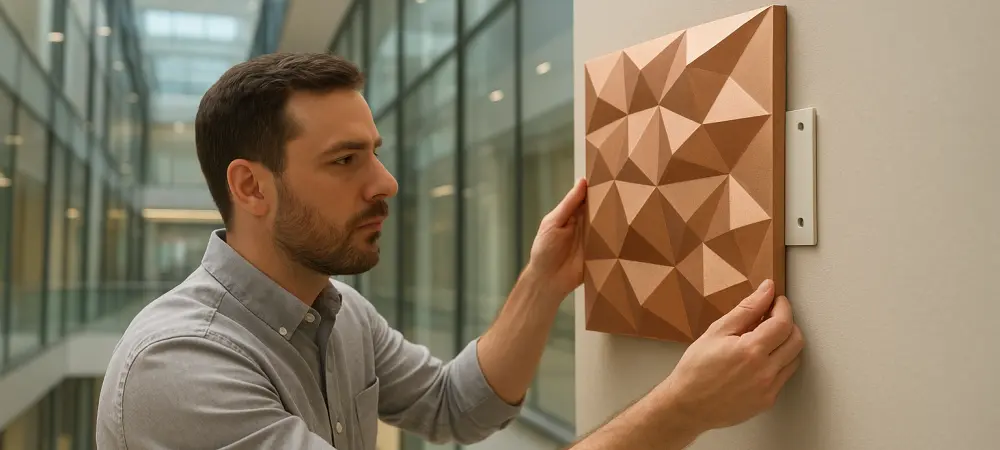
The path-obstruction problem in high-frequency wireless communications has necessitated a transition from active electronic hardware to intelligent, passive environments. As 6G networks strive to deliver multi-gigabit speeds, they increasingly rely on millimeter-wave and sub-terahertz frequencies. While these bands offer vast bandwidth, they possess a significant physical limitation: the inability to penetrate solid materials. Common household objects like drywall, wooden doors, or even office partitions act as impenetrable barriers, causing signal drops and frustrating dead zones. To maintain connectivity, traditional solutions have relied on dense deployments of active base stations and repeaters, which are both expensive to install and energy-intensive to operate. However, a recent breakthrough from the University of California San Diego introduces FlowForm, a system of 3D-printed passive tiles. These tiles redefine the indoor environment, transforming walls and ceilings into collaborative reflectors that guide signals efficiently.
Passive Metasurface Technology: A Focus on Cost Efficiency
Engineering Passive Frameworks: The Rise of Intelligent Signal Reflectors
The foundational principle behind FlowForm is the use of passive metasurfaces to redirect wireless signals without the need for internal power sources or complex digital circuitry. Led by Professor Xinyu Zhang, researchers developed a hardware framework that functions essentially as a series of smart mirrors for radio waves. Instead of broadcasting a new signal, these tiles intercept incoming millimeter waves and reflect them toward specific areas that would otherwise be shielded by obstacles. This redirection is not a simple mirror-like reflection but a controlled manipulation of the phase and direction of the wave. By precisely engineering the surface structure, the system allows signals to flow around corners and through narrow hallways. This passive approach eliminates the technical overhead of active signal boosters, such as thermal management and high energy consumption, which often plague high-frequency hardware deployments in residential and commercial spaces.
Accessible Infrastructure: The Economics of Conductive Paint
The construction of these tiles highlights a major shift toward sustainable and accessible telecommunications infrastructure. Each six-inch tile is manufactured using standard 3D-printing plastic and finished with a thin layer of conductive copper paint. Despite this simplistic material list, each unit contains thousands of sub-wavelength elements that provide extreme precision in wave control. The total manufacturing cost for a single tile is approximately $2, a figure that drastically undercuts the hundreds or thousands of dollars required for active electronic surfaces currently on the market. By prioritizing low-cost production, the technology makes high-end wireless infrastructure available for diverse environments, from large-scale industrial warehouses to small home offices. This economic accessibility ensures that the benefits of 6G are not restricted to premium enterprise settings but can be broadly integrated into the physical fabric of modern architecture without requiring a massive financial investment.
The Major-Minor Flow Topology: Designing for Reliability
A Hierarchical Strategy: Establishing the Wireless Backbone
The core architectural innovation enabling this level of performance is the major-minor flow topology, a design strategy heavily inspired by the efficient branching found in natural river systems. In this framework, major flows act as the primary backbone of the wireless network, utilizing focused relay chains to move high-strength signals over significant distances. These chains are designed to shuttle millimeter-wave energy around sharp corners and through deep building interiors where line-of-sight communication with a base station is impossible. By keeping the wireless energy tightly focused during these long-haul hops, the FlowForm system significantly reduces signal attenuation and energy dispersion. This hierarchical approach ensures that the signal arriving at a distant room retains enough strength to support high-speed data transfers. It effectively creates a high-capacity interstate for data, bridging the gap between the external access point and the interior sections of a structure.
Signal Redundancy: Ensuring Stability in Occupied Spaces
Complementing the robust backbone are the minor flows, which take over once the wireless signal reaches a specific destination area or user cluster. These minor flows distribute the radio waves through wide fan beams that saturate the space from multiple angles, creating a highly redundant and resilient coverage map. This two-tier structure ensures that even if a human occupant moves through the room or furniture is rearranged, the signal can still reach the user’s device via an alternative path. The system is mathematically optimized to manage these reflections, preventing destructive interference and maximizing the probability of a stable connection. By providing coverage from several directions simultaneously, the minor flows eliminate the fragility often associated with high-frequency beams, which are typically sensitive to even minor obstructions. This creates a spatial diversity that mimics the reliability of lower-frequency bands while maintaining the immense throughput.
Real-World Performance: Testing and Global Integration
Enhancing Network Metrics: Scalability and Future Data Rates
Practical performance evaluations conducted in various indoor settings have confirmed the viability of this passive reflection strategy, demonstrating that FlowForm can nearly double average data rates and total wireless coverage area. What makes these results particularly compelling is that the performance gains were achieved without any additional electrical power or manual coordination between the tiles. Since the tiles are entirely passive components, they remain transparent to both current and future wireless protocols. This means that as wireless standards evolve from 5G to 6G and beyond, the physical infrastructure provided by FlowForm will not require expensive hardware upgrades or software modifications. The system functions as a permanent layer of the environment, augmenting the capabilities of any radio technology that operates within the supported frequency bands. This transparency makes the solution highly attractive for property developers and network operators looking for long-term stability.
Future Strategic Outlook: Industry Adoption and Connectivity
The integration of FlowForm into modern building designs represented a pivotal shift from focusing on radio complexity to optimizing the physical environment. Access points in 2026 already utilized steerable beams to identify the best signal paths, allowing them to interact with the passive tiles automatically and without modification. This synergy paved the way for rapid scaling in dense urban environments and industrial complexes where signal blockages were once considered insurmountable. Industry leaders adopted this technology to reduce the carbon footprint of digital infrastructure, proving that passive solutions provided the necessary robustness for the next generation of global communication systems. Standardizing the installation of conductive, 3D-printed surfaces across commercial real estate established a blueprint for sustainable high-speed networks. The successful implementation of these reflective arrays demonstrated that 6G connectivity achieved its full potential only when the architecture participated.